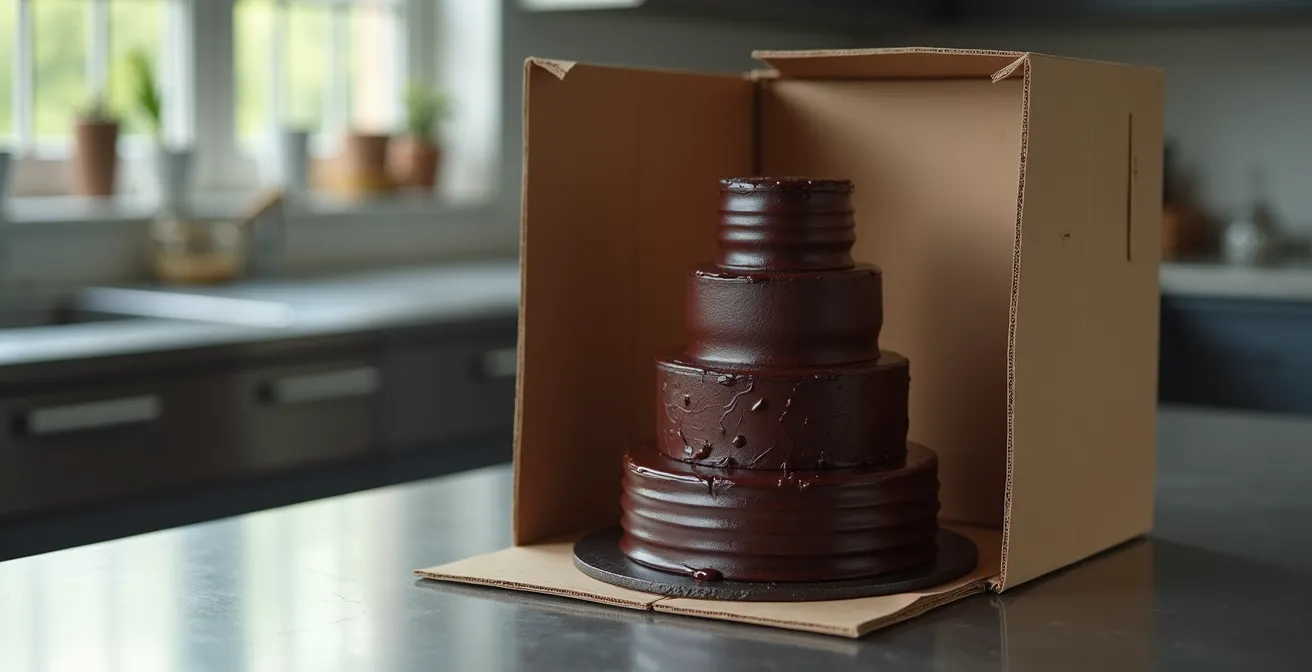
The structural integrity of a tiered cake is determined by its material science, not just its external supports like dowels.
- Sponge density and composition are the true foundation, dictating the cake’s ability to bear load without compression.
- Ganache is not just icing; it’s structural mortar whose properties must be adjusted for climate and load.
Recommendation: Shift your focus from simple assembly to culinary architecture. Analyze your ingredients and recipes for their structural properties before you even think about stacking.
For any cake designer, the moment of transport is one of maximum anxiety. The fear of a masterpiece, hours in the making, arriving as a catastrophic, chocolatey landslide is all too real. We’ve all been told the standard solutions: use plenty of dowels, chill the cake thoroughly, and drive as if you’re transporting a priceless Ming vase. These are components of the solution, but they are not the solution itself. They are assembly instructions, not architectural principles.
Focusing solely on dowels and supports is like trying to build a skyscraper with strong steel beams set into a foundation of soft sand. The failure isn’t in the beams; it’s in the material they’re anchored to. The secret to a truly transport-proof tiered cake doesn’t lie in the assembly process alone. But what if the true key to stability wasn’t the external hardware, but the inherent structural integrity of the cake itself—from the molecular structure of its cocoa butter to the load-bearing capacity of its sponge?
This guide re-frames cake construction through the lens of a culinary architect. We will move beyond generic tips to explore the material science of our ingredients. We will analyze the cake as a structure, understanding the forces at play and engineering our creation to withstand them. Together, we will dissect the critical elements, from the foundational importance of sponge density and the role of ganache as structural cement, to the precise protocols for chilling and slicing that preserve your cake’s integrity from creation to consumption.
This article provides a comprehensive blueprint for cake stability. Below is a summary of the key architectural checkpoints we will cover to ensure your creations are not only beautiful but structurally infallible.
Summary: The Architectural Blueprint for a Flawless Tiered Chocolate Cake
- Why Sponge Density Matters More Than Dowels for Stability?
- Buttercream vs. Ganache: Which Cement Holds in Humid Weather?
- How to Slice a Tall Cake Without Crushing the Layers?
- The Layering Mistake That Makes Your Crunch Soggy
- How to Chill a Cake for Delivery Without Cracking the Icing?
- Which Cocoa Powder Type Creates the Darkest, Moistest Cakes?
- Why High-Quality Forastero Is Essential for Structured Ganaches?
- How to Calculate Chocolate Quantities for a 200-Person Wedding?
Why Sponge Density Matters More Than Dowels for Stability?
We begin by dismantling the biggest myth in cake support: that dowels are the ultimate guarantors of stability. While essential for transferring vertical load, dowels are only as effective as the foundation they rest on. A dowel inserted into a light, airy, and overly delicate sponge is useless. The sponge itself will compress under the weight of the tiers above, leading to tilting, bulging, and eventual collapse. The true foundation of a tiered cake is the load-bearing capacity of its sponge.
Think of the sponge not as a dessert, but as a building material. Its density, crumb structure, and moisture content determine its ability to resist compression. A sponge with high structural integrity will support the weight of the layers above without deforming, providing a solid base for the dowels to do their job. A recipe rich in fat and protein, using methods that develop a stable crumb, will always outperform a lighter-than-air sponge in a stacked application. Before you can build up, you must build strong.
Therefore, the first step in cake architecture is to test the compressive strength of your sponge. You don’t need a lab; a simple, practical test will suffice. This hands-on evaluation tells you more about your cake’s structural potential than any visual inspection.
Your Action Plan: The Cupcake Compression Test Method
- Bake a single test cupcake from your recipe, without a liner, to assess its true structure.
- Allow the cupcake to cool completely to room temperature for a realistic assessment.
- Press down firmly with your thumb on the center of the cupcake, applying significant pressure.
- Observe the result: if the cake springs back completely, it has excellent structural integrity suitable for stacking.
- If the cake remains compressed or collapses, the recipe must be adjusted (e.g., increase fat, use a stronger flour) before it can be used for a load-bearing tier.
Buttercream vs. Ganache: Which Cement Holds in Humid Weather?
Once your foundation is solid, the next critical choice is your structural “cement.” This is the material used to fill, dam, and coat your tiers. While buttercream is a popular choice for its flavour and texture, in the context of structural engineering, it often fails, especially in challenging climates. In humid weather, buttercream can soften, weep, and lose its adhesive properties, allowing layers to slip. For true structural reliability, we must turn to the superior building material: chocolate ganache.
Ganache is not a single material but a spectrum of them. By adjusting the ratio of chocolate to cream, you can create everything from a soft, spreadable filling to a rock-hard outer shell. This versatility is its greatest strength. In hot or humid conditions, a high-ratio ganache acts like a rigid exoskeleton, holding the cake’s shape and protecting it from the environment. It is the architectural equivalent of choosing the right grade of concrete for a specific structural application.
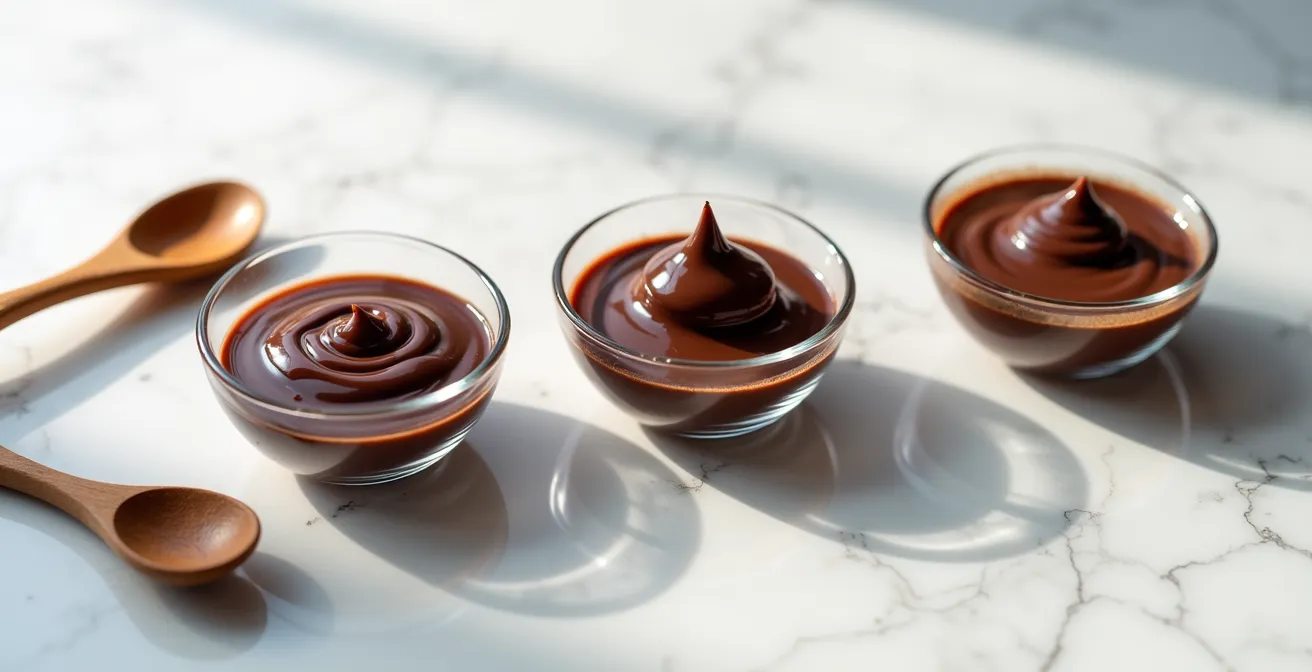
The following table, based on professional best practices, reframes ganache ratios not by flavour, but by their structural purpose. It is your guide to choosing the right “grade” of ganache for the job at hand.
| Ratio (Chocolate:Cream) | Structural Grade | Best Use | Climate Suitability |
|---|---|---|---|
| 4:1 | Mortar Grade | Outer shell coating | Tropical/humid climates |
| 3:1 | Structural Beam | Layer dams & support | Moderate humidity |
| 2:1 | Spackle Grade | Standard crumb coat | Cool, dry conditions |
How to Slice a Tall Cake Without Crushing the Layers?
The structural integrity of a cake is not only tested during transport but also during its final deconstruction: slicing. A poorly executed slice can instantly crush delicate layers, smear fillings, and ruin the visual appeal you worked so hard to create. Slicing a tall cake is a logistical challenge that requires a systematic approach, not brute force. The goal is to isolate sections and cut them cleanly, preventing the knife from dragging through multiple layers and causing a compressive failure.
Professionals don’t just hack at a large cake. They employ methods that break the task down into manageable parts. One of the most effective techniques treats the cake like a structure to be methodically disassembled.
Case Study: The Professional Core & Deconstruct Method
As detailed by professional bakers like those at British Girl Bakes, a common catering method for tall, wide tiers involves a two-stage process. First, the top tiers are removed for separate serving. For a large bottom tier (e.g., 12-14 inches), a large, sharp ring cutter is used to “core” out the center, creating an inner cake and an outer doughnut-shaped ring. The outer ring is then sliced radially into neat, manageable portions. Finally, the inner core is sliced. This technique completely avoids dragging a long knife through the entire cake diameter, which is the primary cause of layer compression and smearing.
Temperature is also a critical variable in achieving a clean cut. Different fillings have different optimal slicing temperatures. Slicing a cake at the wrong temperature can be as damaging as using the wrong knife. Follow these temperature guidelines for perfect servings:
- Ganache-filled cakes: The ganache should be firm but not rock-hard. Aim for a cake chilled to 60-65°F (15-18°C) for the cleanest cuts without cracking.
- Dense buttercream layers: Similar to ganache, serve at around 60-65°F (15-18°C) for the best balance of flavour and structural stability during slicing.
- Mousse fillings: These must be kept at refrigerator temperature (35-40°F, 2-4°C) to remain stable. Slice and serve immediately.
- Always use a long, thin, serrated knife with a gentle sawing motion, and wipe the blade clean with hot water between each slice to prevent dragging.
The Layering Mistake That Makes Your Crunch Soggy
A common desire in cake design is to introduce textural contrast, often by adding a crunchy layer of feuilletine, praline, or toasted nuts. However, this is a frequent point of structural and sensory failure. The number one mistake is failing to account for moisture migration. A cake sponge is a high-moisture environment. Over time, that moisture will inevitably travel from the sponge and fillings into your crunchy layer, transforming it from a delightful surprise into a disappointing, soggy mess.
To prevent this, you must think like an architect waterproofing a foundation. A fat-based moisture barrier is non-negotiable. This means fully encapsulating your crunchy element in a material that repels water. Melted chocolate or a thin, complete seal of cocoa butter are the most effective barriers. A simple dam of buttercream is insufficient; moisture will find its way through. The barrier must be 360 degrees, completely isolating the crunch from the cake.
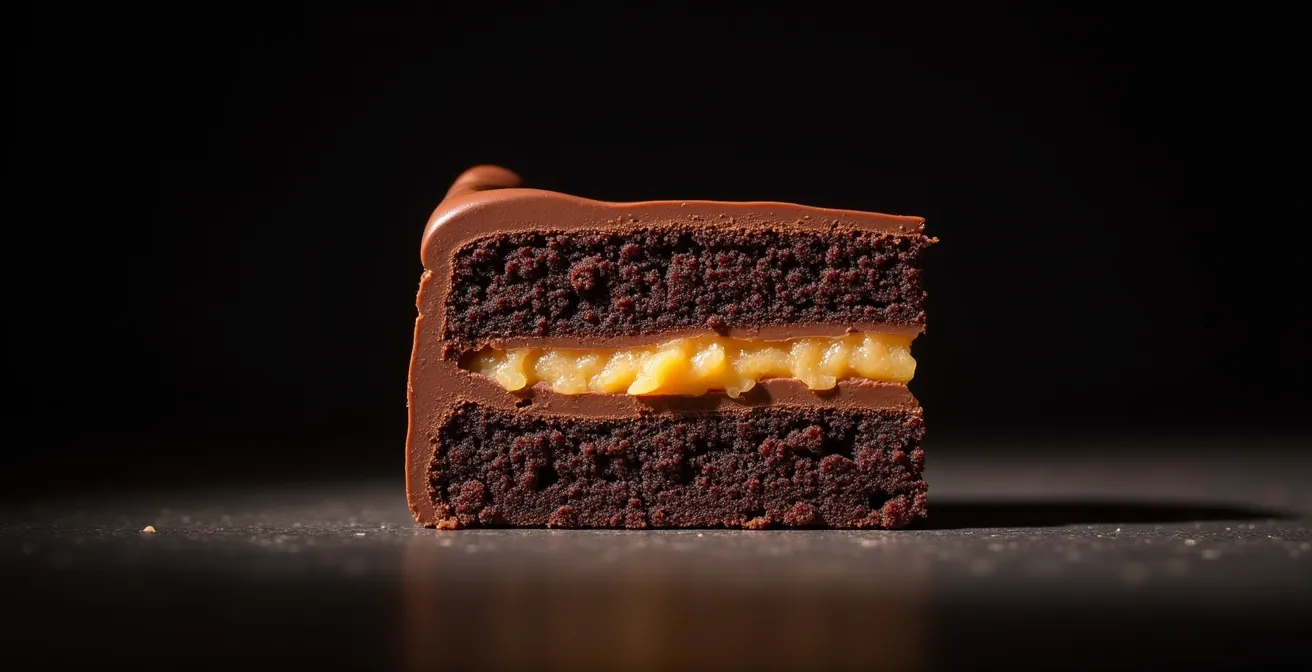
Furthermore, not all crunchy elements are created equal. Some have a much higher tolerance for moisture than others. Understanding the lifespan of your chosen element is key to managing client expectations and ensuring the cake is enjoyed at its peak.
| Crunchy Element | Moisture Tolerance | Barrier Method | Crispness Lifespan |
|---|---|---|---|
| Feuilletine | Very Low | Full cocoa butter seal | 4-6 hours |
| Toasted Nuts | Moderate | Thick ganache barrier | 8-12 hours |
| Brittle/Praline | Low | Melted chocolate coating | 6-8 hours |
| Cookie Crumbs | Moderate-High | Buttercream barrier | 12-24 hours |
How to Chill a Cake for Delivery Without Cracking the Icing?
Chilling a cake before delivery is standard advice, and for good reason. It solidifies the fats in the ganache or buttercream, creating a firm, rigid structure that is far less prone to shifting or sliding during transport. As the experts at Sugar & Sparrow Bakery note, this step is crucial for minimizing risk.
Refrigerate your cake until you’re ready to leave. This will make the frosting nice and firm, minimizing the chances of the layers underneath sliding around
– Sugar & Sparrow Bakery, Professional Cake Transport Guide
However, the common problem cake designers face is thermal shock. Moving a cake directly from a warm room to a cold refrigerator (or vice-versa) causes the different layers and the icing to expand or contract at different rates. This creates immense stress on the outer coating, often resulting in unsightly cracks in your perfectly smooth ganache. The solution is not to avoid chilling, but to manage the process through a gradual temperature reduction.
This “step-down” protocol allows all components of the cake to acclimate slowly, preventing the buildup of thermal stress. Think of it as annealing metal; the gradual cooling process strengthens the final product and prevents fractures.
- Stabilize at Room Temperature: Let the finished cake sit at a cool room temperature (68-72°F / 20-22°C) for at least 30 minutes to equalize.
- Move to a Cool Room: If possible, move the cake to a cooler environment (60-65°F / 15-18°C), like a basement or pantry, for another 20-30 minutes.
- Transfer to Refrigerator: Now, the cake is ready for the refrigerator (35-40°F / 2-4°C). The temperature differential is much smaller, reducing the risk of shock.
- For Freezing: Never place a ganache-covered cake directly in the freezer for long periods. Use short 10-minute bursts only for rapid firming, if absolutely necessary.
- Pro Tip: Adding a small amount of corn syrup or glucose to your ganache recipe can increase its flexibility, making it more resistant to cracking from temperature changes.
Which Cocoa Powder Type Creates the Darkest, Moistest Cakes?
The choice of cocoa powder is an early architectural decision that has profound implications for the final structure. It’s not just about colour and flavour; cocoa powder dramatically affects moisture, texture, and leavening. For a chocolate cake that is both structurally sound and decadently moist, the key is high-fat Dutch-processed cocoa powder. Dutch-processing (an alkalization process) neutralizes cocoa’s natural acidity, resulting in a smoother flavour and a darker colour.
More importantly from a structural standpoint, high-fat cocoa contributes to a more tender and pliable crumb. As professional bakers and food scientists have demonstrated, many professional bakers recommend high-fat cocoa powder containing 22-24% fat content, compared to the 10-12% in standard powders. This extra fat coats the flour proteins, shortening gluten strands and resulting in a cake that is less prone to becoming dry and brittle—critical for a load-bearing tier.
Many designers seek the dramatic, near-black colour of “Black Cocoa.” However, using it exclusively is an architectural mistake. Black cocoa is heavily alkalized (pH 8+), and its high alkalinity can neutralize the acids needed for leavening agents to work properly, resulting in a dense, dry, and fragile cake.
Case Study: The ‘Balanced Black’ Blending Formula
To achieve a dramatic dark color without sacrificing moisture and structure, professional recipe developers have found an optimal solution. Testing shows that blending just 25-30% black cocoa with 70-75% high-fat Dutch-processed cocoa creates the perfect balance. This formula leverages the intense color of the black cocoa while relying on the high-fat Dutch-processed powder to provide the necessary fat for a moist, stable crumb and to maintain a balanced pH for proper leavening. This strategic blend delivers the desired aesthetic without compromising the cake’s structural integrity.
Why High-Quality Forastero Is Essential for Structured Ganaches?
When creating a ganache for structural purposes—a firm dam, a sharp-edged coating—not all chocolate is created equal. The stability of a ganache is fundamentally determined by the type and quality of the cocoa butter within the chocolate. This is where bean origin and type become critically important. For maximum stability, chocolate made from Forastero cocoa beans is often the superior choice.
The reason lies in the molecular structure of the cocoa butter. As explained by experts in the field, the crystallization of cocoa butter is the key to a hard, snappy, and stable ganache. This insight from chocolate science is directly applicable to our architectural needs.
Forastero beans typically produce cocoa butter with a higher percentage of stable ‘Form V’ beta crystals
– Dr. Emmanuel Ohene Afoakwa, Chocolate Science and Technology
This “Form V” crystal is the most stable and dense crystal structure that cocoa butter can form, resulting in a higher melting point and a much harder set. A ganache made with chocolate high in these crystals will be more rigid at room temperature, more resistant to heat, and provide far greater structural support. While Criollo and Trinitario beans are prized for their complex flavour profiles, the robust and straightforward crystallization of Forastero cocoa butter makes it an engineer’s choice for construction.
When selecting your chocolate, you must learn to read the label for structural clues, not just flavour:
- Check Cocoa Butter Percentage: For a hard-setting structural ganache, aim for a couverture chocolate with a 38-40% cocoa butter content.
- Verify Bean Origin: If listed, prioritize chocolate with a Forastero origin for its structural properties.
- Look for ‘Couverture’: This designation legally requires a higher percentage of cocoa butter, which is essential for fluidity when melted and hardness when set.
- Higher Cocoa Butter % = Harder Ganache: A simple rule to remember when making your selection.
- Test a Small Batch: Before committing kilograms of chocolate to a project, make a small batch of ganache and perform a “slump test” to see how it sets at room temperature.
Key Takeaways
- The true foundation of a stable cake is a dense, load-bearing sponge; dowels are secondary supports.
- Treat ganache as structural mortar, adjusting its chocolate-to-cream ratio based on climate and structural needs.
- Prevent moisture migration by creating a complete fat-based barrier around any crunchy fillings.
How to Calculate Chocolate Quantities for a 200-Person Wedding?
An architect would never begin construction without a Bill of Materials, and a cake architect should be no different. Accurately calculating the amount of chocolate needed is essential for profitability, efficiency, and preventing a last-minute panic. For a large project like a 200-person wedding cake, “guesstimating” is not an option. Your calculation must account for fillings, dams, crumb coats, the final structural coating, and a crucial contingency buffer.
The calculation starts with understanding the surface area of your tiers and the density of your chosen ganache. Different ganache ratios have different densities and coverage rates. A thicker, higher-ratio ganache will require more weight to cover the same area.
| Ganache Ratio | Density Factor (g/ml) | Coverage (g/sq inch) |
|---|---|---|
| 2:1 (chocolate:cream) | 1.2 | 28 |
| 3:1 (chocolate:cream) | 1.3 | 32 |
| 4:1 (chocolate:cream) | 1.4 | 35 |
While you can calculate the base amount using geometry and the table above, professionals know that reality is never so neat. Spills happen, extra-thick coats are needed on stress points, and emergency repairs are sometimes necessary. This is where the professional buffer rule comes in.
Professional Insight: The 30% Buffer Rule Application
For a large-scale project, a baseline calculation is just the starting point. As seen in professional workflows, a 30% buffer is the industry standard for ensuring you have enough material. For a 200-person wedding cake (e.g., 6-10-14 inch tiers) requiring a base calculation of 3kg of chocolate, an additional 900g buffer would be added. This buffer is mentally allocated: 300g for inevitable waste (in the bowl, drips), 300g for applying a thicker structural coat on key stress points (like the base of each tier), and 300g for a separate, untouched emergency batch for on-site repairs. This brings the total chocolate order to 3.9kg, often strategically split between premium Forastero for the vital outer coating and a more cost-effective chocolate for internal fillings.
By embracing this architectural mindset—from material selection at the molecular level to precise project planning—you transform the stressful act of cake transport into a confident, controlled delivery. Your creations will not only look spectacular but will be monuments to your skill as a true cake engineer.