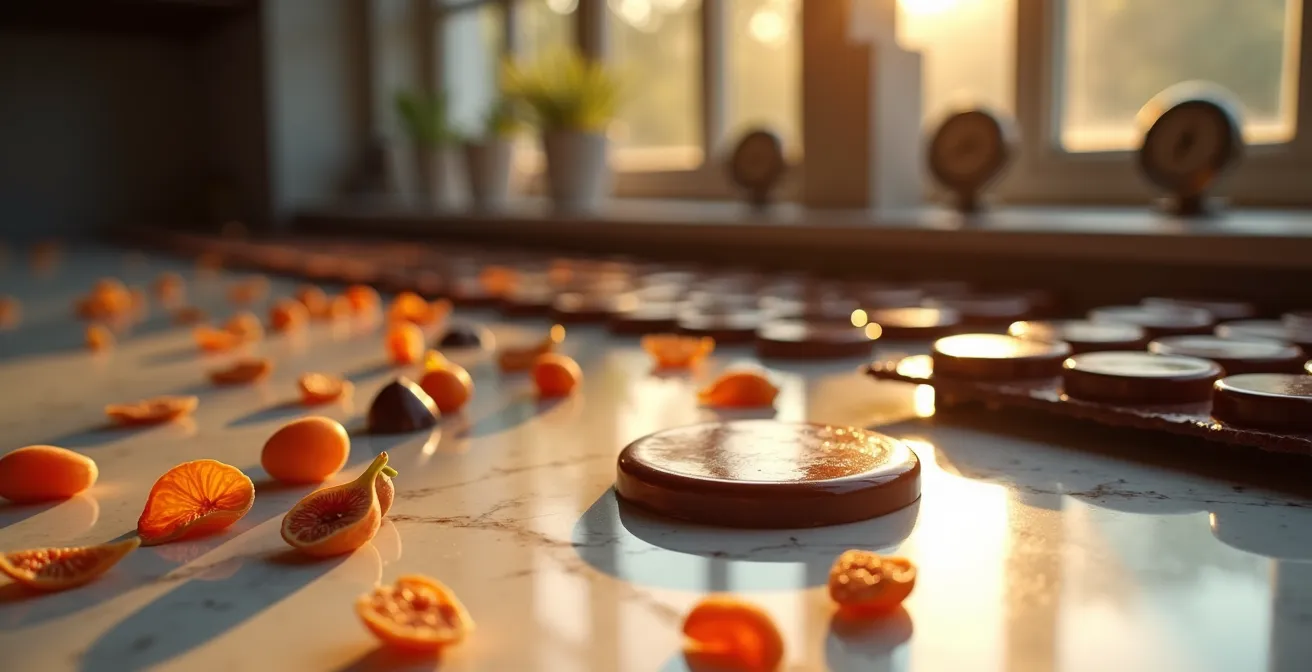
The key to stable chocolate confections isn’t just using ‘dry’ fruit; it’s mastering the science of water activity (Aw) to halt moisture migration at a molecular level.
- Moisture moving from high-Aw fruit to low-Aw chocolate is the root cause of bloom, softening, and compromised shelf life.
- Techniques like using high-proof spirits, precise chopping, and choosing freeze-dried over sun-dried inclusions are all methods of controlling water activity.
Recommendation: Shift your focus from moisture content to measuring and managing the water activity of every inclusion to guarantee product quality and stability.
As an artisan chocolatier, you’ve mastered the delicate art of tempering. You know the crystalline structure of cocoa butter by heart and can achieve that perfect snap and glossy finish in your sleep. Yet, a persistent problem plagues even the most skilled craftsmen: the unpredictable behavior of dried fruit inclusions. You select what appears to be a perfectly dry raisin or apricot, only to find your beautiful bars blooming or becoming soft and tacky weeks later. The frustration is immense, as it undermines your expertise and compromises the quality you strive for. You’ve likely heard the standard advice—use drier fruit, ensure a good temper—but these platitudes fall short because they don’t address the fundamental scientific principle at play.
The common understanding of “dryness” is insufficient. The true culprit is a force invisible to the naked eye: moisture migration, governed by a precise metric known as water activity (Aw). This isn’t about the total amount of water in a fruit, but the amount of “free” water available to move and cause chemical reactions. When an inclusion with a higher Aw (like a raisin) is embedded in chocolate with a very low Aw, a one-way transfer of water begins. This microscopic movement of H₂O molecules is what destabilizes the perfect Form V cocoa butter crystals, leading to fat bloom, sugar bloom, and a ruined texture.
This guide reframes the problem through the lens of a food technologist. We will move beyond guesswork and into the realm of measurable science. We will dissect why certain fruits fail, how alcohol can be an ally or an enemy, and why the extra cost of specific ingredients like Piedmont hazelnuts or freeze-dried raspberries is an investment in stability. By understanding and controlling water activity, you will gain ultimate command over your creations, ensuring every bar remains as perfect as the day it was made.
This article provides a comprehensive framework, from the science of moisture to the art of composition, to help you master fruit and nut inclusions. The following sections break down each critical aspect of the process.
Summary: Mastering Chocolate and Dried Fruit Inclusions
- Why Do Raisins Make Your Chocolate Bloom After 2 Weeks?
- How to Soak Fruits in Alcohol Without Melting the Coating?
- Apricot vs. Fig: Which Fruit Cuts Through 80% Dark Chocolate Best?
- The Chopping Mistake That Ruins the Snap of Your Bar
- Freeze-Dried vs. Sun-Dried: Is the 3x Cost Difference Worth It?
- Why Do Piedmont Hazelnuts Cost Double but Taste Triple?
- Why Does Cocoa Butter Polymorphism Matter for Mouthfeel?
- How to Balance Nuts and Fruit Ratios on Mendiant Discs?
Why Do Raisins Make Your Chocolate Bloom After 2 Weeks?
The reason your chocolate blooms weeks after including raisins lies not in the chocolate’s temper, but in the raisin’s relatively high water activity (Aw). Water activity is a measure of the energy status of water in a system, indicating how “free” it is to migrate or participate in reactions. Chocolate is extremely low in free water (Aw < 0.4), making it hygroscopic—it actively pulls moisture from its surroundings. A sun-dried raisin, while feeling dry to the touch, has a much higher water activity, typically between 0.46 and 0.60. This differential creates a powerful thermodynamic drive for water molecules to migrate from the raisin into the surrounding chocolate matrix.
This moisture migration is the direct cause of bloom. As water moves into the chocolate, it can dissolve microscopic sugar crystals. When that water later evaporates from the surface, it leaves behind a fine, white layer of recrystallized sugar, known as sugar bloom. More insidiously, this influx of moisture can disrupt the stable Form V crystal structure of your perfectly tempered cocoa butter, causing it to re-crystallize into an unstable form (like Form VI), resulting in the greasy, greyish appearance of fat bloom. The stability of any low-moisture food is paramount; food safety research establishes that products below a 0.85 water activity threshold are generally safe from pathogen growth, but for chocolate’s textural integrity, the target must be far lower. Indeed, any microbial growth is effectively halted at water activity levels below 0.6, a threshold some dried fruits exceed.
To visualize this risk, it’s helpful to compare the inherent water activity of common inclusions. This data, based on a comprehensive analysis of various dried fruits, clearly shows why some are more problematic than others.
| Dried Fruit | Water Activity (aw) | Risk Level for Chocolate |
|---|---|---|
| Freeze-dried Raspberries | <0.1 | Very Low |
| Dried Strawberry | 0.21 | Low |
| Raisins | 0.46-0.60 | Moderate |
| Dried Apricots | 0.55 | Moderate |
| Date Paste | 0.69 | High |
As the table illustrates, a raisin’s moderate Aw makes it a ticking time bomb for moisture migration. To prevent bloom, you must either choose inclusions with an inherently low Aw or pre-treat higher-Aw fruits to reduce their free water before they ever touch your chocolate.
How to Soak Fruits in Alcohol Without Melting the Coating?
Introducing alcohol-soaked fruits into chocolate is a high-risk maneuver, as it involves adding a liquid to a fat-based system. The key to success is, once again, controlling water activity. The goal is to infuse flavor without introducing excessive free water that will cause the chocolate to seize or the coating to melt. The secret lies in using high-proof spirits, such as 95% grain alcohol or a high-proof rum. Alcohol itself has a lower water activity than water, and the higher the proof, the less water you introduce into the equation. A standard 40% ABV (80-proof) spirit is 60% water, a recipe for disaster.
The process must be executed with precision. Soaking should always be done cold. Warming the mixture is counterproductive; alcohol’s lower boiling point means you risk compromising the fruit’s structure and creating off-flavors. After a cold soak, the most critical step is air-drying. The fruits must be spread in a single layer and dried until their surface is no longer tacky to the touch. This ensures that any residual surface moisture and alcohol have evaporated, leaving behind only the infused flavor compounds and a low-Aw surface that can be safely enrobed.
A common mistake is to follow traditional macerating techniques that involve sugar. As the Professional Chocolatier Guidelines warn, this is a fatal error in this context. The following advice from *Chocolate Manufacturing Best Practices* is critical:
Never use macerating techniques with sugar, as the sugar draws water out of the fruit, creating a syrup that guarantees seizing.
– Professional Chocolatier Guidelines, Chocolate Manufacturing Best Practices
This sugar-laden syrup is a high-Aw catastrophe waiting to happen. It will instantly cause the chocolate to thicken and become unworkable. The only way to succeed is by using pure, high-proof spirits and ensuring complete surface drying before inclusion, effectively creating a flavor-infused but low-Aw ingredient.
Apricot vs. Fig: Which Fruit Cuts Through 80% Dark Chocolate Best?
When pairing fruit with high-percentage dark chocolate (70% and above), the goal is not just to add sweetness, but to create a dynamic sensory experience. The best pairings often rely on contrast rather than harmony. In the battle of apricot versus fig against an 80% dark chocolate, the apricot is the clear winner due to its bright acidity and firm, chewy texture. An 80% chocolate is intensely bitter, with deep roasted notes and minimal sugar. The malic and citric acid in a dried apricot provide a sharp, tart counterpoint that cuts through the richness, cleansing the palate and creating a complex flavor arc. Research from confectionary experts confirms that tart fruits with citric acid are the ideal partners for intense dark chocolates, creating this desirable contrast.
A fig, by contrast, is dense, jammy, and predominantly sweet with earthy, molasses-like notes. When paired with an 80% bar, its sweetness can get lost, and its flavor profile can muddle with the chocolate’s inherent dark notes rather than stand out. Texturally, the apricot’s firm flesh provides a satisfying chew that contrasts with the chocolate’s snap, whereas the fig’s soft, seedy interior can create a less pleasant, gritty mouthfeel.
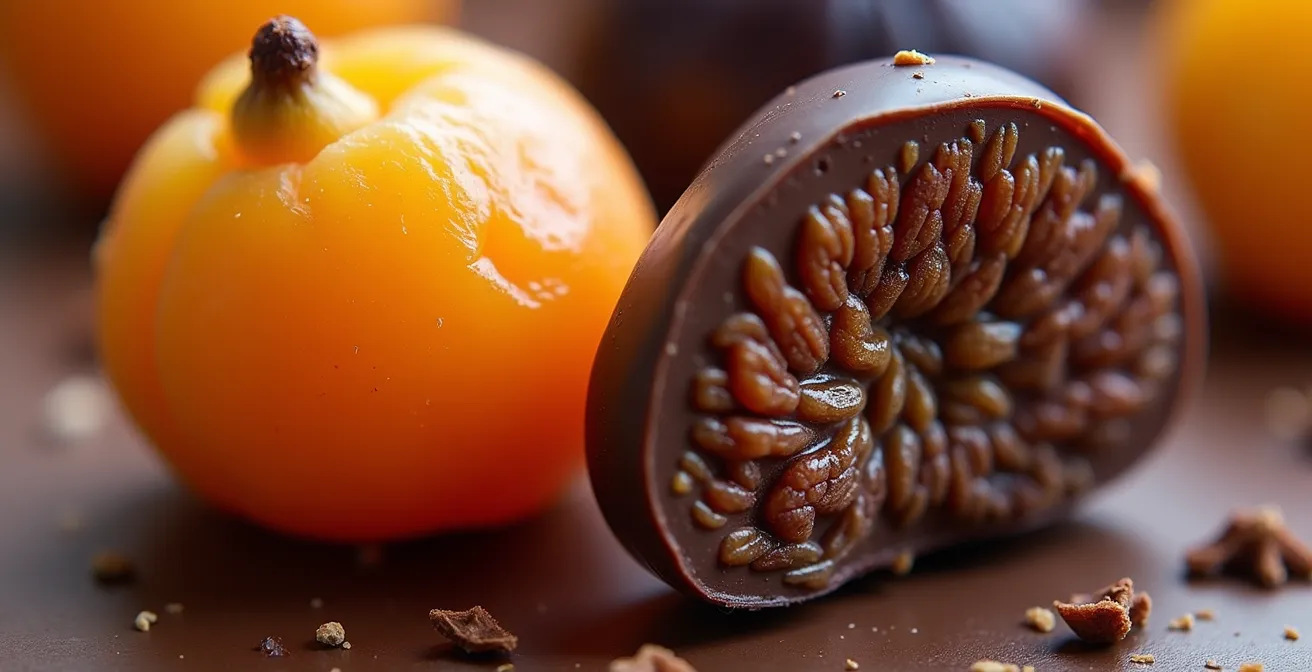
The visual and textural difference, as seen in the macro view, is stark. The apricot’s translucent, fibrous structure interacts differently with the chocolate than the fig’s dense, seedy pulp. From a water activity perspective, the higher sugar content in figs often correlates with a higher Aw, making it a slightly riskier choice for long-term stability compared to a tarter, less sugary apricot. Therefore, for both flavor complexity and textural integrity, the apricot offers a superior pairing for robust dark chocolate.
The Chopping Mistake That Ruins the Snap of Your Bar
The way an inclusion is prepared is as critical as the inclusion itself. The most common and destructive mistake an artisan can make is in the simple act of chopping. Using a dull or serrated knife to process dried fruits doesn’t cut—it tears. This violent action shreds the fruit’s cellular structure, vastly increasing the surface area and, more importantly, releasing sticky sugars and free water. This creates a “fruit dust” of microscopic, high-Aw particles that act as moisture nucleation points. When these are mixed into your chocolate, they become thousands of tiny entry points for moisture, compromising the entire batch’s stability and ruining the clean, sharp snap of the final bar.
The solution is to treat fruit preparation with surgical precision. A very sharp, clean chef’s knife is non-negotiable. The goal is to make swift, clean cuts that slice through cell walls rather than crushing them. This minimizes moisture leakage and preserves the fruit’s integrity. Chilling the fruit for 10-15 minutes beforehand can firm it up, making it easier to achieve these clean cuts. For particularly sticky fruits, a light coating of a neutral oil or even a bit of cocoa butter on the blade can prevent dragging and tearing. Any fine ‘dust’ or particles left on the cutting board should be discarded and never incorporated into the chocolate.
Action Plan: Professional Fruit Chopping for Chocolate Inclusions
- Sharpen and Clean Your Blade: Use a razor-sharp chef’s knife. A dull blade crushes cell walls, releasing moisture. A light coat of cocoa butter on the blade can prevent sticking.
- Chill the Inclusions: Place dried fruits and nuts in the freezer for 10-15 minutes. This firms them up, allowing for cleaner cuts and less tearing.
- Use Swift, Decisive Cuts: Employ a swift downward chopping motion. Avoid a back-and-forth sawing action, which increases cell damage and moisture release.
- Sift and Discard Dust: After chopping, pass the pieces through a coarse sieve to remove any fine ‘fruit dust’. These tiny particles are high-Aw hotspots that can trigger seizing or bloom.
- Toast Nuts Separately: Always toast nuts (e.g., at 350°F for 5-7 minutes) *before* chopping. This not only develops flavor but also further reduces their water activity, making them a more stable inclusion.
Ultimately, by minimizing cell damage during chopping, you are directly controlling the surface water activity of your inclusions. This meticulous attention to detail at the preparation stage is what separates a stable, professional-quality bar from one that is destined to fail.
Freeze-Dried vs. Sun-Dried: Is the 3x Cost Difference Worth It?
For an artisan chocolatier focused on premium quality and shelf stability, the significant cost difference between freeze-dried and sun-dried fruit is not just justified—it’s a strategic investment. The answer lies, once again, in water activity. The freeze-drying process, or lyophilization, removes water via sublimation (from solid ice directly to vapor), which is far more effective at reducing Aw than traditional sun-drying, which relies on evaporation. A freeze-dried fruit has an ultra-low water activity, often below 0.1, while a sun-dried fruit hovers in the 0.4-0.6 range. This difference is monumental in a chocolate system.
This ultra-low Aw makes freeze-dried fruit almost perfectly inert in chocolate. There is virtually no free water to migrate, meaning no risk of bloom and a vastly extended shelf life. Furthermore, it introduces a completely different texture: a light, crisp, and airy crunch that provides a delightful contrast to the smooth chocolate, something a chewy sun-dried fruit cannot offer. While sun-drying concentrates and caramelizes sugars, freeze-drying preserves the fruit’s original flavor profile with remarkable fidelity. A case study on confectionery stability highlights that water activity is a far more precise predictor of shelf life than simple moisture content; a tiny 1.9% change in moisture can alter Aw by 150 units, demonstrating its sensitivity and importance.
The choice between the two methods depends entirely on the intended product and its life cycle. For a product intended for immediate consumption, the chewy texture and concentrated sweetness of sun-dried fruit may be desirable. But for a premium, packaged bar intended to be stable for months, the freeze-dried option is unequivocally superior.
| Factor | Freeze-Dried | Sun-Dried |
|---|---|---|
| Cost | ~3x higher | Baseline |
| Water Activity (Aw) | <0.1 (Ultra-Low) | 0.4-0.6 (Moderate) |
| Texture | Crisp, airy, crunchy | Chewy, dense |
| Shelf Stability in Chocolate | Excellent (no moisture migration) | Moderate (high risk of bloom) |
| Flavor Profile | Original, fresh flavor preserved | Concentrated, caramelized notes |
| Best Use Case | Premium, long-shelf-life products | Products for immediate consumption |
Therefore, the 3x cost difference is the price for near-perfect stability, unique texture, and flavor fidelity. For the artisan chocolatier, it is the price of quality assurance.
Why Do Piedmont Hazelnuts Cost Double but Taste Triple?
The revered status—and steep price—of PGI “Nocciola Piemonte” is not a matter of marketing, but of quantifiable biochemical superiority. The “triple taste” sensation comes from a unique combination of high fat content, a specific fatty acid profile, and the potential for developing an intense array of volatile aromatic compounds upon roasting. These hazelnuts possess a higher monounsaturated fatty acid content, particularly oleic acid, compared to standard varieties. This contributes not only to a richer, more buttery mouthfeel but also provides exceptional resistance to rancidity, a crucial factor for shelf stability in a high-fat product like chocolate.
However, the true magic is unlocked during roasting. As one *Artisan Chocolate Making Manual* notes, much of the flavor is in volatile compounds that dissipate quickly. The manual advises artisans to buy raw Piedmont hazelnuts and roast them themselves just before inclusion to capture their peak aromatic expression. This is where the artisan’s skill comes into play. A proper “profile roast” is not simply about browning the nut; it’s a controlled process. It starts at a high temperature to kick off the Maillard reaction, developing color and foundational roasted notes. Then, the temperature is reduced for a period of controlled Strecker degradation, a process that produces pyrazines—the compounds responsible for the classic “nutty” and “toasty” aromas.
The higher fat content acts as a solvent and reservoir for these aromatic compounds, holding onto them and releasing them slowly in the mouth, creating a lingering, complex flavor that standard, lower-fat hazelnuts cannot match. This synergy of a stable, flavorful fat base and a high potential for aromatic development is why the investment pays dividends in the final product’s sensory profile. It’s a clear case where a higher-cost raw material, when handled with expert technique, delivers an exponentially better result.
Why Does Cocoa Butter Polymorphism Matter for Mouthfeel?
Cocoa butter polymorphism is the scientific heart of chocolate making. It refers to cocoa butter’s ability to crystallize into six different forms (Form I to VI), each with a unique molecular arrangement, density, and melting point. For a chocolatier, only one form matters: Form V. This is the stable, desirable crystal structure that gives well-tempered chocolate its signature glossy sheen, satisfying snap, and luxurious melt-in-the-mouth sensation. The mastery of tempering is, in essence, the art of coaxing cocoa butter to crystallize exclusively in this perfect form.
The magic of Form V lies in its melting point. According to baking science resources, Form V crystals melt sharply around 34°C (93°F), which is just below human body temperature. This is why a piece of well-tempered chocolate remains solid at room temperature but begins to melt almost instantly on the tongue, releasing its flavors in a smooth, non-waxy flood. Improperly tempered chocolate, which may contain a mix of unstable forms like Form II or IV, will have a lower melting point, feel soft or tacky at room temperature, and lack the characteristic snap.

This is where our discussion of water activity comes full circle. The introduction of free water from a high-Aw fruit inclusion acts as a critical impurity in the cocoa butter matrix. This moisture can disrupt the tightly packed Form V crystals, providing the energy and mobility for them to transition into the more stable, but undesirable, Form VI. This is the mechanism behind fat bloom. Form VI crystals are larger, more stable, and have a higher melting point, resulting in a coarse, gritty texture and a dull, greyish surface that no longer melts pleasingly in the mouth. Thus, protecting your perfect Form V temper is entirely dependent on preventing the moisture migration from your chosen inclusions.
Key Takeaways
- Water activity (Aw), not total moisture, is the key metric for predicting the stability of fruit inclusions in chocolate.
- Moisture migration from high-Aw fruit to low-Aw chocolate is the direct cause of sugar and fat bloom.
- Ingredient preparation, including precise chopping and proper roasting, directly impacts surface Aw and overall stability.
How to Balance Nuts and Fruit Ratios on Mendiant Discs?
After mastering the science of stability, the final step is the art of composition. The mendiant, a traditional French confection of chocolate discs studded with nuts and dried fruit, is the perfect canvas for this. Balancing these inclusions is not a random act but a thoughtful process guided by principles of visual appeal, textural contrast, and flavor intensity. The goal is to create a harmonious whole where each element is distinct yet contributes to a unified experience. A key aesthetic guideline is the “Rule of Odds”: using an odd number of inclusions (typically 3 or 5) is more visually dynamic and appealing than an even number.
A functional approach to selection is also effective. Think of inclusions in categories: an ‘Anchor’ nut for a rich, fatty base (like a toasted almond or hazelnut), a ‘Highlight’ fruit for a burst of acidity or sweetness (like a sour cherry or apricot piece), and a ‘Texture’ element for crunch or complexity (like a vibrant green pistachio or a bitter cacao nib). It’s also critical to leave adequate negative space; about 30-40% of the chocolate surface should remain visible. This not only showcases the quality of your chocolate but also prevents the mendiant from becoming a cluttered, muddled mess of flavors.
Most importantly, the intensity of the inclusions must match the intensity of the chocolate. A robust 85% dark chocolate can stand up to the strong flavors of a walnut and a sour cherry, while a delicate 40% milk chocolate would be overwhelmed and is better suited to a buttery macadamia nut and a piece of sweet dried pineapple. This pairing guide serves as an excellent starting point for creating balanced combinations.
| Chocolate % | Recommended Nuts | Recommended Fruits | Intensity Level |
|---|---|---|---|
| 85% Dark | Pistachio, Walnut | Sour Cherry, Cranberry | Robust |
| 70% Dark | Hazelnut, Pecan | Apricot, Fig | Balanced |
| 60% Dark | Almond, Cashew | Date, Mango | Delicate |
| Milk (40%) | Macadamia, Cashew | Pineapple, Strawberry | Sweet |
By combining these principles of visual balance, functional selection, and flavor matching, you move beyond simply placing fruit on chocolate and begin to compose a thoughtful, professional, and delicious confection.
Now that you are equipped with the scientific principles to control moisture and the artistic guidelines to create beautiful, stable confections, the next step is to apply this knowledge in your own workshop. Start by auditing the water activity of your current inventory of inclusions and experiment with creating perfectly balanced mendiants.