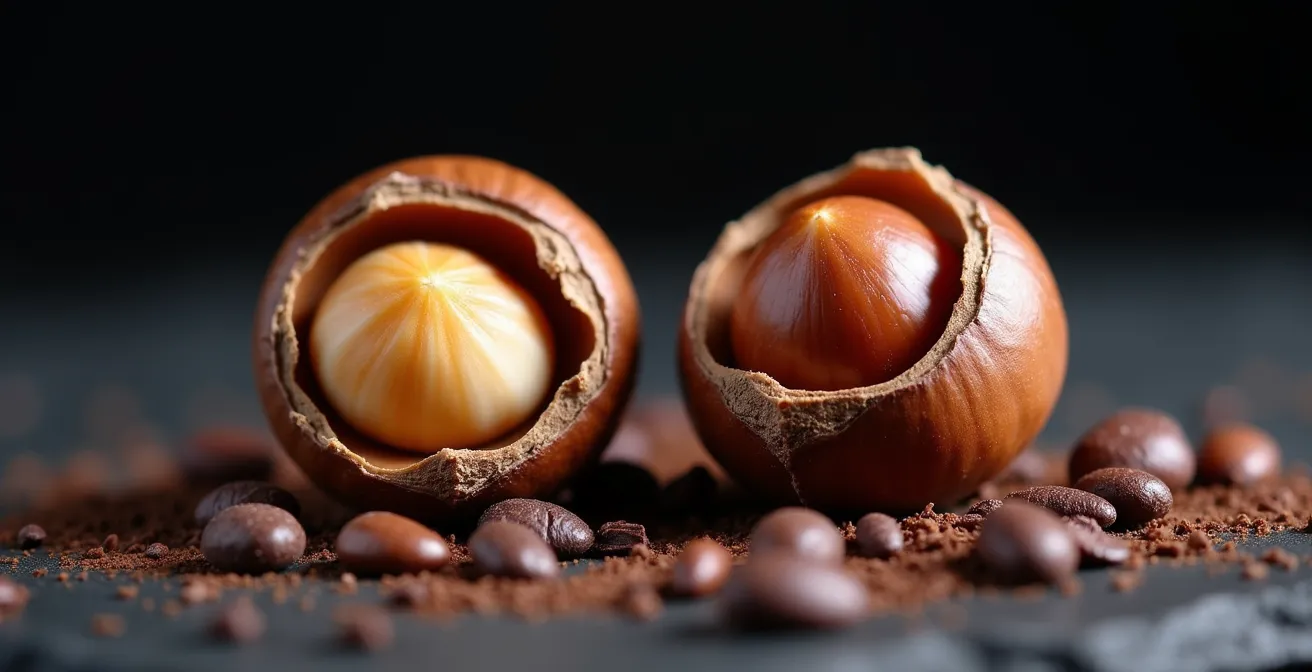
The superior taste of Piedmont hazelnuts isn’t magic; it’s a direct result of a unique, non-replicable molecular blueprint guaranteed by its origin.
- Their exceptionally high oleic acid content creates a richer flavor and smoother texture, ideal for gourmet spreads.
- The specific terroir of the Langhe hills in Italy, a UNESCO site, imparts a natural sweetness that other varieties lack.
Recommendation: Treat the higher price not as a cost, but as an investment in a scientifically superior ingredient that elevates your creations from good to exceptional.
For any true food lover, especially one dedicated to the art of chocolate and pastry, the question inevitably arises: why pay a premium for one ingredient when a cheaper alternative is readily available? This is the central dilemma of the Piedmont hazelnut. It’s easy to dismiss its price tag as mere marketing, especially when mass-market products often use more affordable Turkish varieties. Many believe the difference is negligible, a nuance only detectable by the most refined palates. This perspective, however, misses the fundamental point.
The value of the ‘Nocciola Piemonte IGP’ is not just in its taste, but in its very composition. As an importer of Italy’s finest products, I’ve learned that exceptional quality is never an accident. It is the result of a perfect convergence of genetics, geography, and meticulous cultivation. We are not just talking about a nut; we are talking about a unique molecular blueprint, a specific profile of fats and aromatic compounds that simply cannot be replicated elsewhere. This isn’t about snobbery; it’s about science.
This article will deconstruct the myth that “a hazelnut is a hazelnut.” We will move beyond vague descriptors like “better flavor” and delve into the tangible, measurable reasons that justify the investment. We will explore the scientific guarantees of the IGP label, the precise techniques for preserving its delicate sweetness, and the critical role its unique terroir plays in creating the perfect partner for fine chocolate. By the end, you will understand that the price reflects not just a place, but a promise of unparalleled quality.
To fully appreciate the value locked inside each of these prized nuts, we will explore the specific characteristics that set them apart. This guide breaks down everything a discerning gourmet needs to know, from the science of its fat content to the art of preparing it for the most exquisite recipes.
Contents: The Piedmont Hazelnut Deconstructed
- Why Does the “IGP” Label Guarantee a Specific Oil Content?
- How to Roast Piedmont Nuts to Preserve Their Sweetness?
- Piedmont vs. Turkey: Which Hazelnut Works Best for Chocolate Spreads?
- The Storage Error That Ruins Expensive Nuts in 2 Weeks
- When is the Best Time to Buy the New Harvest from Italy?
- How to Make Crunchy Hazelnut Praline Paste Without Burning the Sugar?
- How Does Volcanic Soil Change the Acidity of Cocoa Beans?
- Skin-On vs. Blanched Hazelnuts: Which Yields a Deeper Flavor?
Why Does the “IGP” Label Guarantee a Specific Oil Content?
The ‘Indicazione Geografica Protetta’ (IGP) label is far more than a geographical marker; it’s a legally binding quality assurance. For the Nocciola Piemonte, it certifies that the nut is the ‘Tonda Gentile Trilobata’ variety grown in a specific area of Piedmont. But more importantly, it guarantees a distinct chemical profile. The primary differentiator is its fat composition, specifically its remarkably high level of oleic acid. Analysis confirms that the Piedmont IGP hazelnut has up to an 82.7% oleic acid content, a figure significantly higher than many other varieties.
This isn’t just a number; it’s the source of the nut’s magic. Oleic acid is a monounsaturated fat, the same healthy type found in high-quality olive oil. This high concentration has two major benefits for a gourmet. First, it gives the hazelnut paste or gianduja a silky, buttery texture without any added oils. Second, it makes the nut more resistant to oxidation, meaning it is less likely to go rancid quickly, preserving its sweet, delicate flavor for longer. This superior “molecular blueprint” is precisely what you are paying for.
The fats in the hazelnut are primarily monounsaturated (similar to those in extra virgin olive oil) and are known for their beneficial effects on health, protecting cell membranes.
– Maison della Nocciola, Hazelnut Piedmont IGP Analysis
So, when you choose IGP, you’re not just buying a nut from Italy. You are investing in a guaranteed high-oleic-acid content that directly translates to superior flavor, texture, and shelf stability in your final product. This scientific reality is the first pillar supporting its premium price.
How to Roast Piedmont Nuts to Preserve Their Sweetness?
Purchasing Piedmont hazelnuts is only half the battle; unlocking their full potential requires a precise roasting process. The goal is not just to toast them, but to trigger the Maillard reaction, developing complex aromas while carefully preserving the volatile compounds responsible for their signature sweetness. Over-roasting can destroy these delicate notes, replacing them with a generic, burnt bitterness. The key lies in moderate temperature and careful timing.
The professional standard is to roast the nuts in a single layer to ensure even heat distribution. A temperature of 170°C (338°F) for approximately 12 minutes is considered the sweet spot. This is hot enough to develop a deep, aromatic profile but gentle enough to avoid scorching the valuable oils. Immediately after roasting, they should be transferred to a cool baking sheet to stop the cooking process. Allowing them to cool completely at room temperature is a non-negotiable step, as this “locks in” the flavor.
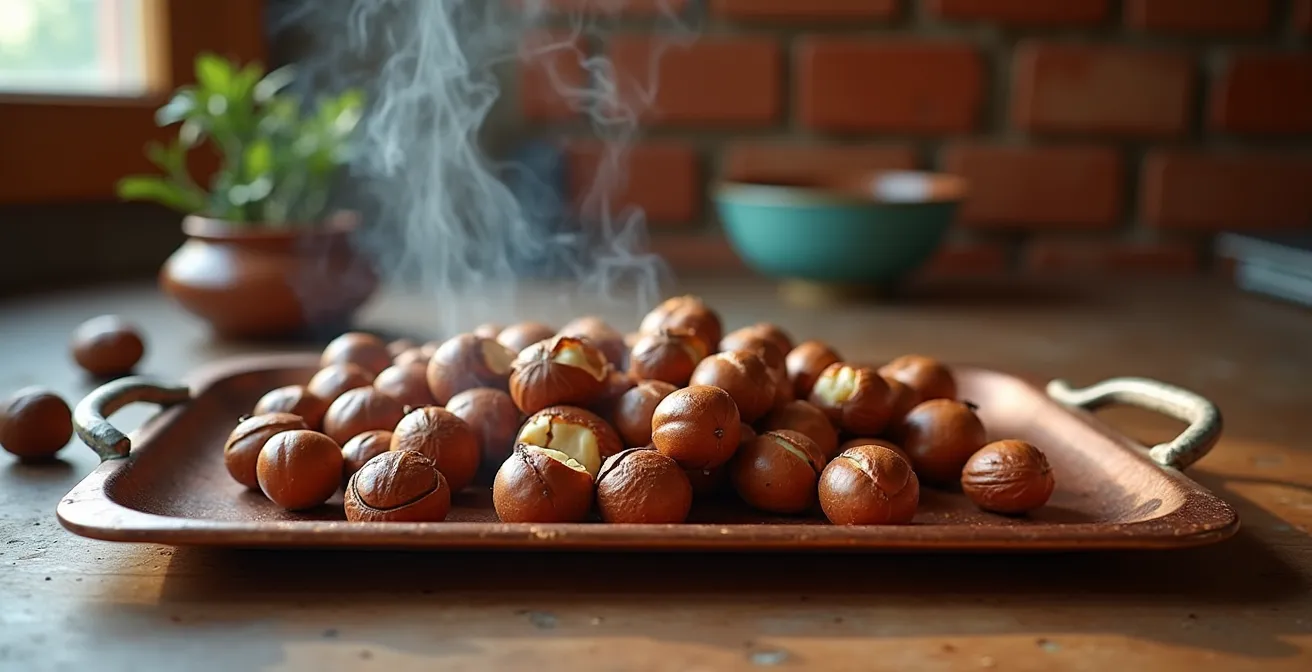
As the image illustrates, the ideal roast yields a beautiful golden-brown color without dark, burnt spots. For peeling, the traditional Italian method is both gentle and effective: while still warm, rub the hazelnuts vigorously inside a dark, clean kitchen towel. The friction will remove the thin, papery skins without damaging the nut or stripping away its precious surface oils. This technique respects the integrity of the ingredient, ensuring the flavor you paid for makes it into your final creation.
Piedmont vs. Turkey: Which Hazelnut Works Best for Chocolate Spreads?
For high-end chocolate spreads like gianduja, the choice of hazelnut is the single most important decision. While Turkish hazelnuts dominate the mass market due to their abundance and lower cost, they are not the ideal partner for fine chocolate. The difference lies in flavor profile and oil content. Turkish varieties can be excellent, but they often possess a woodier, more tannic flavor that can compete with, rather than complement, the delicate notes of a good cacao.
Piedmont hazelnuts, by contrast, are celebrated for their pure, sweet, and persistent flavor with almost no bitterness. This is a direct result of their unique terroir and genetic makeup. Furthermore, their high oil content creates a naturally creamier, more luxurious spread without the need for emulsifiers or additional fats. This distinction is not just a matter of opinion; it is a measurable difference in composition.
Case Study: The Uniqueness of the Tonda Gentile Tree
The inherent superiority of the Piedmont hazelnut is rooted in its very nature, a fact highlighted by attempts to cultivate it elsewhere. As reported by Great Italian Chefs, when growers tried to plant Piedmont’s indigenous ‘Tonda Gentile’ trees in the United States, the endeavor failed completely. American growers eventually found success with a hardier Spanish variant, but the resulting nuts lacked the same quality. This proves that the Piedmont hazelnut’s delicate sweetness and lack of bitterness are not just a product of technique, but of a unique tree thriving in its one-of-a-kind native soil. It simply cannot be replicated.
The following table, based on chemical analysis, clearly shows why Piedmont is the professional’s choice for premium applications.
| Variety | Oil Content | Oleic Acid % | Best Use |
|---|---|---|---|
| Piedmont IGP | 61-65% | 82.7% | Premium chocolate spreads |
| Turkish varieties | 38-66% | 73-81% | Commercial products |
| Oregon hazelnuts | 56-60% | 76-79% | Bulk processing |
While Turkish hazelnuts show a wide range, the IGP-certified Piedmont nut consistently delivers at the high end for both total oil and beneficial oleic acid, making it the clear winner for creating a silky, flavorful, and stable chocolate spread, as a recent comparative analysis of hazelnut varieties confirms.
The Storage Error That Ruins Expensive Nuts in 2 Weeks
Investing in Piedmont hazelnuts is a commitment to quality, but that quality is fragile. The most common and devastating mistake is improper storage. The high concentration of precious, delicate oils that makes these nuts so flavorful also makes them highly susceptible to rancidity. Leaving them exposed to oxygen, light, and warmth at room temperature initiates a rapid process of oxidation. In fact, research shows that improperly stored raw or roasted hazelnuts can become noticeably rancid in as little as two weeks, a costly error that erases their superior flavor profile.
To protect your investment, you must treat them with the same care as any other fine, perishable ingredient. The ideal environment is a cool, dry, dark, and odorless place. Heat and light accelerate oxidation, while proximity to aromatic items like coffee or spices can contaminate their pure flavor. The professional standard for storage is between 14°C and 20°C (57°F and 68°F).
For anyone purchasing in bulk, vacuum sealing is not a suggestion—it’s a necessity. By removing oxygen, you effectively halt the oxidation process. Here are the essential rules for long-term preservation:
- Store nuts in an airtight container in a cool, dark place for short-term use (up to a month).
- For storage up to a year, vacuum seal the nuts in portions and place them in the freezer.
- Never store non-vacuum-sealed nuts in a standard freezer bag, as ice crystals and freezer burn can ruin their texture and flavor.
- Always bring frozen nuts back to room temperature before opening the seal to prevent condensation from making them soggy.
Adhering to these principles ensures that every nut you use tastes as fresh and vibrant as the day it was harvested, preserving the very qualities you paid a premium for.
When is the Best Time to Buy the New Harvest from Italy?
For the true connoisseur, freshness is paramount. Like fine olive oil or wine, hazelnuts have a peak season, and buying from the new harvest ensures you experience their flavor at its most vibrant and intense. The Nocciola Piemonte IGP harvest is a meticulously timed process that begins in late August and runs through September. However, the nuts are not immediately ready for international distribution.
After harvesting, they undergo a crucial drying phase. This step is critical to reduce their moisture content to an optimal 6%. This precise level of dryness concentrates their flavor, enhances their crunch, and is essential for ensuring their stability for storage and transport. This careful, unhurried process means the freshest nuts from the autumn harvest typically become available to international buyers between late October and December each year. This is the window to act if you want to secure the absolute best of the best.
Case Study: The Low-Yield, High-Quality Alta Langa Production
The premium price is also a function of scarcity and effort. Consider the producer Terra delle Nocciole in Cravanzana, in the heart of the Alta Langa. They manage 10,000 ‘Tonda Gentile Trilobata’ trees, but each tree is a low-yield producer, yielding only about 17 pounds of nuts annually. This is roughly 30% less than other, more common hazelnut varieties. This focus on quality over quantity is a hallmark of IGP production. When you buy from the new harvest, you are getting a share of a limited, highly prized crop that required a full year of expert cultivation to produce.
Therefore, planning your purchases for the late autumn and early winter is the smartest strategy. You will be rewarded with an ingredient that is bursting with fresh, sweet, and aromatic compounds, providing a far superior base for your creations than nuts that have been sitting in a warehouse for months. As an importer, this is the time of year our most discerning clients place their largest orders.
How to Make Crunchy Hazelnut Praline Paste Without Burning the Sugar?
Making a flawless hazelnut praline paste—the crunchy, caramelized heart of many fine confections—is a test of technique. The primary challenge is achieving a deep amber caramel without it crystallizing or, worse, burning. A burnt sugar note will completely overwhelm the delicate flavor of your expensive Piedmont hazelnuts. The secret lies in temperature control and the use of an “interfering agent.”
To prevent the sugar from recrystallizing into a grainy mess, add a small amount of an interfering agent like lemon juice or corn syrup to your sugar and water mixture. This simple addition disrupts the formation of large sugar crystals, ensuring a smooth syrup. The next critical step is to use a candy thermometer. You are aiming for the “hard crack” stage, which occurs between 150-160°C (300-320°F). At this point, the caramel will have a beautiful amber color and will set into a glass-like sheet upon cooling.
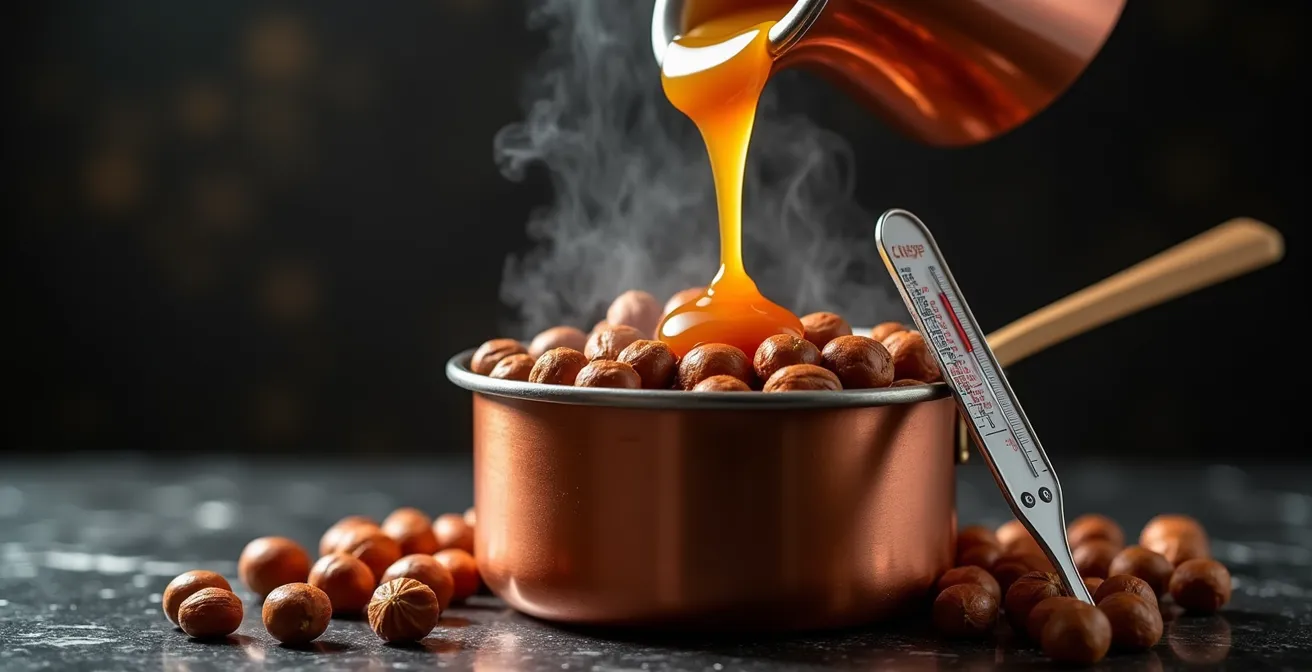
To ensure a fluid, even coating, use pre-warmed hazelnuts. Adding cold nuts to hot caramel can cause it to seize. Once the caramel reaches temperature, work quickly to mix in the warm nuts, then immediately pour the mixture onto a sheet of parchment paper or a silicone mat to cool. This stops the cooking process instantly and prevents the residual heat from turning your perfect caramel into a bitter, burnt disappointment.
Action Plan: Perfect Praline Temperature Control
- Check Your Tools: Ensure you have a reliable candy thermometer, parchment paper, and a heavy-bottomed saucepan.
- Prepare the Nuts: Lightly roast and warm your Piedmont hazelnuts just before the caramel is ready.
- Control Crystallization: Add a small amount of corn syrup or a few drops of lemon juice to your sugar and water mixture before heating.
- Monitor the Temperature: Heat the mixture steadily, without stirring, until the thermometer reads between 150-160°C (300-320°F) for the hard crack stage.
- Execute and Cool: Quickly stir in the warm nuts, then immediately pour the praline mixture onto parchment paper to halt the cooking process.
By following these technical steps, you transform sugar and hazelnuts into a sublime, crunchy praline paste where the sweetness of the caramel enhances, rather than overpowers, the star ingredient.
How Does Volcanic Soil Change the Acidity of Cocoa Beans?
While the question of volcanic soil is most often associated with cocoa beans from regions like Sicily or Central America, its underlying principle—that soil composition dictates flavor—is the absolute key to understanding Piedmont hazelnuts. The unique flavor of any agricultural product is an expression of its terroir: a combination of soil, climate, and geography. You cannot separate the ingredient from the land that grew it.
The soil conditions that make this area perfect for growing grapes are also the reason why Piedmont is home to the world’s best hazelnuts.
– Great Italian Chefs, Nocciola del Piemonte IGP Feature
The hills of the Langhe, Roero, and Monferrato, where Nocciola Piemonte IGP are grown, are so unique that they were designated a UNESCO World Heritage Site in 2014. This is not volcanic soil; it is a distinctive blend of marl, limestone, and sand. This specific mineral composition, which is also responsible for the region’s world-famous Barolo and Barbaresco wines, imparts a natural sweetness and complexity to the hazelnuts that is found nowhere else on Earth. It minimizes any potential bitterness or astringency, creating a flavor profile that naturally balances the acidity of fine chocolate.
Terroir in Action: The UNESCO Heritage Hills
The Langhe’s unique terroir provides the perfect foundation for the Tonda Gentile hazelnut. The marl and limestone soils are well-draining yet retain enough moisture to nourish the trees. IGP regulations also control cultivation density to between 200 and 500 trees per hectare, preventing overcrowding and ensuring each tree has access to the full spectrum of soil nutrients. It is this combination of unique soil minerality and controlled agriculture that forges the hazelnut’s characteristic sweetness—the very quality needed to create a perfectly balanced gianduja.
So, while the soil isn’t volcanic, the principle is the same. The ground itself builds the hazelnut’s flavor from the roots up. The price reflects not just a nut, but a piece of one of the most prized agricultural landscapes in the world.
Key Takeaways
- The IGP label guarantees a high oleic acid content, which provides superior flavor, creaminess, and a longer shelf life.
- Piedmont hazelnuts have a non-replicable flavor profile thanks to the unique, UNESCO-protected terroir of the Langhe hills.
- Proper roasting and storage are not optional; they are critical for preserving the delicate and volatile compounds you pay a premium for.
Skin-On vs. Blanched Hazelnuts: Which Yields a Deeper Flavor?
The final layer of flavor control for a true hazelnut aficionado lies in the decision to use them with skins on or blanched. This choice is not merely aesthetic; it has a significant impact on the final flavor and texture of your product. Leaving the skin on introduces more complex, slightly tannic, and rustic notes. This can add a wonderful depth and a slight textural grit that works beautifully in chocolate bars or as a crunchy topping.
However, for the silkiest, purest expression of the hazelnut—as required for a traditional gianduja or a delicate pastry cream—blanching is essential. Removing the skin eliminates any trace of astringency, allowing the pure, sweet, creamy flavor of the nut to shine through without interruption. The good news is that the ‘Tonda Gentile’ variety is prized for having a skin that is exceptionally thin and easy to remove after roasting. Furthermore, its skin is known to be less bitter than that of other varieties.
The skin of the ‘Tonda Gentile’ hazelnut is famously thin and less astringent than that of other varieties.
– Research from Nocciola del Piemonte Consortium, Italian Food Excellence Report
This means that even when a few flecks of skin remain (a “partial skin” preparation), they contribute a balanced complexity rather than an overwhelming bitterness. The choice ultimately depends on your desired outcome, as outlined in this comparative table.
| Preparation | Flavor Profile | Texture | Best Application |
|---|---|---|---|
| Skin-On | Complex, tannic, rustic notes | Slightly gritty | Chocolate bars, praline, toppings |
| Blanched | Pure, sweet, creamy | Silky smooth | Gianduja, pastry cream, spreads |
| Partial skin | Balanced complexity | Mostly smooth | Versatile for most uses |
Understanding this final nuance allows you to tailor the hazelnut’s flavor profile precisely to your recipe, transforming a great ingredient into the perfect component. It is the last step in mastering this exceptional nut.
Now that you understand the science, terroir, and technique that justify the value of Piedmont hazelnuts, the next step is to experience the difference for yourself. Source authentic ‘Nocciola Piemonte IGP’ for your next creation and elevate your craft from simply good to truly exceptional.