
The secret to a flawless ganache lies not in subjective flavor notes, but in mastering the objective science of a single-origin chocolate’s structure and chemical behavior.
- The specific cocoa butter crystallography of an origin dictates the final texture, sheen, and stability of your ganache.
- Couverture’s higher cocoa butter content and uniform crystal structure provide a predictable foundation that consumer-grade chocolate cannot match.
Recommendation: Stop choosing chocolate based on taste alone; start selecting it based on its technical properties for predictable, consistently superior results.
For any pastry chef, amateur or professional, the pursuit of the perfect ganache is a rite of passage. We strive for that elusive silken texture, a deep, resonant flavor, and a lustrous sheen that promises indulgence. The common advice is to simply “use good chocolate.” But what does that truly mean? Many believe the answer lies in the tasting notes described on the packaging—fruity, earthy, or spicy. This approach, however, leaves far too much to chance.
The truth is that a ganache is a feat of engineering; a delicate emulsion of fat and water. Its success or failure is determined by physics and chemistry, not just by subjective taste. The real key to elevating your work from good to exceptional is to move beyond flavor profiles and begin to understand the fundamental structural and chemical properties of your primary ingredient. This is where single-origin couverture chocolate reveals its true power.
This guide will deconstruct the science behind why specific origins and couverture quality are non-negotiable for achieving superior results. We will explore how cocoa butter structure, fat content, and terroir-driven chemistry are the true levers a chef must pull to achieve ganache perfection. It’s time to think less like a taster and more like a technician.
To help you master this technical approach, we will delve into the specific properties of different chocolates and the common pitfalls to avoid. The following sections provide a complete roadmap for understanding and leveraging the science of couverture in your kitchen.
Summary: The Science of Superior Ganache with Single-Origin Couverture
- Why Madagascar Chocolate Makes Fruitier Mousses Than Ghanaian Varieties?
- How to Choose the Right Origin for a Heavy Cream Dessert?
- Couverture vs. Supermarket Bars: Is the 20% Price Hike Worth It?
- The Melting Mistake That Ruins the Gloss of Expensive Couverture
- How to Pair Single-Origin Chocolate with Local Seasonal Fruits?
- How Does Volcanic Soil Change the Acidity of Cocoa Beans?
- Why Does Your Dark Chocolate Ganache Split and Look Oily?
- Heavy Cream vs. Water: Which Liquid Releases More Chocolate Flavor?
Why Madagascar Chocolate Makes Fruitier Mousses Than Ghanaian Varieties?
The difference in the final character of a dessert made with Malagasy versus Ghanaian chocolate goes far beyond simple “flavor notes.” It’s a question of chemistry. Ghanaian chocolate, typically made from robust Forastero beans, provides a classic, deep cocoa foundation. It’s reliable and consistent, forming a stable backbone in a mousse or ganache. Madagascar chocolate, however, is an entirely different beast. Derived from rare Criollo and Trinitario hybrids, it possesses a unique chemical signature. This cacao has the potential to produce dark chocolate with strong, bright red fruit flavors and a distinct citrus-like acidity.
This terroir-driven profile is due to a higher concentration of specific volatile organic compounds, particularly acidic esters. When you incorporate this chocolate into a fat-rich medium like a mousse, these compounds behave differently than the more stable flavor compounds in Ghanaian chocolate. As pastry expert Neil Kelsall notes in the Confectionery News Industry Report:
The bright, acidic esters in Malagasy chocolate are more readily volatilized, perfuming the mousse.
– Neil Kelsall, Confectionery News Industry Report
This “volatilization” means the fruity, acidic aromas are released more easily, creating a perception of a much fruitier, livelier dessert. This effect is amplified by the fact that Madagascar’s rare criollo-trinitario hybrids represent less than 0.2% of the world’s cacao production, making its unique chemical makeup a prized asset for pastry chefs seeking aromatic complexity rather than just foundational cocoa flavor.
How to Choose the Right Origin for a Heavy Cream Dessert?
Choosing the right single-origin chocolate for a cream-based dessert is not about matching tasting notes; it’s a technical decision based on the interaction between two fats: cocoa butter and milkfat. Different origins have fundamentally different cocoa butter crystallization patterns. These structures determine how the chocolate will set, its final texture, and how it will emulsify with the cream. A robust, stable cocoa butter from a Ghanaian Forastero bean will create a firm, dense ganache. In contrast, the more volatile, sharper crystal structure of a Venezuelan Chuao will produce a different mouthfeel and sheen.

The fat percentage of your heavy cream is the second critical variable. A higher-fat cream (35-40%) requires a chocolate with a robust cocoa butter structure to create a stable emulsion, while a lower-fat cream can be paired with chocolates that have more delicate profiles without becoming too soft. A chef’s role is to act as a matchmaker between the cocoa butter’s structural potential and the cream’s fat content. This ensures the final dessert has the desired texture, whether it’s a firm truffle filling or a soft, spoonable crémeux.
This framework, detailed in a recent comparative analysis of chocolate properties, provides a clear guide for making technical choices. The following table breaks down the roles different origins can play in cream-based desserts.
| Chocolate Role | Origin Example | Cocoa Butter Profile | Best with Cream % |
|---|---|---|---|
| Star (Complex) | Venezuelan Chuao | Sharp, high melting point | 35-40% fat cream |
| Backbone (Structure) | Ghanaian Forastero | Robust, stable crystals | 30-35% fat cream |
| Accent (Specific note) | Madagascar/Mexican | Volatile, fruity profile | 25-30% fat cream |
Couverture vs. Supermarket Bars: Is the 20% Price Hike Worth It?
For a demanding chef, the debate between couverture and a standard supermarket bar is not about price; it’s about control and predictability. The extra cost of couverture is a direct investment in performance. The primary difference lies in the minimum 31% cocoa butter content legally required for couverture. This higher fat content is not for flavor, but for function. It provides the fluidity (viscosity) needed for dipping and enrobing, and more importantly, it creates a superior crystal structure for ganaches and mousses.
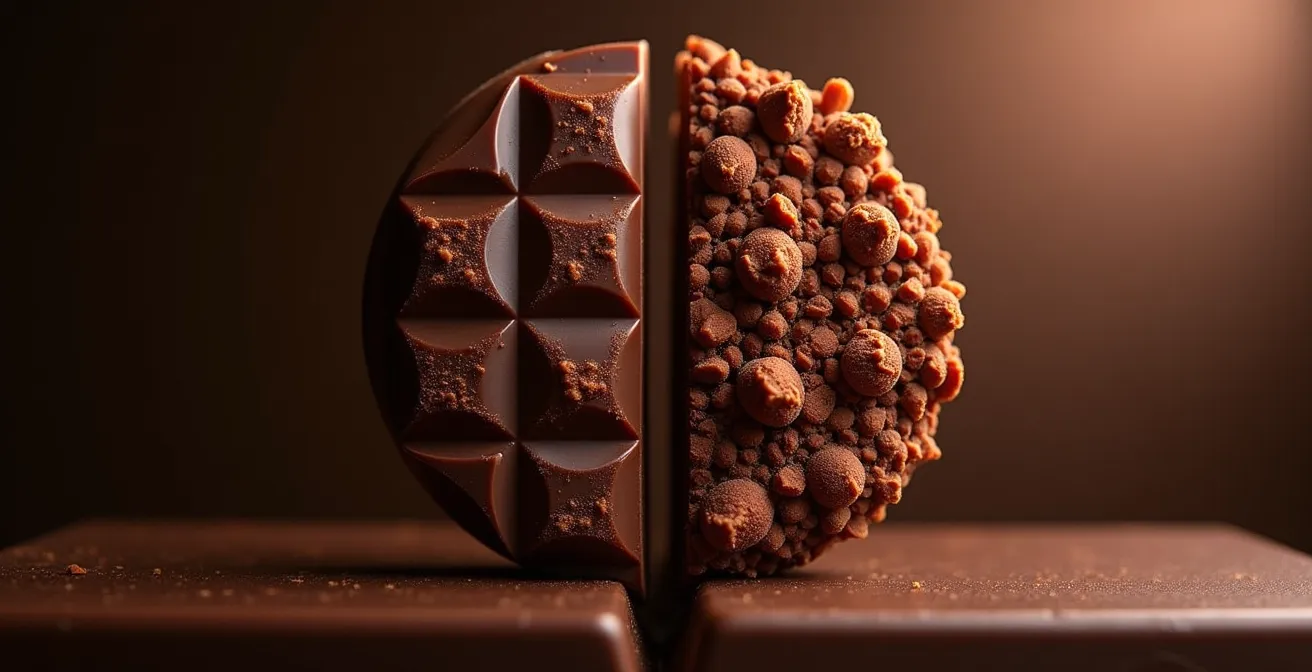
Supermarket chocolate often contains other fats, emulsifiers (like soy lecithin), and a lower cocoa butter percentage to reduce cost. This results in a chaotic, unstable crystal formation when melted and cooled. Couverture, on the other hand, is engineered for a uniform, stable crystallization. This structural integrity is measurable; a scientific study showed that professional couverture demonstrates a faster crystallization time of 15.78 minutes compared to 17.88 minutes for a compound alternative, indicating a more efficient and stable molecular structure. This efficiency translates directly to a ganache that sets with a cleaner snap, a higher gloss, and a significantly reduced risk of splitting or becoming grainy. The price difference is not a markup; it’s payment for superior engineering.
The Melting Mistake That Ruins the Gloss of Expensive Couverture
You’ve invested in a premium single-origin couverture, appreciating its complex chemistry and superior cocoa butter structure. The worst mistake you can make now is to destroy those properties in the first step: melting. The number one error that ruins the potential for a glossy, stable ganache is aggressive, uncontrolled heat. Chocolate, especially high-quality couverture, is incredibly sensitive. Its perfect sheen and snap are owed to a specific arrangement of cocoa butter crystals, primarily the stable Form V crystal.
When you melt chocolate too quickly or at too high a temperature (anything above 120°F / 49°C for dark chocolate), you are not just liquifying it; you are shattering this delicate crystal structure. The heat forces the fat molecules into a chaotic state. Even if you cool it down, these molecules will not easily reform into the stable Form V structure on their own. Instead, they will likely form unstable crystals, leading to a dull, streaky finish (fat bloom) and a soft, crumbly texture. You have effectively erased the very properties you paid for.
The professional approach is to treat melting as a process of controlled structural disassembly. Use a bain-marie with barely simmering water, ensuring the bowl does not touch the water. Stir constantly and remove the chocolate from the heat when it is about two-thirds melted, letting the residual heat of the bowl finish the job. This gentle persuasion preserves the integrity of the cocoa butter, giving you a fluid mass that retains the potential to be coaxed back into a perfect, glossy emulsion.
How to Pair Single-Origin Chocolate with Local Seasonal Fruits?
Pairing chocolate with fruit is often approached as a simple flavor-matching game: fruity chocolate with fruit, nutty chocolate with stone fruit. A more technical and effective method, however, is to pair them based on their chemical properties, specifically acidity and aromatic compounds. Your goal as a chef is to decide whether you want to complement or contrast these properties.
For a complementary pairing, match intensity. A highly acidic Madagascar or Mexican single-origin chocolate, with its bright, volatile esters, will sing when paired with equally acidic fruits like raspberries, passion fruit, or tart cherries. The similar pH levels and aromatic profiles create a harmonious, layered experience where the fruit and chocolate notes amplify each other. This works best when the fruit is used in its fresh, raw state, preserving its own volatile compounds.
For a contrasting pairing, use a robust, low-acidity chocolate to provide a rich foundation for a bright fruit. An earthy, rich Ghanaian or Ecuadorian chocolate can serve as a deep, resonant bass note against the high-pitched acidity of a lemon or apricot. This is particularly effective if the fruit is cooked, as in a compote or gelée, which mellows its acidity slightly and requires a stronger chocolate to hold its own. The contrast prevents the dessert from becoming monotonously sharp and instead creates a dynamic interplay between deep cocoa and bright fruit. The choice is not about right or wrong, but about the intended narrative of your dessert: harmony or dynamism?
How Does Volcanic Soil Change the Acidity of Cocoa Beans?
The concept of *terroir* in chocolate extends deep into the ground. The soil composition is not just a passive medium but an active participant in creating a bean’s final chemical profile. Volcanic soil, in particular, imparts a distinct signature that a discerning chef can taste and utilize. These soils are typically rich in specific minerals like sulfur, potassium, and magnesium, and they often have a naturally lower pH, making them more acidic.
During its growth, the cacao tree absorbs these minerals from the soil. The presence of higher levels of sulfur, for instance, can influence the formation of certain flavor precursors within the bean. More importantly, the acidic nature of the soil affects the bean’s internal pH. This inherent acidity is a crucial starting point that is later shaped by fermentation and roasting. A bean that begins its life with a lower pH has the potential to develop more complex, tangy, and fruit-forward flavor compounds.
Think of it as setting the initial conditions for a chemical reaction. A bean from the rich, alkaline soils of Ghana will have a different starting point than one from the acidic, mineral-laden volcanic slopes of Hawaii or parts of Central America. This results in a final chocolate that is not just “acidic” in taste, but one whose very molecular makeup lends itself to a brighter, sharper profile. A chef using a chocolate from volcanic terroir is not just using a flavor; they are harnessing a geological history to add a specific kind of vibrancy and tang to their creations.
Why Does Your Dark Chocolate Ganache Split and Look Oily?
A split, oily ganache is the physical manifestation of a broken emulsion. It’s not a sign of bad chocolate, but a failure in technique. A ganache is a delicate suspension of fat (from the cocoa butter and cream) in water (from the cream). When it looks smooth and glossy, the fat globules are tiny and evenly dispersed. When it looks split and greasy, those fat globules have clumped together and separated from the water. This happens for two primary reasons: incorrect ratios or thermal shock.
The most common culprit is an imbalanced ratio. If there is too much fat (from either too much chocolate or a very high-fat cream) for the amount of water available, the emulsion will not have enough liquid to suspend the fat globules. They will inevitably separate, creating an oily slick. Conversely, too much liquid can also cause separation, though it often looks watery and broken rather than greasy. For a standard dark chocolate (around 70%) ganache, a 1:1 ratio by weight of chocolate to heavy cream is a safe starting point.
Thermal shock is the second cause. Pouring very hot cream onto cold chocolate, or vice versa, causes the cocoa butter to seize and separate before it has a chance to emulsify properly. The key is to bring the two components together at similar, gentle temperatures. A split ganache can often be saved. The goal is to reintroduce a small amount of liquid to help re-emulsify the fat. Gently warming the ganache and whisking in a tablespoon of warm milk or water can often bring it back together.
Action Plan: Rescuing a Split Ganache
- Diagnose the Problem: Is the ganache grainy and thick (too cool) or oily and separated (too much fat or heat)?
- Gently Reheat: Place the bowl over a bain-marie with low heat. Stir gently until it reaches a uniform temperature of around 90-100°F (32-38°C). Do not overheat.
- Add a Stabilizing Liquid: While stirring continuously with a spatula, slowly drizzle in a very small amount (1-2 teaspoons) of warm, low-fat liquid like milk or even water. This provides more water for the fat to emulsify into.
- Create a Mini-Emulsion: Focus your stirring in the center of the bowl to create a small, glossy “seed” of stable emulsion. Once this core is formed, gradually widen your stirring motion to incorporate the rest of the broken mixture.
- Stabilize with Immersion: If the ganache is stubborn, use an immersion blender. Keep the blade below the surface to avoid incorporating air and blend in short bursts until the mixture becomes smooth and glossy again.
Key Takeaways
- Mastery of ganache comes from understanding the technical, structural properties of chocolate, not just its flavor.
- Single-origin couverture is a technical ingredient; its cocoa butter profile dictates texture, stability, and interaction with fats like cream.
- Common failures like splitting or a dull finish are preventable problems of chemistry (emulsion science) and physics (thermal shock).
Heavy Cream vs. Water: Which Liquid Releases More Chocolate Flavor?
The doctrine of classic pastry dictates that ganache is made with heavy cream. The milkfat, we are told, adds richness and a luxurious mouthfeel. While true, this orthodoxy overlooks a critical aspect of flavor science: solubility. Flavor compounds in chocolate are not monolithic; some are fat-soluble, while others are water-soluble. By using only heavy cream, which is primarily fat and a small amount of water, we are potentially muting a significant portion of the chocolate’s aromatic potential.
The rich, deep, and nutty notes in chocolate are often carried by fat-soluble compounds. These bind beautifully with the milkfat in cream, creating a round, decadent, and lingering flavor. However, the brighter, more volatile, and acidic notes—the very characteristics prized in many single-origin chocolates like those from Madagascar or Peru—are often water-soluble. When these compounds are trapped in a high-fat environment, their expression can be dulled. The fat coats the palate, slowing the release and perception of these delicate aromas.
This is why making a ganache with water can be a revelation. A water-based ganache, or *pâte à glacer*, presents a much cleaner, more direct expression of the chocolate’s terroir. The water-soluble flavor compounds are free to volatilize and hit the palate with startling clarity. The result is a ganache that tastes intensely and purely of its origin, with a much sharper and more defined flavor profile. You trade the rich, creamy mouthfeel of a traditional ganache for an unparalleled purity of flavor. For a chef aiming to showcase the unique personality of a rare single-origin couverture, using water is not a compromise; it’s a strategic choice to let the chocolate speak for itself.
By moving beyond traditional recipes and embracing the science of your ingredients, you gain the control to create desserts that are not just delicious, but are a true and precise expression of your vision. Start by choosing your chocolate not for what it tastes like on its own, but for what its structure and chemistry will allow you to build.