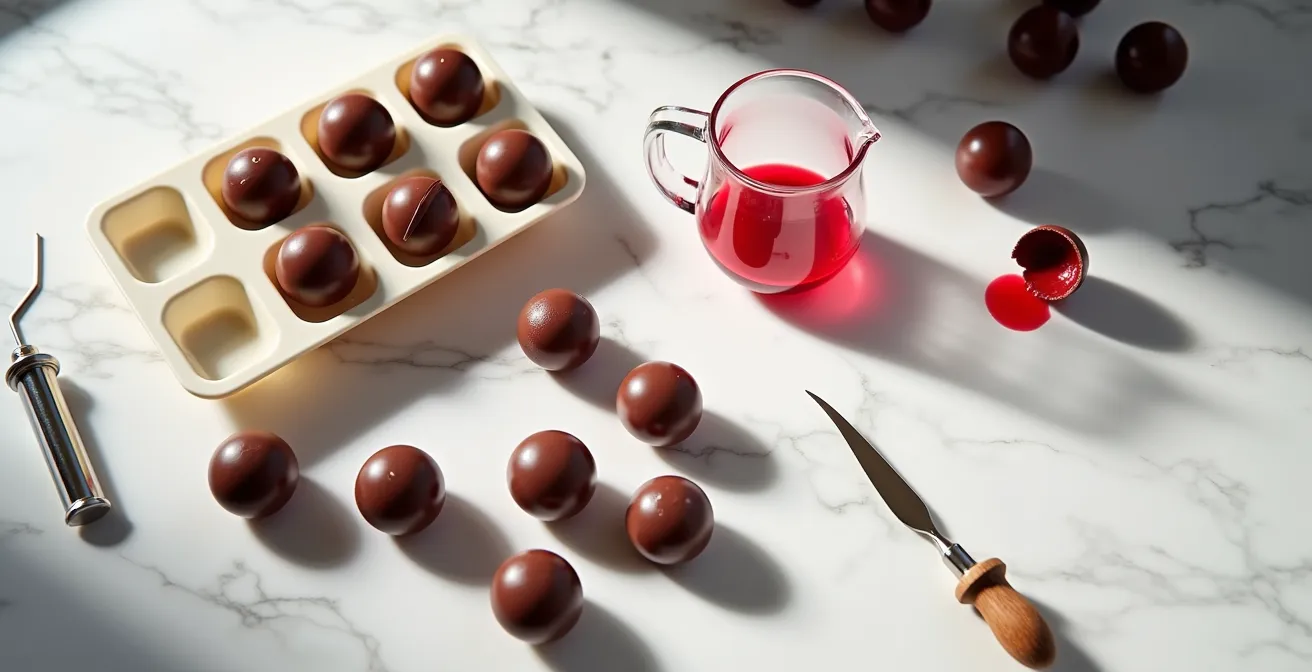
Achieving a stable, liquid coulis inside a thin chocolate shell is a matter of scientific control, not guesswork.
- Success depends on managing three key variables: coulis viscosity through the right pectin, water activity (aW) for shelf-life, and thermal dynamics during capping.
- Frozen fruit purées offer superior consistency over fresh fruit for predictable results in water content and acidity.
Recommendation: Prioritize controlling the water activity (aW) of your filling to below 0.85 and ensure your capping chocolate temperature is precisely managed to prevent leaks and ensure structural integrity.
The ultimate challenge for any advanced confectioner is the creation of a bonbon that offers a dramatic textural contrast: a liquid fruit coulis that bursts forth from a paper-thin, crisp chocolate shell. Many attempt this, but the results are often disappointing—leaks, a soft shell, or worse, premature mold growth. The common advice often revolves around generic tips like using a thick shell or simply “being careful” during sealing. These approaches miss the fundamental point and often sacrifice the very delicacy we aim to achieve.
The truth is, successfully encapsulating a liquid is not an art of approximation. It is a science of control. The stability of your final product hinges on a precise understanding of the physical and chemical interactions between your filling and your shell. Factors like water activity, hydrocolloid chemistry, and thermal dynamics are not abstract concepts; they are the core engineering principles that dictate success or failure. This guide moves beyond the surface-level advice to dissect these principles. We will not just tell you *what* to do, but explain *why* it works, giving you the technical foundation to troubleshoot and innovate.
This article provides a structured, engineering-led approach to mastering liquid-filled bonbons. By understanding the core scientific principles at each stage, you can move from inconsistent results to reliable, repeatable excellence. The following sections will break down each critical control point in the process.
Summary: The Engineering of Liquid-Center Bonbons
- Why High Acidity Is Necessary to Balance Sweet Shells?
- How to Use Pectin to Control Coulis Viscosity?
- Fresh Fruit vs. Frozen Puree: Which Offers Consistent Water Content?
- The Capping Mistake That Causes Leaks in Liquid Centers
- When Will the Water Activity Cause Mold Inside the Bonbon?
- How to Aerate Chocolate Mousse Without Losing Stability?
- How to Pair Floral Chocolates with Tea Without Masking the Flavor?
- When Will the Water Activity Cause Mold Inside the Bonbon?
Why High Acidity Is Necessary to Balance Sweet Shells?
In confectionery, acidity is not merely a flavor component; it is a critical tool for creating balance and enhancing the consumer’s sensory experience. A chocolate shell, particularly one made from milk or white chocolate, possesses a significant level of sweetness and richness from cocoa butter and sugar. A liquid fruit coulis without sufficient acidity would be cloying and one-dimensional when paired with it. The sharp, bright notes of citric, malic, or tartaric acid from the fruit cut through the richness, cleansing the palate and making the overall flavor profile more complex and enjoyable.
The goal is to achieve a flavor “snap” that mirrors the physical snap of the tempered chocolate shell. When the bonbon is consumed, the initial sweetness of the chocolate should be immediately followed by the vibrant, acidic burst of the fruit coulis. This contrast prevents flavor fatigue and highlights the quality of both the chocolate and the fruit. Think of it as an engineering principle: you are using one component (acidity) to modulate the perception of another (sweetness).
Furthermore, the perceived intensity of fruit flavor is directly linked to its acidity. A higher acid level makes a raspberry coulis taste more “raspberry-like” and a lemon coulis more “lemony.” Without it, the flavor can taste flat, cooked, or overly sugary. Therefore, measuring and sometimes adjusting the pH of your fruit puree with citric acid or another food-grade acid is a key step in formulating a filling that can stand up to its chocolate shell. This isn’t just about taste, but about ensuring the core ingredient’s character is not lost.
How to Use Pectin to Control Coulis Viscosity?
To successfully encapsulate a liquid, it must not be truly liquid at the time of piping and capping. It needs to be a thixotropic gel: a substance that appears solid or highly viscous at rest but flows under stress (i.e., when piped). This is where hydrocolloids, specifically pectin, become your primary engineering tool. However, not all pectins are created equal. For liquid-filled bonbons, Pectin NH is the industry standard for a clear reason: it is thermoreversible.
Unlike standard pectins that create a permanent gel once set, Pectin NH has the unique property of being able to be melted and re-set multiple times. This allows you to prepare a batch of coulis, let it set, and then gently re-melt it to the perfect piping consistency without compromising the final gel structure. This level of control is invaluable in a professional workflow.
The gelling mechanism of Pectin NH relies on the presence of calcium ions, and it’s less dependent on high sugar and high acid content compared to traditional HM pectins. This is a significant advantage, as it allows you to create fillings that are less sweet and have a more natural fruit flavor. The activation process is precise: the pectin powder must be whisked with a portion of the sugar before being added to the heated fruit puree to prevent clumping. The mixture is then brought to a boil for 1-2 minutes to ensure full hydration and activation of the pectin.
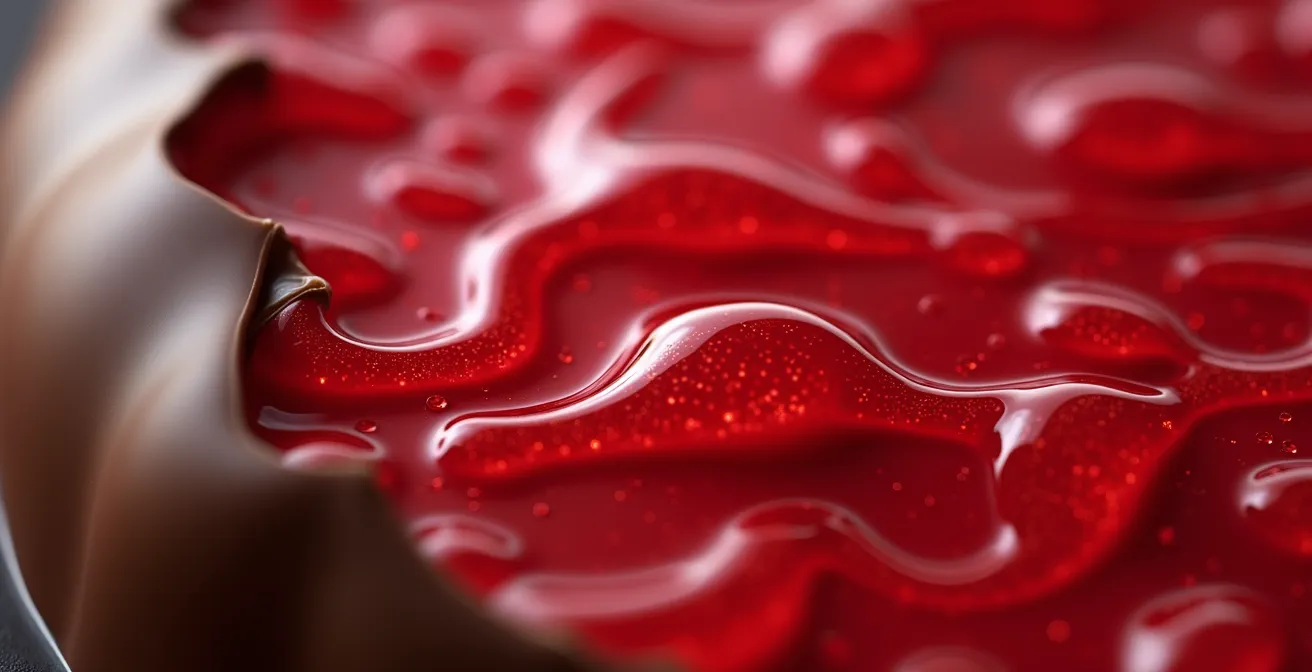
As the image above illustrates, a correctly made pectin gel has a smooth, continuous structure capable of holding its shape. After boiling, the coulis is cooled to below 30°C (86°F) before piping. This cooling step is critical to prevent the heat from melting the thin chocolate shell from the inside. The final result is a filling that is solid enough to be capped easily but breaks down into a luscious liquid in the mouth.
Case Study: The Thermoreversible Advantage of NH Pectin
Professional pastry chefs leverage NH Pectin for fruit glazes and fillings due to its unique thermoreversible properties. This type of pectin allows a gel to be melted and set repeatedly, making it ideal for creating fillings that are stable for piping but liquid upon consumption. Unlike high-methoxyl (HM) pectins, which require a high-sugar, high-acid environment to set, NH Pectin is a low-methoxyl (LM) pectin pre-blended with calcium salts. This means it can gel with a much lower sugar content, preserving the fruit’s natural flavor. As little as 10mg of calcium can effectively gel one gram of this pectin, providing reliable results without compromising taste or texture.
Fresh Fruit vs. Frozen Puree: Which Offers Consistent Water Content?
While the idea of using fresh, seasonal fruit is romantic, it introduces a significant variable that is the enemy of consistent confectionery: unpredictable water content. The water content and Brix (sugar level) of fresh fruit can vary dramatically depending on the season, ripeness, and even the specific batch. This variability directly impacts pectin activation, flavor concentration, and most importantly, the final water activity (aW) of your coulis, which is critical for shelf stability.
For an engineering approach focused on repeatability, high-quality frozen fruit purées are unequivocally superior. Manufacturers of professional-grade purées standardize their products to a consistent Brix level (typically around 10-12°) and water content. This means that every time you open a container, you are starting with the same baseline parameters. Your pectin will behave predictably, and your water activity calculations will be reliable. This removes a massive source of potential error from your process.
When making filled chocolates, consistency is key. Professional chocolatiers often prefer frozen purees because they provide predictable water activity levels critical for shelf stability.
– Chef Christophe Rull, Sugar Geek Show Tutorial
Beyond consistency, frozen purées offer practical advantages. They are pre-strained, saving significant labor. Their flavor is often more concentrated and stable than that of out-of-season fresh fruit. While a perfectly ripe, in-season fresh fruit might offer a sublime flavor, the risk and inconsistency it introduces are often not worth it for producing a stable, replicable product.
The following table breaks down the key differences for a technical evaluation.
| Property | Fresh Fruit | Frozen Commercial Puree |
|---|---|---|
| Water Content Consistency | Variable (seasonal) | Standardized |
| Brix Level | Varies 8-15° | Consistent 10-12° |
| Processing Required | Strain, reduce, measure | Thaw and use |
| Flavor Intensity | Bright, fresh | Concentrated, stable |
| Pectin Activation | Variable results | Predictable gelling |
The Capping Mistake That Causes Leaks in Liquid Centers
A bonbon can have a perfectly formulated filling and a flawless shell, but it will fail if the final seal—the cap—is compromised. Leaks are almost always a result of errors in the capping process, often stemming from a misunderstanding of thermal dynamics. The most common mistake is applying capping chocolate that is too warm or not leaving the correct amount of space for it. This creates a weak seal that will inevitably fail.
The process requires precision. The set coulis filling should have a temperature below 28°C (82°F). Crucially, you must leave a headspace of exactly 1.5mm from the top edge of the mold. This space is not arbitrary; it is the required volume to create a cap of sufficient thickness and strength to contain the liquid without being overly thick. Any filling on the edges of the mold must be meticulously cleaned, as it will prevent the cap from bonding to the shell.
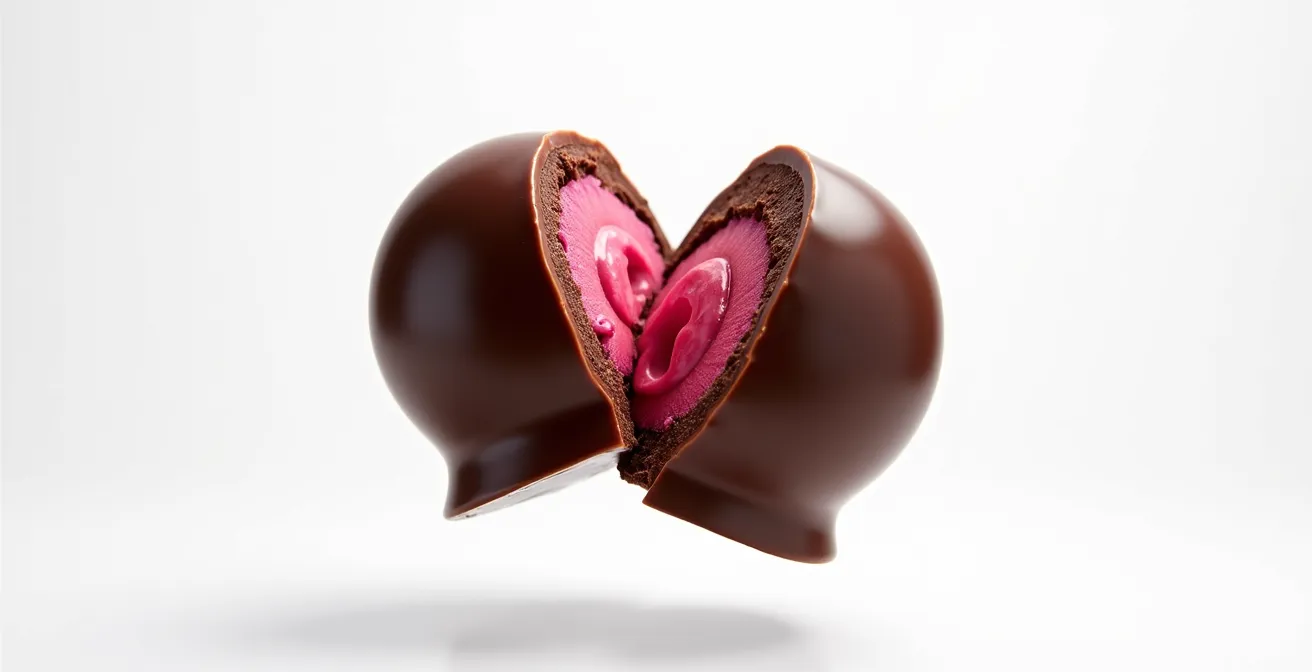
The tempered chocolate used for capping should be at its lowest workable temperature, typically 30-31°C (86-88°F). Applying chocolate that is too hot will cause a “thermal shock,” melting the top layer of the set coulis and thinning the chocolate shell, leading to a weak point. Once the chocolate is applied, the mold must be tapped gently on the work surface to release any trapped air bubbles that could create pinholes in the cap. Rushing the final crystallization in a refrigerator can also create stress and micro-fractures. The initial setting of the cap should happen at a cool room temperature.
Action Plan: Professional Sealing Checklist for Liquid-Filled Bonbons
- Filling Temperature: Ensure filling is cooled to below 28°C before starting the capping process.
- Headspace Control: Leave a precise 1.5mm headspace between the filling and the top of the mold.
- Edge Cleanliness: Meticulously clean any filling from the mold’s top edges to ensure a perfect bond.
- Chocolate Temperature: Apply tempered chocolate at its lowest workable temperature, between 30-31°C.
- Air Bubble Removal: Gently tap the mold after applying the cap to release any trapped air bubbles.
When Will the Water Activity Cause Mold Inside the Bonbon?
This is the most critical question for shelf stability, and the answer lies in a scientific parameter: water activity (aW). Water activity is not the same as water content. It measures the amount of “free” water available in a product for microorganisms like mold and bacteria to grow. It is measured on a scale from 0 (completely dry) to 1.0 (pure water). Controlling aW is the single most important factor in creating a shelf-stable confection.
For confectionery, a critical threshold exists. Extensive research on chocolate safety shows that a water activity below 0.85 is generally sufficient to inhibit the growth of most pathogenic bacteria. To prevent mold, which can grow at lower aW levels, an even lower target is often desired. However, pushing the aW too low (e.g., below 0.75) typically requires adding large amounts of sugar or other humectants, which can negatively impact the texture and flavor of the coulis, making it overly sweet or gummy.
Therefore, the professional confectioner’s target is a balancing act. As a case study in ganache demonstrates, the principles are transferable. In a basic ganache, the water activity can exceed 0.90, giving it a very short shelf life. However, professional chocolatiers aim for an aW between 0.75 and 0.85, which can provide a shelf life of up to two months while maintaining an optimal texture and taste. This range is the sweet spot for fruit coulis as well. It is low enough to ensure microbiological safety and prevent mold for a reasonable period, yet high enough to maintain a pleasant, fluid-like mouthfeel. Achieving this requires precise recipe formulation, often using a combination of sugar, glucose syrup, and invert sugar to bind free water effectively.
How to Aerate Chocolate Mousse Without Losing Stability?
While this article focuses on liquid coulis, the question of stability in aerated structures like mousse provides a valuable parallel. In both cases, the goal is to maintain structural integrity. For a mousse, stability comes from a well-formed emulsion and the crystallization of cocoa butter. For a bonbon shell containing a liquid, stability comes from a perfectly crystallized, non-porous chocolate barrier. The common enemy in both scenarios is unwanted air.
In the context of our liquid-filled bonbon, “aeration” refers to air bubbles trapped within the chocolate shell itself. These are microscopic weak points that can compromise the shell’s ability to contain the filling, leading to leaks. Preventing this unwanted aeration is a matter of proper chocolate handling and molding technique. The stability of your shell depends on its density and freedom from voids.
The process begins with perfectly melted chocolate, free of any unmelted pieces that can introduce instability. Adding a small amount of extra cocoa butter (or using a more fluid couverture) can help reduce viscosity, allowing air to escape more easily. After filling the molds to create the shell, thoroughly tapping the mold on the work surface is non-negotiable. This action forces trapped air bubbles to rise to the surface. Professional chocolatiers often use a vibrating table to achieve this more effectively and consistently.
Finally, the cooling process must not be rushed. Slow, controlled cooling allows the cocoa butter to form stable beta V crystals, creating a strong, dense shell. Rushing the process in a freezer can trap micro-bubbles and create stress fractures. Just as a mousse’s stability depends on a careful folding technique to preserve air, a shell’s stability depends on a careful molding technique to expel it.
How to Pair Floral Chocolates with Tea Without Masking the Flavor?
The principle of pairing—ensuring one element does not overwhelm another—is central to high-end confectionery. Just as one must carefully select a tea that complements, rather than masks, the delicate notes of a floral chocolate, one must pair the chocolate shell with its fruit coulis to create a harmonious experience. If the chocolate is too powerful, the subtle flavor of the fruit filling will be lost. The primary technique to manage this balance is not just choosing the right chocolate, but controlling the thickness of the shell.
As one French Pastry Chef notes in a professional guide to bonbon making, “The shell should snap and then yield to the coulis’s flavor – a thin shell is the primary technique for preventing chocolate from overwhelming delicate fruit notes.” A shell of 1-1.5mm is ideal for most pairings. It is thick enough to be structurally sound but thin enough to shatter instantly, allowing the liquid coulis to become the dominant flavor immediately after the initial snap.
The choice of chocolate origin and type also plays a critical role. A single-origin chocolate with its own distinct flavor notes can be used to complement the filling. For example, a Madagascar 70% dark chocolate, known for its bright red fruit notes, will beautifully enhance a raspberry coulis. Conversely, a robust, earthy chocolate might completely overpower it. The goal is synergy, not competition.
This pairing guide offers a starting point for matching chocolate profiles to common fruit coulis types.
| Chocolate Type | Flavor Profile | Best Fruit Pairing | Shell Thickness |
|---|---|---|---|
| Madagascar 70% | Red fruit notes | Raspberry coulis | 1-1.5mm |
| Ecuador 65% | Floral, honey | Passion fruit | 1.5mm |
| Ghana Milk 40% | Caramel, toffee | Mango coulis | 2mm max |
| White chocolate | Vanilla, cream | Citrus coulis | 1.5-2mm |
Key Takeaways
- Water activity (aW) is the single most important parameter for ensuring the shelf stability and safety of liquid fillings. Aim for a target range of 0.75-0.85.
- The choice of pectin is critical; thermoreversible Pectin NH provides the best control over the viscosity and texture of the coulis for piping and consumption.
- Precision during the capping stage—specifically managing headspace (1.5mm) and chocolate temperature (30-31°C)—is essential to prevent leaks.
When Will the Water Activity Cause Mold Inside the Bonbon?
We return to this critical question to synthesize its importance. Throughout this guide, we have deconstructed the process of creating a liquid-filled bonbon into a series of controllable engineering steps. We have managed flavor with acidity, viscosity with pectin, and structural integrity with capping techniques. However, all of these efforts are futile if the final product is not shelf-stable. Water activity (aW) is the invisible thread that ties everything together, representing the final gatekeeper of quality and safety.
To reiterate, mold and bacteria require free water to thrive. By precisely formulating our coulis with a controlled ratio of water, sugar, and other solutes, we effectively “lock up” this water, reducing the aW to a level that is inhospitable for microbial growth. Ignoring this parameter is the most common reason why technically perfect bonbons develop mold weeks or even days after being made. It is a silent failure that undermines all other craftsmanship.
Mastering water activity moves you from being a confectioner who follows recipes to an engineer who designs them. It allows you to confidently create products with a predictable and safe shelf life, freeing you to focus on the creative aspects of flavor and texture. It is the final piece of the puzzle, transforming the fragile art of confectionery into a robust science.
By applying these scientific principles with precision, you can systematically eliminate failures and consistently produce exquisite liquid-filled bonbons that are as stable and reliable as they are delicious. The next logical step is to equip your workshop with the tools needed to measure and control these critical parameters.