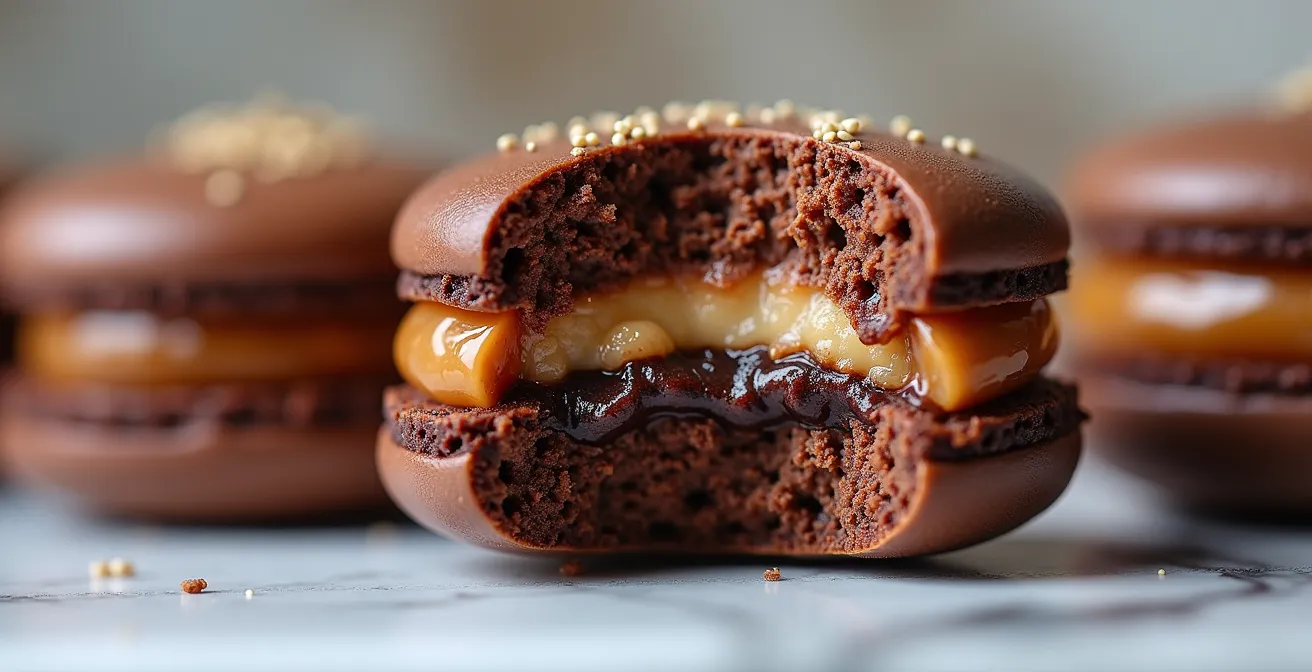
The secret to perfectly crisp macaron shells isn’t avoiding moist fillings, but mastering their “water activity” (Aw) to control moisture migration.
- The internal structure of your ganache (crystallized vs. whipped) has a greater impact on shell texture than its overall moisture content.
- Strategic ingredients like gelatin, invert sugar, and specific fats act as precision tools to create hydrophobic barriers and lock in free water.
Recommendation: Stop thinking in terms of “wet vs. dry” and start formulating your fillings to achieve a specific water activity equilibrium between the shell and the ganache.
Every macaron specialist knows the heartache. You craft a perfect, glossy shell with a delicate crispness and a chewy interior. You prepare a vibrant, high-moisture filling—a sharp raspberry gel or a creamy white chocolate ganache. You assemble them, let them mature, and then the dreaded transformation occurs: the once-crisp shell becomes a soft, disappointingly soggy cookie. The common advice is to use stable buttercreams or avoid “wet” fillings altogether, but this limits creativity and flavor profiles. This approach treats the symptom, not the cause.
The conventional wisdom focuses on moisture content, but this is a misleading metric. The real culprit is not the amount of water, but its freedom to move. This is a battle of physics, a phenomenon known as moisture migration, driven by a gradient in “water activity” (Aw). A macaron shell has a very low Aw, making it a powerful moisture magnet. When it touches a high-Aw filling, water inevitably travels from the filling to the shell, destroying its delicate texture. True mastery, therefore, doesn’t come from eliminating water, but from controlling it at a molecular level.
This guide abandons the simplistic “dry filling” rule. Instead, we will delve into the science of water activity. We’ll explore how to formulate ganaches that trap water, how to build hydrophobic barriers with cocoa butter, and how to use ingredients like gelatin and invert sugar as precision instruments. By understanding and manipulating the Aw of each component, you can create macarons with intensely flavorful, high-moisture fillings that coexist harmoniously with a perfectly crisp shell, day after day.
To navigate this complex topic, this article is structured to build your expertise progressively. We will start with the foundational science of ganache stability and move towards advanced formulation and commercial application, giving you a complete framework for macaron perfection.
Summary: A Deep Dive into Macaron Filling Stability
- Why White Chocolate Ganache Needs More Gelatin for Macarons?
- Whipped vs. Crystallized: Which Filling Method Ships Better?
- How to Insert a Fruit Gel Inside a Chocolate Macaron Filling?
- The Freezing Mistake That Makes Macarons Weep Upon Thawing
- Cocoa Shell vs. Plain Shell: Which Balances Intense Ganache?
- How to Create a Ganache with a Shelf Life of 6 Weeks?
- How to Curate a Chocolate Box That Pleases Every Generation?
- When is the Optimal “Best Before” Date for a Mixed Box?
Why White Chocolate Ganache Needs More Gelatin for Macarons?
The tendency for white chocolate ganache to make macaron shells soggy faster than its dark chocolate counterpart isn’t just a matter of perception; it’s rooted in its fundamental composition and resulting water activity. White chocolate contains milk solids and a higher sugar content but lacks cocoa solids. These cocoa solids in dark chocolate naturally bind some water and contribute to a denser structure. As a result, for a similar cream-to-chocolate ratio, a white chocolate ganache often possesses more “free water”—water that is available to migrate. A 2024 study on chocolate ganache formulation highlighted this, noting that dark chocolate ganache inherently has a water activity (Aw) of around 0.86, which is often higher than that of a standard white chocolate formulation, but its structure offers better initial water retention.
This is where gelatin becomes a non-negotiable tool for the precision-focused pâtissier. Gelatin, a hydrocolloid, works by forming a gel network that traps free water molecules, effectively lowering the ganache’s overall Aw and drastically reducing moisture migration. It’s not just about making the ganache “firmer”; it’s about fundamentally altering its relationship with water. While a dark chocolate ganache has some inherent structural help from cocoa solids, a white chocolate ganache is far more reliant on added stabilizers to control its free water.
The amount of gelatin needed is directly proportional to the amount of “free water” you need to control. For high-moisture white chocolate ganaches, especially those with added fruit purées, a higher concentration of gelatin is essential to create a sufficiently robust network. This intervention ensures the filling remains luscious and stable without leaching its moisture into the delicate, low-Aw macaron shell, thereby preserving that all-important crisp texture for much longer. Think of gelatin not as a thickener, but as a moisture management system at the molecular level.
Whipped vs. Crystallized: Which Filling Method Ships Better?
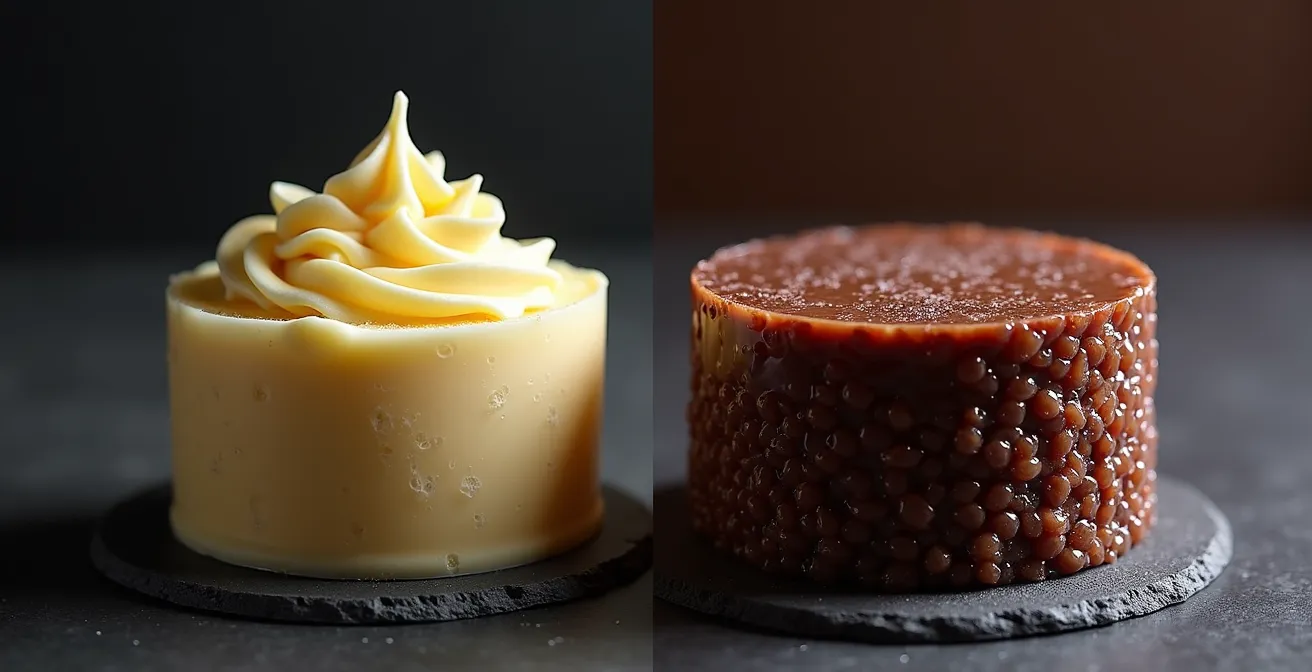
The choice between a whipped and a crystallized ganache is one of the most critical decisions affecting a macaron’s shelf life and stability, especially for shipping. While a whipped ganache offers a light, airy texture, it is structurally fragile and a poor choice for longevity. The process of whipping incorporates air, creating a loose foam structure. This structure does little to bind water; in fact, it exposes more surface area for moisture to escape. As pastry experts warn, whipped cream fillings with high moisture will deteriorate macaron shells in a very short time. To be stable at all, they require a stabilizer like gelatin to provide a structural backbone.
A crystallized ganache, on the other hand, is built for stability. This method involves creating a stable emulsion and allowing the cocoa butter to cool and form a tight, organized network of fat crystals. This crystalline matrix physically traps both water and fat droplets, significantly inhibiting moisture migration. The ganache is dense, smooth, and far more resilient to temperature fluctuations and physical stress, making it the superior choice for macarons that need to travel or have a longer shelf life.
The visual difference below illustrates this fundamental structural distinction. The whipped ganache is an aerated foam, while the crystallized version is a dense, stable matrix.
For a macaron destined for shipping, the crystallized ganache is unequivocally better. Its dense structure acts as a superior barrier against moisture loss, protecting the shell’s integrity. It’s less prone to weeping, separation, or textural breakdown during transit. While a whipped ganache might provide a delightful immediate eating experience, it is a liability for any product that won’t be consumed within a day or two. The crystallized method is the professional standard for creating a product that is both delicious and durable.
How to Insert a Fruit Gel Inside a Chocolate Macaron Filling?
Inserting a high-moisture fruit gel into a macaron without it turning the shell to mush is a masterclass in water activity management. The core principle is not to eliminate water, but to achieve an osmotic equilibrium between the gel, the surrounding ganache, and the shell. A pure fruit purée has a very high water activity (Aw), often above 0.95, making it a powerful moisture donor. Placing it directly in a macaron is a recipe for disaster. The solution is to adjust the Aw of the gel downwards and use the surrounding ganache as a hydrophobic barrier.
The first step is to formulate the fruit gel. This involves adding solutes—sugars that bind with free water molecules. Trehalose and glucose syrup are particularly effective for this without adding excessive sweetness. The goal is to lower the gel’s Aw to a more stable range. As a benchmark, chocolate technology experts recommend maintaining an Aw between 0.75 and 0.85 to achieve a shelf life of up to two months. This requires precise measurement with an Aw meter, a tool indispensable for professional pastry work.
Next, the ganache itself must be formulated to act as a barrier. Increasing the ratio of cocoa butter or another stable fat makes the ganache more hydrophobic (water-repellent), physically slowing down any residual moisture migration from the adjusted gel. This creates a “fat shield” around the moisture-sensitive core. The technique is to pipe a dam of this high-fat ganache, fill it with the Aw-adjusted gel, and then cap it to completely encapsulate the insert.
Action Plan: The Professional Water Activity Equalization Method
- Measure the water activity of your raw fruit gel using an Aw meter to establish a baseline.
- Adjust the gel’s Aw to the target range of 0.75-0.85 by incorporating solutes like trehalose or glucose syrup.
- Formulate the outer ganache with an increased cocoa butter ratio to create a strong hydrophobic barrier.
- Pipe a dam of the ganache, leaving a 2mm gap from the shell’s edge to prevent direct contact.
- Insert the cooled, Aw-adjusted gel center immediately, before the outer ganache dam fully sets.
- Cap the gel with an additional layer of ganache to completely seal the insert and isolate it from the top shell.
This methodical approach transforms the fruit gel from a liability into a stable, flavorful component, allowing for complex, multi-textured macarons that last.
The Freezing Mistake That Makes Macarons Weep Upon Thawing
Freezing is an excellent method for preserving macarons, but a single mistake during thawing can undo all your careful work: condensation. When a frozen macaron is exposed to warmer, humid air, moisture from the air rapidly condenses on its cold surface. This sudden influx of water is immediately absorbed by the low-Aw shell, turning it soft and sticky. The most common error is opening the storage container while the macarons are still cold.
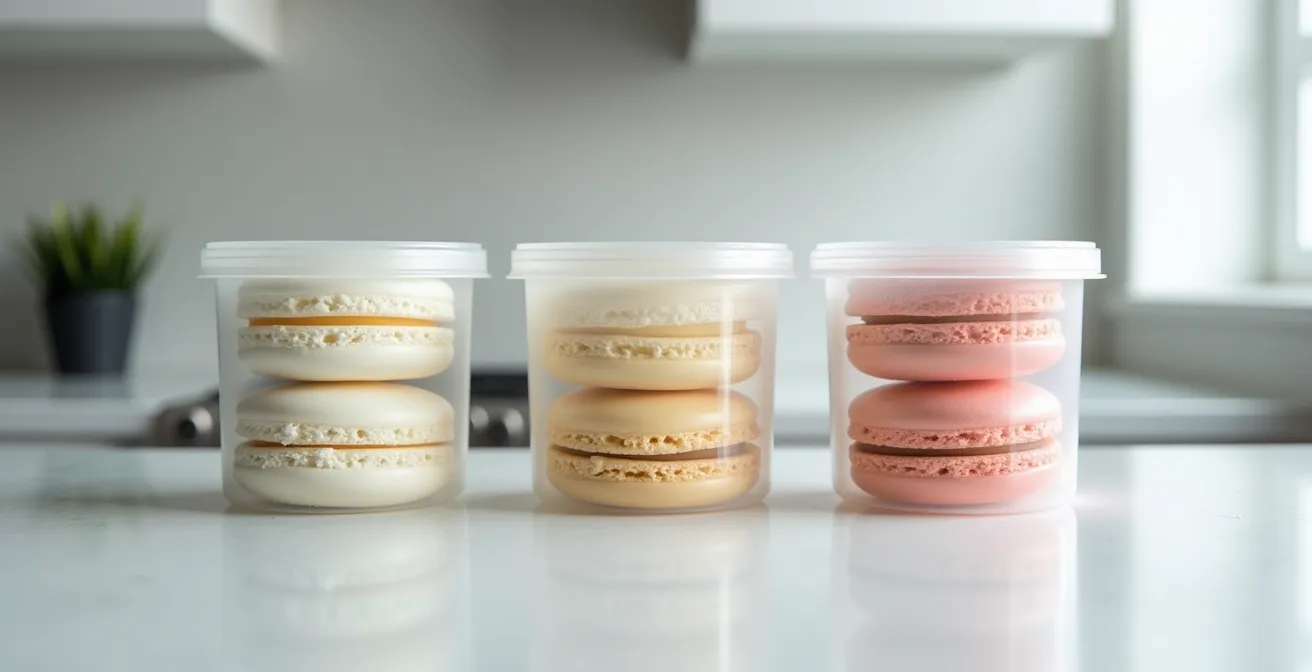
The correct thawing protocol is a non-negotiable process designed to prevent this very phenomenon. It’s a gradual temperature transition that allows the macarons to equalize with the ambient temperature while still protected inside their sealed container. This ensures that any condensation forms on the *outside* of the container, not on the macarons themselves. The process requires patience and discipline. Whether you are thawing empty shells or filled macarons, the container must remain sealed until they have reached full room temperature. Opening it prematurely, even for a quick peek, is enough to introduce damaging moisture.
The image below illustrates the ideal stages of a professional thawing protocol, emphasizing the transition from a frozen, frosted state to a perfect, room-temperature product, all while protected from external humidity.
For filled macarons, the process involves an additional “maturation” step. First, they should be matured in the refrigerator for 24 hours to allow the filling and shell to equilibrate. Only then should they be transferred to the freezer in an airtight container. To thaw, move the sealed container from the freezer to the refrigerator for several hours, and then from the refrigerator to the countertop. Do not open the container until it is no longer cool to the touch. This multi-stage process prevents thermal shock and ensures the texture you worked so hard to create remains perfectly intact.
Cocoa Shell vs. Plain Shell: Which Balances Intense Ganache?
The choice between a plain almond shell and a cocoa-infused shell goes beyond flavor; it has significant implications for moisture management, especially when paired with intense ganaches. Cocoa powder is hygroscopic, meaning it attracts and holds onto water molecules. This property gives chocolate macaron shells a distinct advantage in some scenarios and a disadvantage in others. When added to the batter, the cocoa powder’s proteins and starches help provide stability. As noted by the experts at Edible Times, the protein content in cocoa powder provides stability, making chocolate shells a high-success-rate option even for novices.
However, this hygroscopic nature means a cocoa shell will also absorb moisture from a filling more readily than a plain almond shell. It acts as a buffer, initially soaking up moisture and potentially preventing a ganache from feeling “wet.” But once its saturation point is reached, the shell itself becomes soft. A plain almond shell, having a lower initial absorption rate, tends to maintain its crispness for longer when faced with a high-moisture filling. It provides less of a buffer but offers a more distinct textural contrast over time.
The optimal pairing, therefore, depends on the nature of the ganache. An intense, high-cacao-percentage dark chocolate ganache, which is relatively low in free water, pairs beautifully with a plain shell. The shell’s crispness provides a clean textural break against the dense filling. Conversely, a milder milk chocolate ganache or a filling with slightly higher moisture might benefit from the buffering capacity of a cocoa shell, creating a more harmonious, chewy texture throughout.
The following table summarizes the key properties for moisture management:
| Shell Type | Moisture Absorption Rate | Texture Stability | Best Filling Match |
|---|---|---|---|
| Plain Almond | Lower initial absorption | Maintains crispness longer | Intense fruit or dark chocolate ganaches |
| Cocoa Shell | Higher due to cocoa’s hygroscopic nature | Buffers moisture but saturates faster | Mild milk chocolate or stabilized cream ganaches |
Ultimately, the shell is not a passive container but an active participant in the macaron’s final texture. Choosing the right shell is a strategic decision to balance the specific properties of your chosen filling.
How to Create a Ganache with a Shelf Life of 6 Weeks?
Achieving a six-week shelf life in a chocolate ganache without refrigeration is the pinnacle of moisture management. It requires moving beyond basic recipes and employing specific ingredients that actively control water activity (Aw). The primary enemy of shelf life is free water, which allows for microbial growth. The goal is to bind this water so tightly that it’s unavailable for spoilage. The most powerful tool for this is invert sugar.
Invert sugar (a mixture of glucose and fructose) has a higher osmotic pressure than sucrose (table sugar). This means it is much more effective at binding to water molecules, thereby reducing the ganache’s Aw. It also helps prevent the crystallization of other sugars, resulting in a smoother texture over time. According to formulation science, professional chocolatiers achieve extended shelf life by adding 5-8 grams of invert sugar per 100g of cream. This small addition is enough to lower the Aw to a level that inhibits the growth of most bacteria, yeasts, and molds, pushing the shelf life from a few weeks to several months under the right conditions.
Of course, ingredients are only part of the equation. Meticulous sanitation is paramount. All tools, containers, and surfaces must be scrupulously clean to prevent introducing contaminants. The ganache must also be prepared correctly to form a stable emulsion, ensuring the fat phase properly encapsulates the water phase. A well-made dark chocolate ganache naturally has an Aw around 0.86, which, with proper handling, can last up to three weeks. By incorporating invert sugar, you can drive this Aw down further, crossing the threshold required for long-term stability.
Achieving a 6-week shelf life is a deliberate act of food science. It involves a three-pronged approach: impeccable sanitation, a stable emulsion, and the strategic use of water-binding solutes like invert sugar. This transforms the ganache from a perishable fresh pastry component into a shelf-stable confectionery product.
How to Curate a Chocolate Box That Pleases Every Generation?
Curating a successful assorted chocolate or macaron box is an exercise in applied food science, where the order of consumption is as important as the flavors themselves. The key to ensuring a delightful experience from the first piece to the last lies in organizing the box based on the water activity (Aw) of each filling. High-Aw fillings, like fresh cream ganaches, are the most perishable and most likely to cause moisture migration. Low-Aw fillings, such as pralines or alcohol-based ganaches, are far more stable.
A professionally curated box is therefore a journey from high Aw to low Aw. The most delicate, “consume-first” items should be placed in a designated section, often at the front or with a visual cue. This prevents their potential degradation from affecting the rest of the box and ensures they are enjoyed at their peak. As the Callebaut Chocolate Academy explains, the difference in microbial risk between two ganaches with identical moisture content can be enormous if their Aw differs. In their words:
We looked at two ganaches with identical moisture contents. However, one had an Aw of .750, the other an Aw of .900. Note the significantly higher amount of microbial activity that could occur in the second ganache vs the first.
– Callebaut Chocolate Academy, Shelf Life: Introduction to Water Activity
This principle dictates a logical layout. The back rows should be reserved for the most stable pieces—the robust pralines, caramels, and high-proof ganaches that will taste just as good on day ten as on day one. The middle ground is for intermediate-Aw items like fruit-based ganaches. This strategy also pleases different generations: those who prefer fresh, classic flavors can enjoy the front pieces immediately, while those who savor confections over time can work their way to the back. Including a small insert card explaining this optimal tasting progression not only educates the consumer but also elevates the entire experience, transforming a simple box of chocolates into a guided tasting.
Key Takeaways
- Mastering water activity (Aw) is more critical than simply reducing moisture content to prevent soggy macaron shells.
- The structure of a ganache (crystallized for stability vs. whipped for lightness) dictates its suitability for shelf life and shipping.
- Strategic ingredients like gelatin and invert sugar are precision tools for controlling moisture migration and extending shelf life.
When is the Optimal “Best Before” Date for a Mixed Box?
Determining the “Best Before” date for a mixed box of macarons or chocolates is not a matter of guesswork; it’s dictated by the least stable item in the collection. The entire box is only as good as its most perishable piece. A single high-moisture, unstabilized ganache will define the shelf life for the whole assortment, even if it sits next to a praline that could last for months. Ignoring this principle leads to customer disappointment and damages brand reputation.
The primary factors influencing the shelf life of any given piece are its formulation (water activity) and its storage temperature. As we’ve seen, a ganache stabilized with invert sugar and proper technique can last for weeks, while a basic water ganache may only be safe for a day at room temperature. Temperature is a powerful accelerator of degradation. A cool storage environment can dramatically extend the life of even basic ganaches compared to room temperature.
The following table clearly demonstrates how shelf life plummets as storage temperature rises, and how a stabilized ganache consistently outperforms others.
| Storage Temperature | Basic Ganache | Stabilized Ganache | Water Ganache |
|---|---|---|---|
| Room Temp (20°C) | 2 days | 1 week | 24 hours |
| Cool Storage (15°C) | 1 week | 3 weeks | 3 days |
| Refrigerated (4-8°C) | 2 weeks | 6-8 weeks | 1 week |
Therefore, to set an accurate “Best Before” date, you must first identify the “weakest link” in your assortment—the filling with the highest water activity and lowest stability. The shelf life of that single item, under the recommended storage conditions, becomes the shelf life for the entire box. The only way to extend the box’s overall date is to either remove that item or reformulate it to lower its water activity, bringing it in line with the more stable pieces in the collection. This is the unyielding rule of confectionery assortment.
By shifting your focus from the simple concept of “moisture” to the precise science of “water activity,” you gain ultimate control over your creations. Start applying these principles today to formulate macarons and confections that deliver both exceptional flavor and reliable, long-lasting texture.