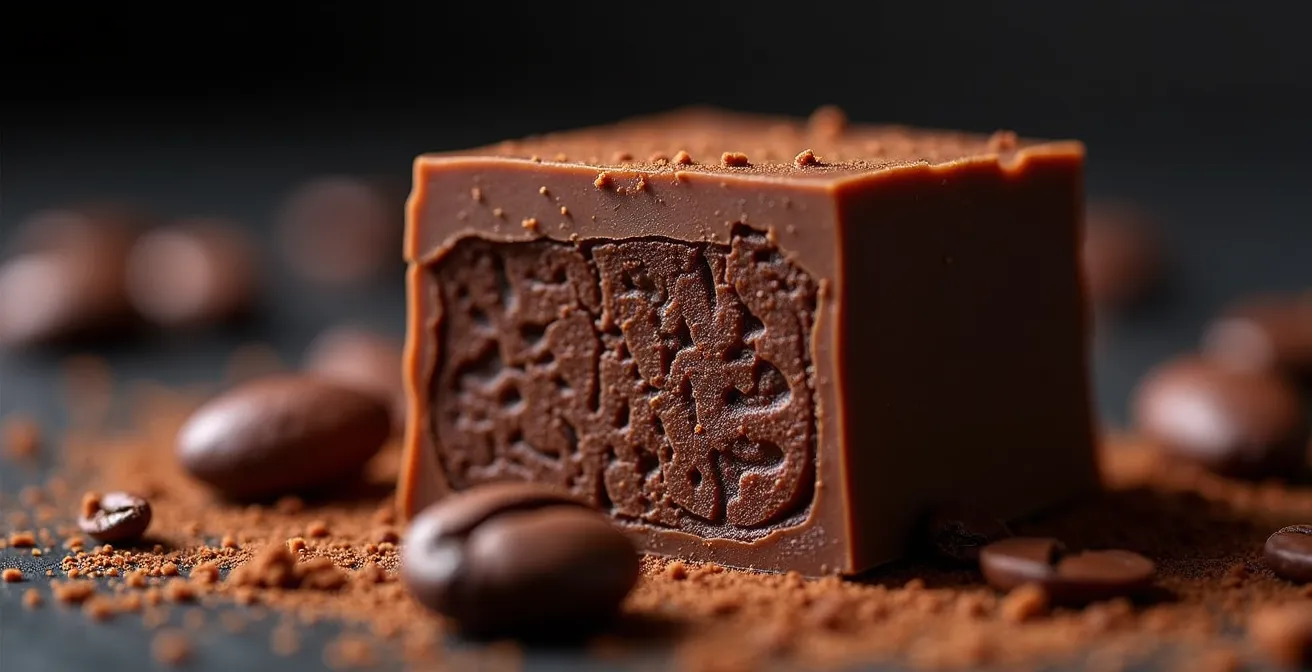
Contrary to popular belief, Forastero is not an inferior bean; its high cocoa-solid content provides an unmatched structural ‘backbone’ for professional pastry applications.
- Forastero’s robustness creates a dense particle network, resulting in ganaches that set firmer and cakes that are more stable.
- Strategic blending with “fine Forastero” varieties allows for significant cost reduction without sacrificing a powerful, deep chocolate flavor.
Recommendation: Shift your focus from avoiding Forastero to mastering it. Use it as a structural foundation to build reliable, intensely flavored, and profitable creations.
For any professional pastry chef, the quest for the perfect ganache is a familiar challenge. It must be luscious and flavorful, yet stable enough to withstand layering, transport, and temperature fluctuations. The conventional wisdom often points towards “fine flavor” beans like Criollo, celebrated for their delicate, aromatic notes. We are taught to associate quality with these rarer, more expensive varieties, while the workhorse bean, Forastero, is frequently dismissed as a one-dimensional, bitter component suitable only for mass-market confectionery.
This widespread perception, however, overlooks a critical technical advantage. What if the very characteristics that make Forastero seem less refined—its robustness, high cocoa solid content, and powerful flavor profile—are precisely the traits needed for superior structural performance? The real art of modern patisserie may not lie in exclusively using the most delicate beans, but in understanding the specific strengths of each variety. High-quality Forastero, when selected and used with expertise, is not a compromise; it is a strategic choice for building ganaches and baked goods with unparalleled stability and a deep, resonant chocolate foundation.
This guide dismantles the myths surrounding Forastero. We will explore the science behind its structural superiority, provide practical techniques for balancing its bold flavor, and reveal how to use it to engineer stronger, more reliable, and cost-effective chocolate creations. It’s time to see Forastero not as a lesser bean, but as an essential tool in the professional’s arsenal.
To fully explore this technical approach, we will break down the essential aspects of working with Forastero, from its core properties to its advanced applications in structural cake design. The following sections provide a complete roadmap for mastering this powerful chocolate variety.
Summary: Why High-Quality Forastero Is Essential for Structured Ganaches?
- Why Forastero Provides the Strongest Cocoa Backbone in Baking?
- How to Balance Forastero Bitterness with Sweet Fillings?
- Forastero vs. Criollo: Which One Handles High Heat Better?
- The Blending Mistake: Using 100% Forastero for Delicate Bonbons
- How to Blend Forastero to Reduce Costs Without Sacrificing Flavor?
- Which Cocoa Powder Type Creates the Darkest, Moistest Cakes?
- How to Build a 3-Tier Chocolate Cake That Survives Transport?
- Why Sponge Density Matters More Than Dowels for Stability?
Why Forastero Provides the Strongest Cocoa Backbone in Baking?
The structural integrity of a ganache or chocolate batter is not magic; it’s physics. It depends on the suspension of cocoa solids within cocoa butter and other liquids. This is where Forastero’s fundamental nature gives it a clear advantage. While it is often seen as the bulk ingredient, given that more than 80% of the world’s chocolate comes from the Forastero variety, its high percentage of cocoa solids is its greatest strength. These particles form a dense, intricate lattice that provides a robust physical structure—a true cocoa backbone.
This concept is best understood visually. The microscopic structure of a ganache reveals everything about its future stability. A Forastero-based emulsion creates a tighter, more interconnected network of solids compared to the more dispersed particles in a Criollo-based one.
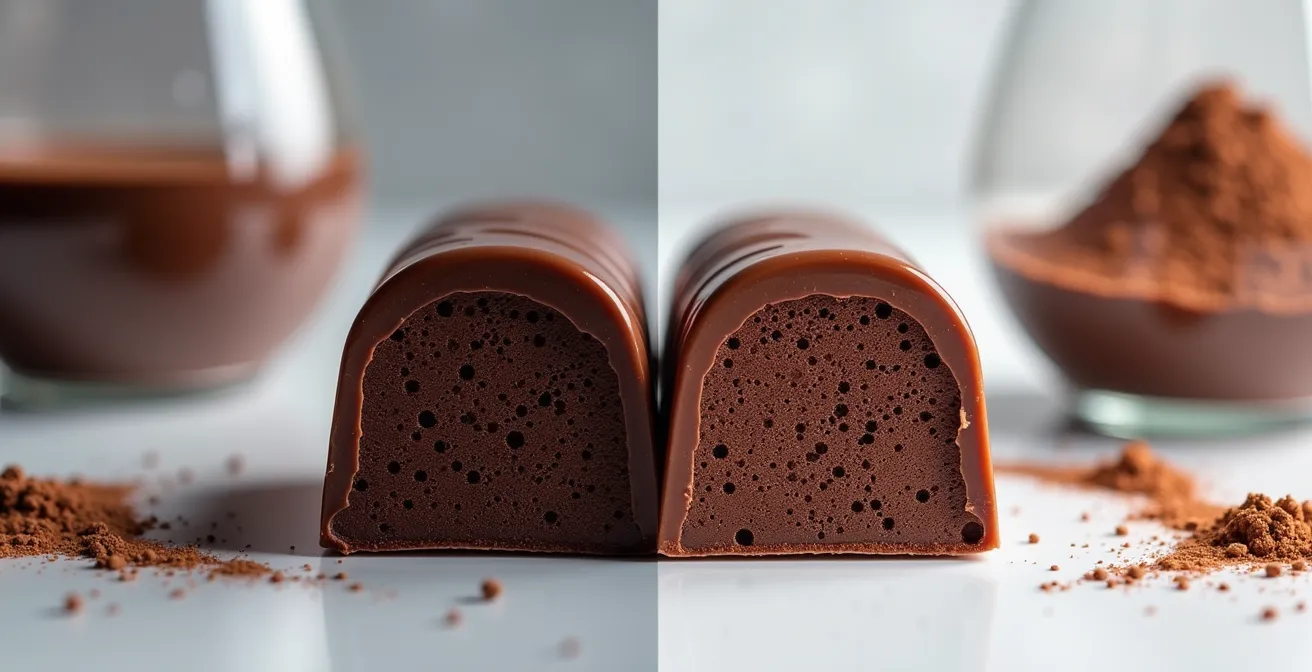
As this magnified comparison shows, the Forastero ganache (left) has a denser particle framework, which translates directly to a firmer set and greater stability. Furthermore, “Forastero” is not a monolith. Research has identified at least ten distinct genetic clusters, including unique types like Amelonado and Nacional. This diversity means that even within this category, there are “fine Forastero” beans with complex flavors that also deliver exceptional structural performance. The key is to move beyond generic labels and understand the specific properties of the chocolate you’re working with.
How to Balance Forastero Bitterness with Sweet Fillings?
The intense, often bitter flavor of Forastero is a primary reason some chefs avoid it. However, from a technical standpoint, this boldness is a feature, not a flaw. It provides a powerful chocolate foundation that can stand up to sweet or fatty ingredients without getting lost. As experts in the field note, its inherent power makes it an ideal starting point for a wide range of products.
Forastero’s robust flavor and bitterness make it a solid base for many types of chocolate, from bars to candies to hot drinks.
– Chocolats du Monde, Swiss chocolate expertise article
The secret is not to mask the bitterness with excessive sugar, but to balance and complement it. This involves using ingredients that interact with the palate in specific ways, either by enhancing perceived sweetness, binding with tannins, or creating flavor contrast. The following steps provide a professional framework for taming Forastero’s power while celebrating its depth.
Action Plan: Taming Forastero’s Power
- Select chocolate between 54-75% cocoa content for an optimal balance of structure and flavor complexity.
- Add a pinch of salt (approximately 1/8 teaspoon per cup of cream) to enhance sweetness perception without adding more sugar.
- Incorporate flavor-binding ingredients like praline paste or fruit purees that contain natural pectins to mellow the bitterness.
- Layer aromatics by adding vanilla extract or liqueurs only after the ganache has cooled to around 95°F (35°C) to preserve their delicate notes.
- Create contrast by using milk proteins (e.g., in a crème anglaise base or milk chocolate blend) to neutralize tannins on the palate.
Forastero vs. Criollo: Which One Handles High Heat Better?
In a professional kitchen, ingredients must be resilient. Chocolate is often subjected to high temperatures during processing, baking, and tempering. This is where the difference between Forastero and Criollo becomes starkly practical. Forastero’s hardiness is a defining trait, making it the preferred choice for large-scale industrial processes where consistency and durability are paramount. This is reflected in production figures, where 95% of cocoa produced globally in 2017 was bulk cocoa, primarily Forastero, chosen for its ability to withstand rigorous processing.
Forastero’s physical characteristics, from its thicker shell to its lower cocoa butter content, contribute to its superior heat and disease resistance. This robustness allows it to endure processes like high-temperature alkalization (Dutch-processing) that would strip a more delicate Criollo bean of its character. A direct comparison, based on an analysis of cocoa bean properties, highlights these differences clearly.
| Characteristic | Forastero | Criollo |
|---|---|---|
| Disease Resistance | High – robust and hardy | Low – susceptible to disease |
| Cocoa Butter Content | Slightly lower | Higher, more creamy |
| Shell Thickness | Thick shell | Thin, delicate shell |
| Processing Resilience | Withstands intense processing | Requires gentle handling |
| Fermentation Time | 5-7 days standard | Shorter, more delicate process |
Ultimately, Forastero’s ability to maintain its fundamental chocolate character through intense heat and mechanical stress makes it the more reliable choice for applications like baking and manufacturing. While Criollo excels in applications where its delicate aromatics can be preserved, Forastero excels in resilience, providing a dependable flavor and structural base under pressure.
The Blending Mistake: Using 100% Forastero for Delicate Bonbons
While Forastero’s power is an asset for structure, its unblended, full force can be a liability in delicate applications. A common mistake is to use a high-percentage, pure Forastero chocolate for the thin shell of a molded bonbon intended to house a nuanced filling like a fruit jelly or an herbal infusion. The aggressive, bitter notes of the Forastero can completely overwhelm the subtle flavors within, resulting in a one-dimensional experience.
This doesn’t mean Forastero has no place in high-end confectionery. The key is to use it strategically. As one expert source on chocolate making astutely observes, the analogy to coffee is fitting. It’s not about the bean type itself, but the quality of the source and the skill of the craftsman.
Forastero is akin in some ways to Robusta coffee beans… It can make some damn fine chocolate. You just have to search out a good source.
– Chocolate Alchemy, Professional chocolate making perspective
The professional solution is strategic blending. For a bonbon, a well-crafted blend might use 70% Forastero for the structural integrity and “snap” of the outer shell, combined with 30% Criollo or Trinitario to round out the flavor and add aromatic complexity. This approach leverages the best of both worlds: Forastero provides the reliable, robust framework, while the fine-flavor beans contribute the sophisticated top notes. Using 100% Forastero isn’t wrong, but it’s often a missed opportunity for creating a more complex and balanced flavor profile.
How to Blend Forastero to Reduce Costs Without Sacrificing Flavor?
In the professional pastry world, quality and cost must coexist. The reality is that fine-flavor beans are a scarce resource. According to industry data, Criollo makes up less than 1-5% of total world production, making it prohibitively expensive for many applications. This is where mastering the art of blending with Forastero becomes a crucial business skill, allowing for significant cost engineering without a noticeable drop in quality.
The secret lies in moving beyond the generic “Forastero” label and seeking out “fine Forastero” varieties. These are beans that, while genetically classified as Forastero, possess exceptionally complex and pleasant flavor profiles. As highlighted in an in-depth analysis of cocoa varieties, certain cultivars defy their broad classification. For example, Nacional beans from Ecuador, historically considered a Forastero type, are renowned for their floral aromas.
Professional chocolatiers leverage this diversity. They create exceptional blends by combining a base of good-quality, standard Forastero with a smaller percentage of these “fine Forastero” beans sourced from regions known for cacao diversity, such as the area where Colombia, Ecuador, Peru, and Brazil meet. This strategy achieves two goals: it keeps the overall cost manageable, and it introduces layers of flavor complexity that mimic a much more expensive blend. The result is a high-performance, cost-effective chocolate that delivers both a strong cocoa backbone and a nuanced taste.
Which Cocoa Powder Type Creates the Darkest, Moistest Cakes?
The answer is unequivocal: Dutch-processed cocoa powder. This type of powder has been treated with an alkalizing agent to neutralize its acidity. The process results in a cocoa powder that is significantly darker in color—from deep reddish-brown to nearly black—with a smoother, less bitter flavor. This dark color is what gives “devil’s food” and other chocolate cakes their signature rich appearance.
The connection to Forastero is direct and technical. The alkalization process is intense, and only robust beans can withstand it without losing all their character. Delicate beans would have their flavors obliterated. Forastero, with its inherent hardiness and high-solids content, is the ideal candidate for Dutch-processing. It retains a deep, fundamental chocolate flavor even after treatment. As noted in professional pastry analysis, this resilience is key.
Furthermore, the change in pH from Dutch-processing affects how the cocoa interacts with other ingredients, contributing to a moister crumb. Because it’s no longer acidic, it won’t react with baking soda to create leavening. Therefore, recipes using Dutch-processed cocoa typically rely on baking powder. The result is a cake with a tighter, fudgier crumb and better moisture retention. For the darkest color and moistest texture, a high-quality, Forastero-based Dutch-processed cocoa powder is the superior technical choice.
How to Build a 3-Tier Chocolate Cake That Survives Transport?
Transporting a tiered cake is the ultimate test of its structural integrity. Success depends less on hope and more on engineering. The “glue” holding the entire structure together is the ganache, which serves as a crumb coat, a filling, and a final frosting. Using the correct ganache ratio and consistency is non-negotiable for stability. A ganache that is too soft will cause the tiers to slide, while one that is too hard will crack.
The key is to use different consistencies for different jobs. A firm, high-ratio ganache is needed for the structural filling layers, while a smoother, more spreadable ganache is better for the final coat. A chocolate with a 60-75% cocoa content, typically derived from Forastero for its firmness, provides the best base for a structural ganache. The following guide outlines the precise ratios and temperatures for each application.
| Application | Ratio (Chocolate:Cream) | Consistency | Temperature |
|---|---|---|---|
| Structural Layer | 2:1 | Firm, moldable | Room temp |
| Crumb Coat | 1:1 | Spreadable | Slightly warm |
| Adhesive Layer (between tiers) | 1.5:1 | Thick glaze | 95°F (35°C) |
| Final Coating | 1:1 | Smooth, pipeable | Room temp |
To execute this, each tier should be filled and crumb-coated with a 1:1 ganache, then thoroughly chilled. The structural 2:1 ganache should be used as a dam to contain softer fillings. Once assembled with dowels and a central support rod, the entire cake should be refrigerated for a minimum of 4 hours to allow the ganache to set into a solid, stable structure before it is moved.
Key Takeaways
- Forastero’s high cocoa-solid content creates a superior “cocoa backbone,” providing unmatched structural stability in ganaches and baked goods.
- Strategic blending of commodity Forastero with “fine Forastero” strains is the professional’s key to balancing deep flavor with effective cost control.
- True structural integrity in cakes comes from internal sponge density, achieved by incorporating high-cocoa chocolate into the batter, rather than relying solely on external supports.
Why Sponge Density Matters More Than Dowels for Stability?
Dowels and cake boards are essential supports, but they are a corrective measure for an inherently weak structure. They prevent a heavy tier from crushing a soft one. However, the true secret to a profoundly stable tiered cake lies in the engineering of the sponge itself. A dense, tight-crumbed cake provides a solid foundation that requires less external reinforcement and is far less prone to compression or shifting during transport. Sponge density is proactive engineering; dowels are reactive support.
How do you increase sponge density? By increasing its specific gravity. Professional pastry chefs achieve this by incorporating high-cocoa-content chocolate directly into the cake batter. Using chocolate with over 75% cocoa solids, which has lower fluidity, adds solids and fat, creating a much denser, more robust crumb structure than a cake made with only cocoa powder. This technique essentially turns the sponge itself into a structural component.
When you build a tier, you can even incorporate a firm, refrigerated 1:1 ganache layer directly into the cake’s structure, which acts as internal reinforcement. This integrated approach, where the cake and ganache work together as a single structural unit, is far superior to simply stacking soft sponges on top of each other and hoping the dowels will hold. A cake built with a dense, chocolate-reinforced sponge is less susceptible to the vibrations and stresses of transport. It’s the difference between a building made of solid bricks versus one made of hollow blocks.
Start applying these principles of structural engineering to your pastry work today. By prioritizing sponge density and using high-quality Forastero for its cocoa backbone, you can build cakes and ganaches with uncompromising stability and profoundly deep flavor.