Many believe ‘low heat’ is the secret to great chocolate. The reality is far more precise: preserving flavor is about managing the vapor pressure of hundreds of volatile compounds. It’s not about temperature alone, but a delicate chemical equilibrium you must control from the bean’s fermentation all the way to the final melt on the palate. This guide deconstructs that science for you.
You’ve sourced exceptional beans. You’ve perfected your conching time. Yet, when you work with the finished chocolate, something vital disappears. The bright, fruity, or floral top notes that defined the single-origin character are gone, replaced by a flat, one-dimensional cocoa taste. You followed the standard advice—gentle heat, careful stirring—but the magic vanished. This is a frustration rooted not in technique, but in chemistry. The common wisdom to simply “avoid overheating” is a dangerous oversimplification. It fails to explain the true mechanism at play: the loss of Volatile Organic Compounds (VOCs).
These molecules are the very essence of aroma, and they are incredibly fragile. Your challenge as a chocolatier isn’t just to melt fat; it’s to act as a custodian for a delicate chemical ecosystem. Understanding this ecosystem means looking beyond the kitchen and into the laboratory. We need to explore the world of esters, aldehydes, Maillard reactions, and crystal polymorphism. This isn’t just about heat; it’s about vapor pressure, fat solubility, and the molecular journey that begins long before the chocolate reaches your workshop.
This article will not repeat the generic advice. Instead, it will equip you with the perspective of a flavor chemist. We will deconstruct the origins of these precious aromas, pinpoint the exact moments they are most at risk, and provide you with the scientific principles needed to protect them. You will learn not just *what* to do, but precisely *why* you are doing it, transforming your process from one of guesswork to one of intentional chemical control.
To navigate this complex world of flavor chemistry, we will explore the key scientific principles and practical applications in a structured way. This overview will guide you through the molecular journey of chocolate, from its aromatic building blocks to its final sensory expression.
Summary: The Molecular Science of Chocolate Aroma
- Esters and Aldehydes: What Makes Chocolate Smell Like Flowers?
- Why Fermentation Is the Most Critical Step for Flavor Development?
- How Does Roasting Temperature Define the Final Chocolate Note?
- How to Bake Chocolate Without Evaporating All Aromas?
- Fat-Washing: How to Trapping Cocoa Aroma in Cream?
- The Exposure Mistake: Leaving Chocolate Unwrapped for 1 Hour
- Why Blue Cheese and Chocolate Share the Same Aroma Compounds?
- Why Does Great Chocolate Linger on Your Palate for 20 Minutes?
Esters and Aldehydes: What Makes Chocolate Smell Like Flowers?
The rich, comforting smell we associate with chocolate is not a single entity. It is an intricate symphony of hundreds of individual molecules, each contributing a specific note to the overall bouquet. The fruity, floral, and bright top notes you’re losing are primarily driven by highly volatile compounds, specifically esters and aldehydes. Esters often contribute fruity scents (like isoamyl acetate, which smells of banana), while aldehydes can provide green, floral, or nutty notes. They are small, lightweight molecules that easily escape into the air, which is precisely why we can smell them.
The complexity is staggering. In fact, scientific analysis shows that chocolate’s aromatic profile is incredibly diverse. Detailed research has identified approximately 600 various compounds as odor-active components in cocoa and chocolate products. These are your flavor assets. However, their volatility is also their greatest vulnerability. Heat provides these molecules with the kinetic energy they need to break free from the chocolate mass and vaporize. A temperature increase of just a few degrees can exponentially increase the vapor pressure of these compounds, leading to their rapid and irreversible loss. Your mission, therefore, is to manage this molecular balancing act.
Understanding this concept is the first step toward mastery. You are not just melting a solid; you are managing a contained atmosphere of delicate chemical compounds. Every degree of heat, every minute of exposure, is a decision that either preserves or depletes this aromatic capital. The blandness you perceive is the ghost of these escaped esters and aldehydes.
Why Fermentation Is the Most Critical Step for Flavor Development?
The sophisticated esters and aldehydes we just discussed don’t magically appear in the cacao bean. They are the end products of a long and complex chemical journey, and that journey begins with fermentation. This stage is not merely about stopping the bean from germinating; it is the single most crucial step for creating aroma precursors. Without proper fermentation, even the best roasting and conching techniques will yield a flat, uninteresting chocolate. It’s like trying to bake a flavorful loaf of bread with flour that has no gluten-forming proteins.
During the 4 to 6 days of fermentation, a cascade of microbial activity takes place. Yeasts first consume the sweet pulp surrounding the beans, producing ethanol and creating an anaerobic environment. Then, lactic acid bacteria and finally acetic acid bacteria take over. This process generates significant heat, and it is a well-documented fact that during the fermentation process, temperatures can exceed 50°C. This heat and the changing pH kill the bean and break down cell walls, allowing enzymes to mix and begin their work. These enzymes break down proteins into amino acids and sugars into simpler forms—these are the fundamental building blocks, or precursors, for the Maillard reaction that will occur during roasting.
As the Food Science Research Team at IFT Food Technology Magazine explains, this step is non-negotiable for flavor. Without it, the necessary amino acids are not formed, and “key aroma compounds that contribute to chocolate flavor cannot be formed.” Therefore, when you source your beans, understanding the farmer’s fermentation protocol is as important as knowing the varietal. Under-fermented beans lack precursors, leading to a weak flavor profile. Over-fermented beans can develop off-flavors. The perfect fermentation is the foundation upon which all subsequent flavor is built.
How Does Roasting Temperature Define the Final Chocolate Note?
If fermentation builds the library of aroma precursors, roasting is the process that “reads” them and transforms them into the final aromatic compounds. This is where the magic of the Maillard reaction happens—a complex chemical dance between amino acids and sugars initiated by heat. This single reaction is responsible for the characteristic flavors of everything from seared steak to baked bread, and in our case, chocolate. However, the outcome is exquisitely sensitive to temperature. Your roasting profile is not just a matter of “doneness”; it is the primary tool for deciding which notes will dominate your final product.
The choice of temperature directly dictates the flavor profile. As explained in research from Ohio State University, there is a clear trade-off: lower temperatures maximize the floral and fruity notes, while higher temperatures create more caramel and coffee notes. Why? Because the volatile esters and aldehydes that produce those delicate fruity aromas are fragile. A high-temperature, aggressive roast will either destroy them or drive them off completely, favoring the creation of more robust, heavier pyrazines (nutty, roasted flavors) and caramels. A lower, slower roast gives the precursors for fruity notes the chance to form without being immediately vaporized.
This is the heart of your problem. If you are losing fruity notes, it’s highly probable that the roasting profile—either your own or that of your chocolate supplier—is too aggressive. It’s optimized for a classic “roasty” cocoa flavor at the expense of the delicate, volatile top notes. To preserve them, a profile that emphasizes a lower peak temperature for a longer duration is essential. This allows the Maillard reaction to proceed and develop complexity without scorching the very molecules you want to protect.
Your Action Plan: Auditing Your Process for Aroma Retention
- Precursor Quality: Contact your bean supplier. Ask for specifics on their fermentation and drying protocols. Are they aiming for full fermentation to maximize precursor development?
- Roasting Profile Review: If you roast in-house, analyze your temperature curves. Are you using high, short roasts? Experiment with lowering the peak temperature by 5-10°C and extending the time to compensate.
- Volatile Compound Capture: During conching and refining, are your machines open to the air? While some volatile acid blow-off is needed, excessive air exposure at elevated temperatures strips desirable aromas. Assess if you can reduce time or temperature.
- Working Temperature Log: Keep a precise log of the temperatures you use when melting, tempering, and holding chocolate. Are there spikes or prolonged periods above 45°C (113°F) that could be driving off top notes?
- Finished Product Storage: Audit your storage. Is the chocolate sealed in airtight containers, away from light and temperature fluctuations, immediately after production? Even a few hours of exposure can dull the flavor.
How to Bake Chocolate Without Evaporating All Aromas?
Once you have a beautifully aromatic chocolate, the challenge shifts to preserving it during application, especially in baking. An oven is a hostile environment for volatile compounds. The dry, circulating heat is designed to drive off moisture, but it will indiscriminately take your precious aromas with it. The key principle to understand here is, once again, vapor pressure. In a hot, dry oven, the partial pressure of aromatic compounds in the air is near zero. This creates a powerful chemical gradient that relentlessly pulls the volatile molecules out of your chocolate.
To counter this, you must think about controlling the atmosphere. The goal is to increase the partial pressure of both water and aroma compounds within the product and its immediate surroundings. One effective strategy is to introduce humidity. Placing a pan of water in the oven increases the ambient moisture, which can help to form a microscopic “blanket” over the surface of your baked goods, slowing the escape of other volatiles. Another strategy is to incorporate the chocolate into a batter or dough. The matrix of fat and flour acts as a physical barrier, trapping some of the aromas that would otherwise be lost from exposed chocolate chips or chunks.
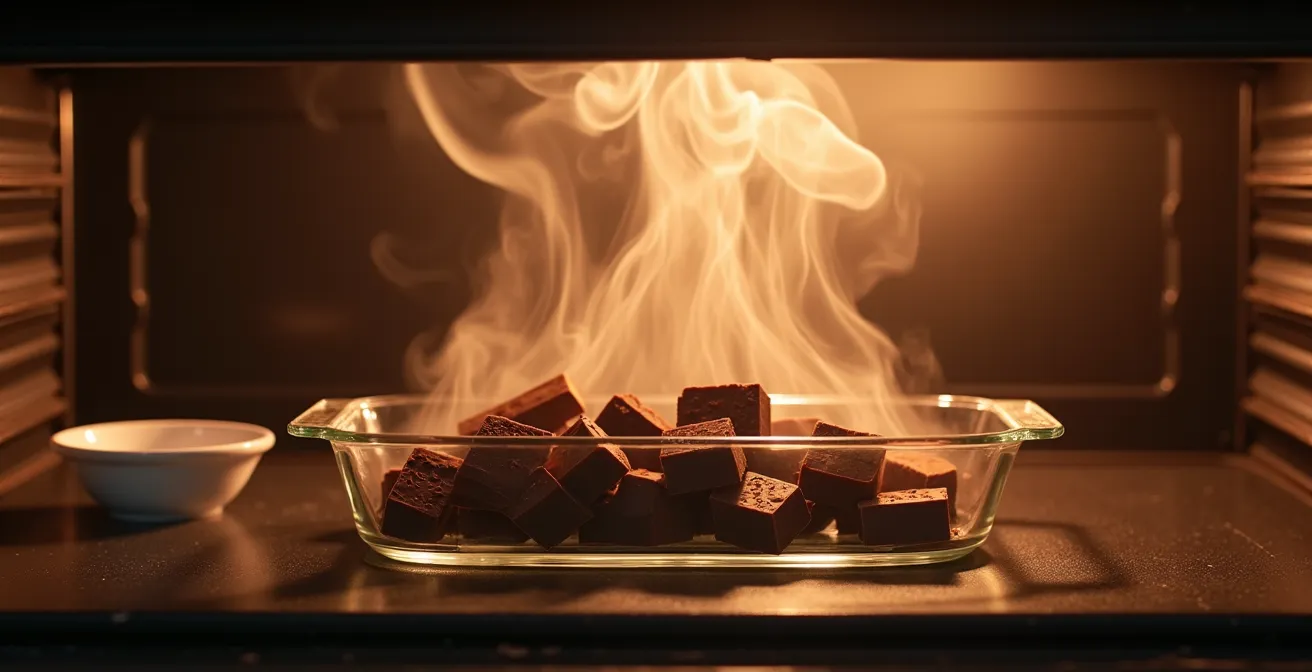
As the illustration suggests, the environment dictates the rate of loss. The greater the difference in vapor pressure between the chocolate and the oven’s air, the faster the aroma evaporates. Furthermore, consider the form of your chocolate. A large chunk has a lower surface-area-to-volume ratio than fine shavings, meaning fewer of its aromatic molecules are exposed to the heat at any given time. For applications where a molten pool is desired, adding the chocolate later in the baking process minimizes its total time exposed to high heat, giving the volatile compounds less opportunity to escape. It’s a strategic retreat to preserve your flavor capital.
Fat-Washing: How to Trapping Cocoa Aroma in Cream?
The challenge of aroma loss is also an opportunity to learn how to capture it. Fats are magnificent solvents for aroma molecules, a principle you can use to your advantage. Most of the key flavor compounds in chocolate are lipophilic, meaning they dissolve in fats and oils far more readily than in water. This is why the cocoa butter in chocolate is not just for texture; it’s the primary reservoir for its flavor. You can leverage this chemical affinity to infuse other fats, like cream or butter, with a deep, nuanced chocolate aroma—a technique often called “fat-washing.”
The process is chemically straightforward. By gently heating chocolate in a fat like heavy cream, you encourage the volatile esters and aldehydes to leave the solid cocoa mass. However, instead of escaping into the air, they are immediately trapped in the surrounding liquid fat. The fat acts as a chemical net. As the Institute of Food Technologists Magazine highlights, the flavor perception itself is tied to this process. In their research, they note that our ability to perceive flavor depends on the melting of cocoa butter, which frees the encapsulated aroma mass.
Milk and dark chocolate contain cocoa mass that is the source of key aroma compounds contributing to chocolate flavor. This mass is encapsulated as a suspension within solid cocoa butter, and our ability to perceive flavor depends on its melting which frees the mass.
– IFT Research Team, Institute of Food Technologists Magazine
In fat-washing, you are simply directing that “freeing” process into a different medium. After a period of infusion at a controlled, sub-boiling temperature, the mixture is chilled. The cocoa solids can then be strained out, leaving behind a cream that is profoundly infused with the chocolate’s most volatile and interesting notes, often with more complexity than if you had simply mixed in cocoa powder. This technique is a powerful way to deconstruct chocolate and transfer its aromatic soul into ganaches, ice creams, and mousses with stunning clarity and intensity.
The Exposure Mistake: Leaving Chocolate Unwrapped for 1 Hour
The preservation of flavor doesn’t end when the heat is turned off. One of the most common and underestimated mistakes is improper storage. Leaving high-quality chocolate unwrapped, even for a short period, is an open invitation for your most volatile aromatic compounds to depart. Air is the enemy of nuance. The same principles of vapor pressure that apply in a hot oven also apply at room temperature, albeit at a much slower rate. Over time, the constant diffusion of molecules from an area of high concentration (the chocolate) to low concentration (the air) will dull the chocolate’s profile.
Beyond simple evaporation, two other chemical processes are at work: oxidation and absorption. Exposure to oxygen in the air can cause the fats in cocoa butter to go rancid, creating stale, cardboard-like off-flavors. This process is accelerated by light, which is why opaque packaging is crucial. Furthermore, chocolate is hygroscopic and lipophilic, meaning it readily absorbs both moisture and foreign odors from the environment. A piece of chocolate left near coffee, spices, or even onions will act like a sponge, its own delicate bouquet contaminated by these stronger aromas. This is why proper packaging is non-negotiable for preserving quality.
The best practices for storage are all based on creating a barrier against these forces. As one study on the chemistry of chocolate highlights, packaging materials serve a critical function. Here are the key takeaways for professional storage:
- Barrier Materials: Use materials like waxed paper, aluminum foil, or multi-layer plastic films. These create a physical barrier to moisture and oxygen, and prevent the chocolate from absorbing external odors.
- Inert Atmosphere: For ultimate preservation, flushing the package with an inert gas like nitrogen before sealing (known as Modified Atmosphere Packaging) can drastically reduce oxidation by displacing oxygen.
- Light & Temperature Control: Store the sealed chocolate in a cool, dark place with a stable temperature, ideally between 15-18°C (60-65°F). Temperature fluctuations can cause sugar or fat bloom, which damages texture and can affect flavor release.
Protecting your finished product is as critical as any step in its creation.
Why Blue Cheese and Chocolate Share the Same Aroma Compounds?
To truly grasp the universality of flavor chemistry, it helps to look at an unexpected parallel: blue cheese. At first glance, pungent, savory Roquefort and rich, fruity chocolate seem worlds apart. Yet, from a molecular standpoint, they are cousins. Both derive a significant portion of their unique flavor profiles from the controlled metabolic processes of microorganisms. They are both products of fermentation, and they share specific classes of aroma compounds, particularly methyl ketones and secondary alcohols.
In blue cheese, the mold *Penicillium roqueforti* breaks down milk fats (lipolysis) to produce these compounds, which are responsible for the cheese’s characteristic sharp, “blue” flavor. In chocolate, a different set of microbes during fermentation also produces precursors that, after roasting, can yield similar molecules, contributing to the tangy, wine-like, or sometimes even cheesy notes found in certain single-origin chocolates. This is not a flaw; it’s a sign of complex fermentation. The shared chemistry explains why certain food pairings, like chocolate and cheese, can work so surprisingly well—their aromas resonate on a molecular level.
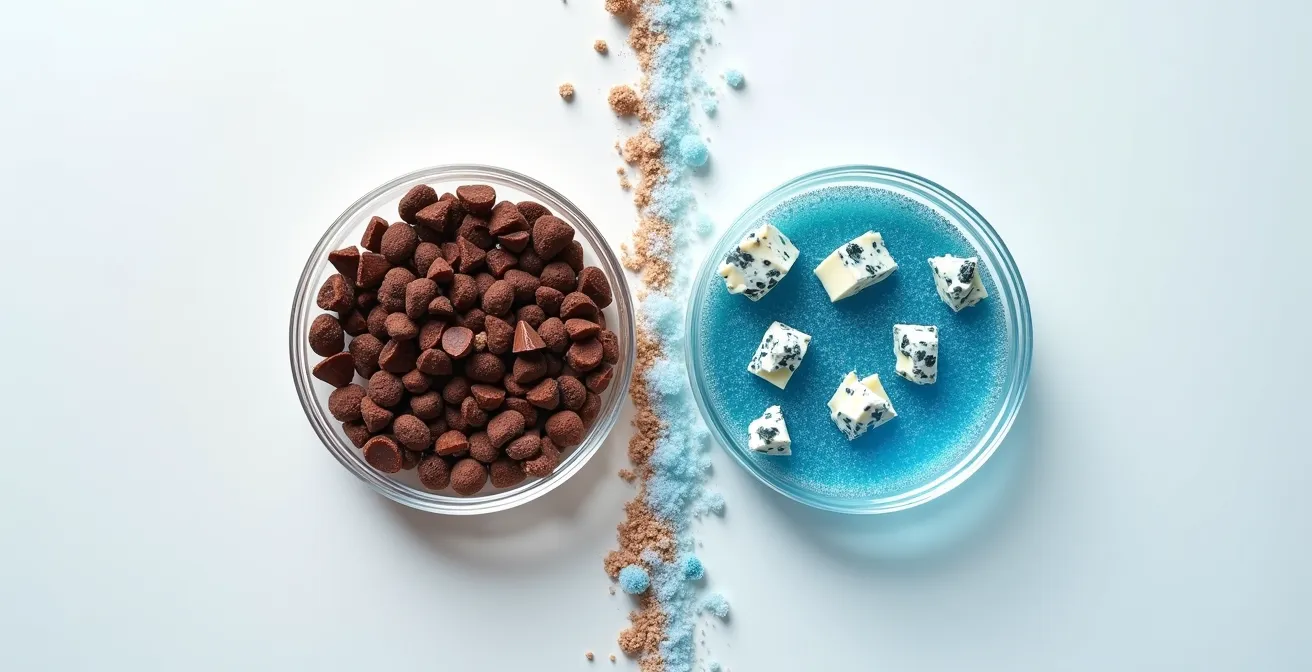
This surprising connection serves a vital purpose for a chocolatier. It reinforces the idea that flavor is not an abstract art but a tangible science based on a finite set of molecular building blocks. Seeing how the same family of compounds can be expressed so differently in cheese versus chocolate teaches you to identify and appreciate these notes in your own products. It trains your palate to move beyond simple “chocolatey” descriptions and into a more precise language of fruity, nutty, spicy, or even savory. This deepens your understanding and allows you to better articulate the unique qualities of your creations, connecting the microbial world of fermentation directly to the final sensory experience.
Key Takeaways
- Fruity and floral aromas are highly volatile esters and aldehydes that are easily destroyed by heat.
- Fermentation is the most critical step, as it creates the non-volatile “aroma precursors” necessary for flavor development during roasting.
- Roasting temperature is a trade-off: lower temperatures preserve delicate fruity notes, while higher temperatures create robust, roasty flavors.
Why Does Great Chocolate Linger on Your Palate for 20 Minutes?
The final dimension of flavor is time. A cheap, poorly made chocolate offers a fleeting burst of sugar and basic cocoa, then disappears. A truly great chocolate, however, unfolds in stages and leaves a pleasant, evolving finish that can last for many minutes. This lingering effect, known as the “length” or “finish,” is not a trick of the mind. It is the direct result of a physical and chemical process governed by the chocolate’s crystal structure, a concept known as polymorphism.
Cocoa butter can solidify into six different crystal forms, labeled I through VI. Each has a different melting point, density, and stability. Only one, Form V, is desirable. This is the goal of tempering. Form V crystals are stable, give chocolate its glossy shine and satisfying snap, and, most importantly, melt smoothly just below body temperature (around 33-34°C or 91-93°F). According to research published in Chemistry World, the ideal Form V crystals start to form just below 35°C, creating a very specific target for chocolatiers. This precise melting point is the key to a long finish. As a piece of well-tempered chocolate melts slowly and evenly in the mouth, it releases its fat-soluble flavor compounds gradually. It’s a controlled, time-release event.
In contrast, poorly tempered chocolate containing unstable crystals (like Form IV) melts too quickly, flooding the palate with a chaotic rush of flavor that vanishes just as fast. Or, it may contain overly stable Form VI crystals (which can form during bloom), which melt too slowly or incompletely, trapping the flavor instead of releasing it. As experts at MIT’s Laboratory for Chocolate Science explain, the quality of the melt directly controls flavor release. A slow, consistent melt from perfect Form V crystals allows the full spectrum of aromas—from the volatile top notes to the heavier base notes—to be perceived sequentially, creating the long, complex finish that is the hallmark of a superior product.
By embracing these chemical principles, you move from simply following recipes to designing flavor from a molecular level. You gain control over the aromatic destiny of your chocolate, ensuring that the remarkable complexity born in the bean survives all the way to the final, lingering taste. This is the transition from craftsman to true chocolate artist.