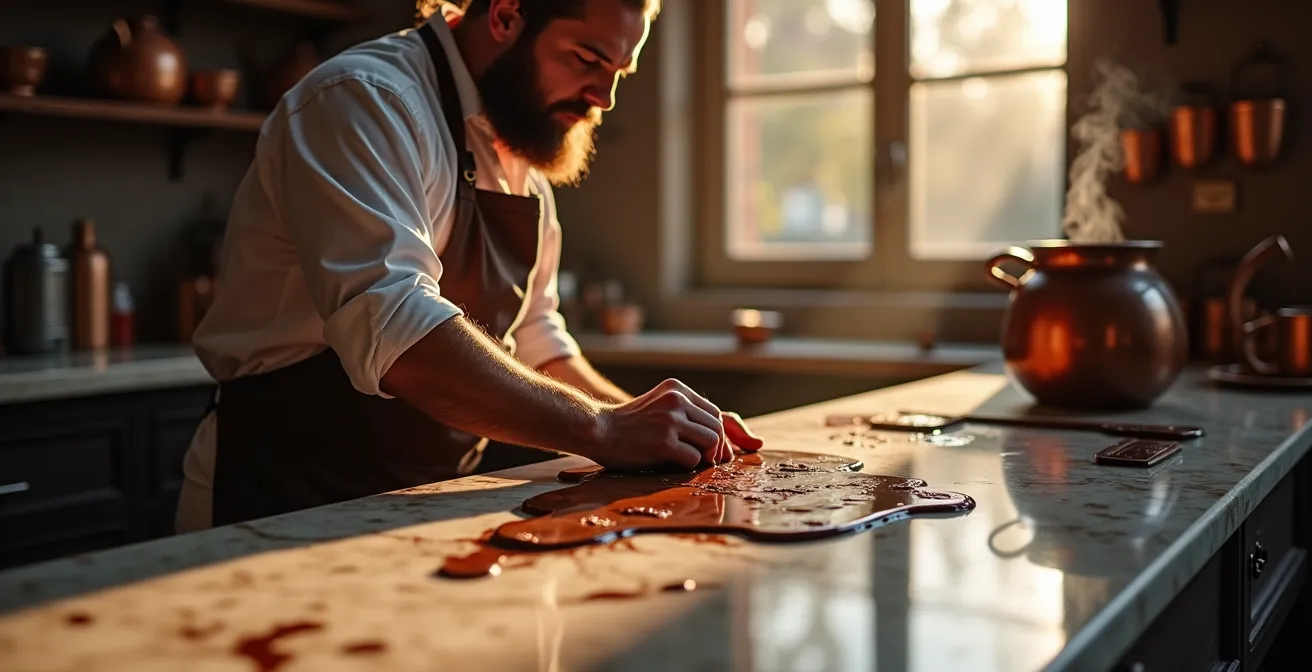
Contrary to the romantic notion that passion for chocolate is enough, becoming a true master is less about the art and more about the brutal transition from artist to entrepreneur. Success isn’t found in a perfect bonbon recipe, but in mastering business acumen, scalability, and strategic decision-making. This is the reality check every aspiring chocolatier needs.
The dream is seductive: a cozy workshop, the rich aroma of molten cacao, and the joy of crafting exquisite bonbons that delight customers. For many aspiring pâtissiers and career-changers, the path to becoming a chocolatier seems paved with passion and creativity. The internet is filled with advice to simply “follow your heart” and “perfect your technique.” While passion is the spark and technical skill is the foundation, they are dangerously incomplete parts of the picture.
The journey to mastery is littered with the failures of talented artisans who loved chocolate but couldn’t run a business. They mastered tempering but not inventory. They created beautiful ganaches but couldn’t manage cash flow or the crushing stress of holiday demand. The real challenge, the one that separates a hobbyist from a master, lies in a difficult transformation: the artisan-entrepreneur dichotomy. It’s about understanding that your most important creation isn’t a truffle, but a resilient and profitable business.
But what if the key wasn’t just about perfecting your craft, but about consciously building a business blueprint from day one? This guide moves beyond the romanticized vision to reveal the strategic crossroads you will face. We’ll dissect the common failure points, explore the mental and financial fortitude required, and outline the real-world choices that define a career, from managing production hell to deciding whether to ever open your own shop at all.
This article lays out the unvarnished truth about the modern chocolatier’s journey. It’s designed to be the mentor you need, offering a clear-eyed look at the challenges and the strategic thinking required to not just survive, but to build a lasting legacy in the world of fine chocolate.
Summary: The Modern Chocolatier’s Strategic Roadmap
- Why Self-Taught Chocolatiers Often Fail at Scalability?
- How to Manage the Stress of Holiday Production Runs?
- Belgian vs. French Style: Which Approach Dominates Modern Competitions?
- The Celebrity Chef Myth: Does Fame Equal Better Bonbons?
- When to Open Your Own Shop vs. Staying as a Head Chocolatier?
- How to Transition from Home Baker to Semi-Pro Chocolatier?
- Is Making Your Own Chocolate Actually Cheaper Than Buying It?
- Building Your Own Legacy: Beyond Fame and Fleeting Trends
Why Self-Taught Chocolatiers Often Fail at Scalability?
The initial success is intoxicating. Friends and family rave about your creations, a local market sells out your stock, and the orders start trickling in. This is where the first great filter appears: scalability. Many self-taught chocolatiers, brilliant in their home kitchens, hit a wall when trying to grow. They are artists, not systems engineers. Their methods rely on intuition and small-batch precision, which shatter under the pressure of increased demand. The global chocolate market is booming, with projections showing it could reach USD 74.14 Billion by 2034, but tapping into that growth requires more than just a good recipe.
The core issue is often a scalability blindspot. You can’t simply make ten times more chocolate by working ten times longer. Growth requires redesigned workflows, commercial-grade equipment, and a robust supply chain. This is where formal training often provides an edge. As noted by experts at Ecole Ducasse, becoming a chocolatier is a “combination of science and art,” and scaling up leans heavily on the science of consistency and efficiency. Without a plan, quality plummets, costs spiral, and the passion that started the journey is extinguished by burnout.
The solution lies in shifting from an artist’s mindset to an entrepreneur’s. This was the path taken by Welsh chocolatier Richard Holt, a former pastry chef who successfully expanded his operations. To meet growing demand, he didn’t just work harder; he secured funding from the Development Bank of Wales to upgrade machinery and build a new factory. This strategic move allowed him to scale production while maintaining quality and supporting local jobs. His story proves that scalability isn’t an obstacle to be feared, but a business problem to be solved with planning and investment.
How to Manage the Stress of Holiday Production Runs?
If scalability is the first filter, the holiday season is the trial by fire. For a chocolatier, the period from October to February, and the weeks leading up to Easter, are a whirlwind of relentless pressure. This is where the business makes a significant portion of its revenue, but it’s also where many unprepared chocolatiers break. The stress isn’t just about long hours; it’s a complex storm of supply chain issues, temporary staffing, tight deadlines, and the immense pressure to maintain flawless quality when producing thousands of items. In Germany, Europe’s largest chocolate market, chocolate sales volume picks up significantly during Christmas and Easter, a trend seen worldwide.
Surviving, and thriving, during these peaks requires a resilience blueprint built on ruthless organization. It’s about preparation, not improvisation. Successful chocolatiers plan their holiday production months in advance, finalizing menus, pre-ordering ingredients and packaging, and creating meticulous production schedules. They design workflows that minimize movement and maximize efficiency, turning their workshop into a model of organized chaos. It’s about having systems in place for everything, from tempering cycles to boxing and shipping, so that the team can operate on muscle memory when fatigue sets in.
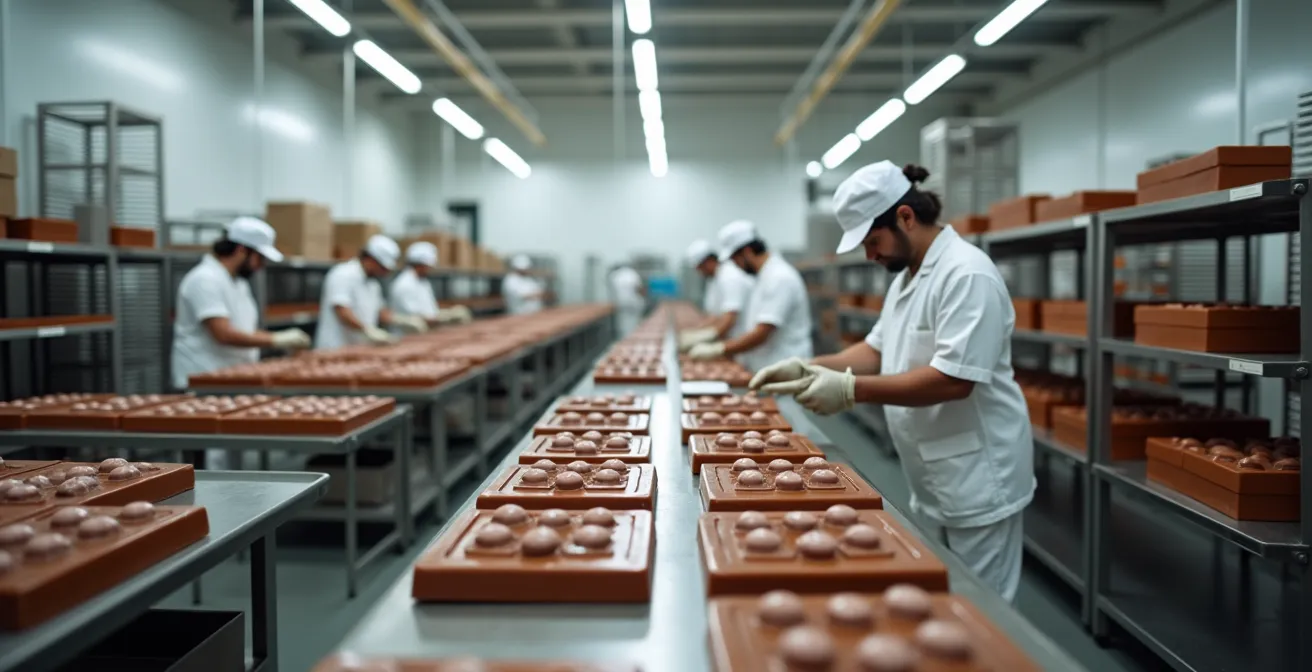
As the image above illustrates, a well-managed production facility during a holiday rush is a ballet of efficiency, not a scene of panic. Every station has a purpose, every worker knows their role, and the flow is logical and continuous. This level of organization doesn’t happen by accident. It is the direct result of strategic planning. Managing holiday stress is the ultimate test of your systems. Pass it, and you’ve proven you have what it takes to run a sustainable business, not just a creative hobby.
Belgian vs. French Style: Which Approach Dominates Modern Competitions?
As you hone your craft, you’ll inevitably encounter the great stylistic debate: the rich, shell-focused Belgian praline versus the subtle, ganache-centric French bonbon. The Belgian approach often emphasizes a thick, crisp chocolate shell with classic, sweet fillings like nougatine or caramel. The French style, in contrast, prioritizes the delicacy of the ganache, using thinner shells to showcase complex and often adventurous flavor infusions. Aspiring chocolatiers often wonder which path to follow, believing one might hold the key to success.
However, focusing on this binary choice is a strategic error. In the arena of modern chocolate-making, especially in high-stakes competitions, the dominant “style” is neither purely French nor Belgian. It is a hybrid philosophy of technical perfection. Judges at prestigious events are looking for flawless execution: perfect shine, a clean snap, an impeccably thin and even shell, and a ganache with a sublime texture and a well-balanced, clear flavor profile. Whether the inspiration is Belgian, French, or something entirely new is secondary to the mastery on display.
This is why, as Le Cordon Bleu Paris highlights, “Competitions such as the Meilleur Ouvrier de France (MOF) or the World Chocolate Masters can give a significant boost to a career.” These events are not about crowning a style, but about certifying a master. Just look at the career of Jacques Torres. Though he grew up in the South of France and holds the coveted MOF title, his success in America came from blending classic French technique with innovative, bold flavors suited to a new market. His career proves that mastery transcends rigid stylistic definitions; it’s about having the technical foundation to create your own signature.
The Celebrity Chef Myth: Does Fame Equal Better Bonbons?
In an age of social media and celebrity chefs, it’s easy to believe that fame is the ultimate goal. The chocolatier with a massive Instagram following or a Netflix special must be the best, right? This assumption creates a dangerous myth: that visibility and quality are the same thing. While a strong brand is essential, chasing fame for fame’s sake can be a fatal distraction from what truly matters—the chocolate itself. The premium chocolate market is growing, expected to hit USD 40.60 billion by 2030, but this growth is driven by discerning consumers who can taste the difference between marketing hype and genuine quality.
True, enduring fame in the chocolate world is almost always a byproduct of relentless dedication to the craft, not the cause of it. Take Jacques Torres again. As Chocolate Affairs Magazine notes, his brand remains a “symbol of authenticity, quality, and indulgence.” His celebrity status was built over decades of painstaking work, earning him the nickname “Mr. Chocolate” because of his uncompromising standards, not because of a clever marketing campaign. His fame is anchored in the undeniable quality of his bonbons.
The most powerful counter-argument to the celebrity myth comes from major brands themselves. In 2024, Mars Wrigley launched its premium Galaxy Jewels line in India, a massive and competitive market. Their strategy wasn’t built around a celebrity chef endorsement. Instead, they focused on product and packaging, creating a luxurious experience to capture the high-end gifting market. This proves that a brand can achieve a premium position based on the intrinsic qualities of its product, not the borrowed equity of a famous face. For an aspiring chocolatier, the lesson is clear: build your reputation on the quality of your work, and any fame that follows will be earned and sustainable.
When to Open Your Own Shop vs. Staying as a Head Chocolatier?
After years of training and honing your skills, you will face one of the most significant strategic crossroads of your career: do you take the leap and open your own shop, or do you build a career as a head chocolatier within an established organization? There is no single right answer, and the choice defines your professional life. Staying as a head chocolatier in a luxury hotel or a large pastry operation offers stability, a steady paycheck, and the ability to focus almost exclusively on the creative aspects of the craft without the headaches of payroll, rent, and marketing.
Opening your own shop, however, is the ultimate expression of the artisan-entrepreneur. It offers complete creative control and the potential for greater financial reward, but at the cost of immense risk and responsibility. You are no longer just a chocolatier; you are the CEO, the head of marketing, the janitor, and the chief financial officer. The decision hinges on a frank self-assessment: are you more passionate about creating chocolate or about building a business? Are you prepared to spend more time on spreadsheets and staff management than on tempering and decorating?
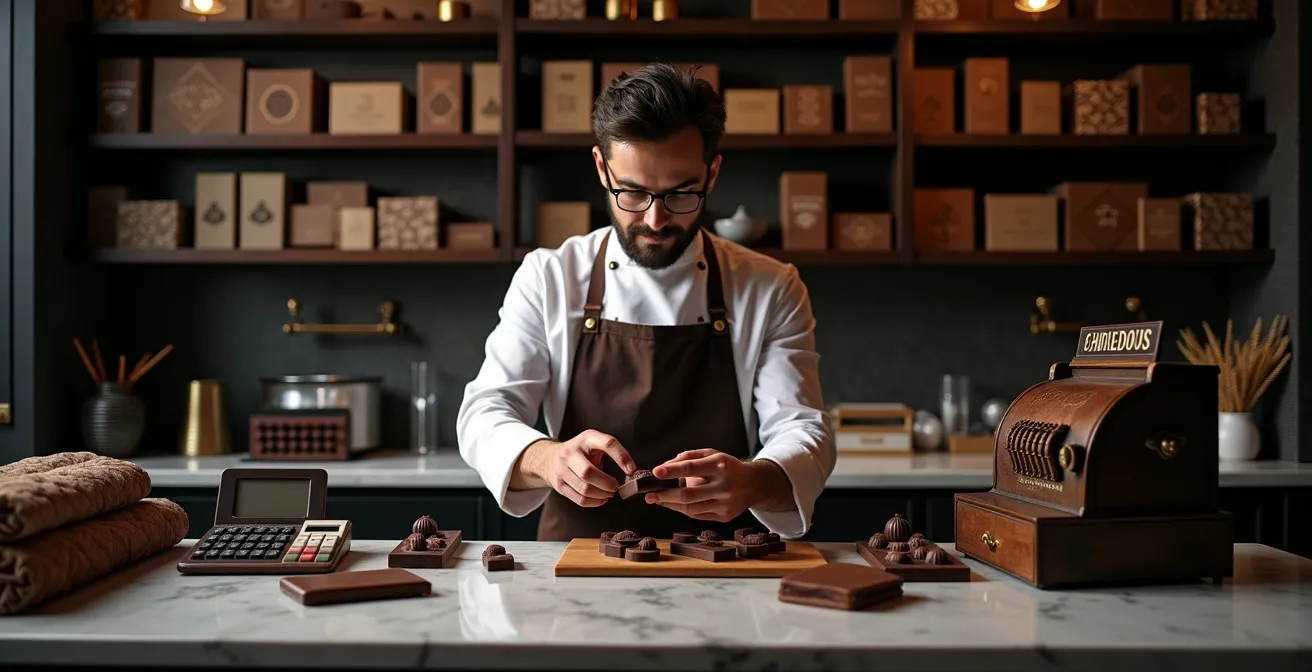
Furthermore, the modern market offers a third way. You don’t have to choose between a corporate job and a brick-and-mortar-storefront immediately. With the online retail channel projected to expand at approximately 6% annually, starting with an e-commerce business is an increasingly viable strategy. It allows you to build a brand, test your market, and generate cash flow with significantly lower overheads. This approach can be a stepping stone, allowing you to transition into entrepreneurship more gradually and make the decision to open a physical shop from a position of strength, not desperation.
How to Transition from Home Baker to Semi-Pro Chocolatier?
For the passionate home baker, the leap into the world of professional chocolate can feel daunting. The precision required for chocolate work is a significant step up from baking a cake. Where baking is forgiving, chocolate is a science. Tempering, in particular, is an unforgiving process that requires a deep understanding of temperature, agitation, and crystal structures. To make the transition, you must commit to a structured path of learning and practice. Passion alone won’t create the perfect shine or snap.
As experts from institutions like Ecole Ducasse advise, “The best way to learn all the required professional skills is to take courses at a recognized institution.” Self-teaching can get you started, but a formal environment accelerates learning, exposes you to professional standards, and provides access to equipment and mentorship that are otherwise unavailable. It’s about building a solid, technical foundation upon which you can later build your creative style. This isn’t just about recipes; it’s about learning the ‘why’ behind every technique.
Moving from amateur to semi-pro is a deliberate process. It requires transforming a hobby into a disciplined practice, documenting your progress, and seeking external validation for your skills. The following steps provide a clear roadmap for that journey.
Your Action Plan: From Kitchen Hobbyist to Pro
- Acquire Basic Education: Enroll in a culinary school or vocational program offering courses in pastry arts and, specifically, chocolate work to learn the fundamentals.
- Gain Real-World Experience: Seek internships or apprenticeships in respected bakeries, pastry shops, or chocolateries to learn tempering, molding, and decorating under real-world pressure.
- Attend Specialized Workshops: Deepen your expertise by taking advanced classes from renowned chocolatiers and culinary institutes on niche techniques like sugar work or airbrushing.
- Build a Professional Portfolio: Systematically photograph your best work. This visual resume should highlight your creativity, craftsmanship, and meticulous attention to detail.
- Obtain Professional Certification: Consider pursuing certifications from organizations like Retail Confectioners International to formally validate your skills and enhance your credibility.
Is Making Your Own Chocolate Actually Cheaper Than Buying It?
A seductive idea for any aspiring chocolatier is “bean-to-bar”—the process of making chocolate from scratch, starting with raw cacao beans. This approach offers ultimate control over flavor and a powerful marketing story. It also raises a critical question: is it more cost-effective? The short answer is a resounding no, at least not initially. The world of chocolate is divided between “chocolate makers” (who perform the bean-to-bar process) and “chocolatiers” (who use pre-made chocolate, or ‘couverture,’ to create their confections). Choosing to be a maker is a massive financial and operational commitment.
The upfront investment in bean-to-bar equipment is substantial. You need roasters, winnowers, grinders, conches, and tempering machines, which can easily run into tens of thousands of dollars. In contrast, a chocolatier using couverture has virtually zero initial equipment cost beyond standard kitchen tools. This financial reality is the primary reason why the vast majority of chocolatiers, including many of the world’s best, are not chocolate makers.
This cost analysis table, based on industry data, breaks down the financial implications. While the long-term per-kilogram cost of bean-to-bar can eventually become competitive, the initial capital outlay and the steep learning curve make it a high-risk path for a new entrepreneur. The key is to understand that ‘cheaper’ is not the right metric; the real question is about brand positioning. Bean-to-bar allows you to charge a significant premium, but you must have the business acumen to survive the first few years of high costs and lower margins.
| Cost Factor | Bean-to-Bar Production | Buying Premium Couverture |
|---|---|---|
| Initial Investment | $15,000-50,000 for equipment | $0 upfront costs |
| Per kg Cost (Year 1) | $45-60 including equipment amortization | $25-35 for premium quality |
| Per kg Cost (Year 3+) | $18-25 once equipment paid | $25-35 (stable) |
| Quality Control | 100% control over flavor profile | Limited to supplier options |
| Market Premium | Can charge 40-60% more for bean-to-bar | Standard market pricing |
Key Takeaways
- Master the Business, Not Just the Art: The most common point of failure is neglecting business skills. Success depends on becoming an entrepreneur as much as an artist.
- Systems Beat Stress: Surviving the critical holiday seasons requires meticulous planning and efficient systems, not just hard work. Organization is your most valuable tool.
- Quality Is Your Brand: Enduring success and fame are built on the foundation of exceptional, consistent quality, not on marketing hype or chasing celebrity status.
Building Your Own Legacy: Beyond Fame and Fleeting Trends
The path to becoming a master chocolatier in the modern era is complex. We’ve seen that it’s a journey fraught with challenges that have little to do with the chocolate itself—the pressures of scalability, the brutal stress of peak seasons, and the constant pull between artistry and commerce. It’s clear that technical skill, while essential, is merely the entry ticket. The real game is played at the strategic level, making deliberate choices about your business model, your brand positioning, and your own definition of success.
Do you pursue the technical perfection required for competitions? Do you build a personal brand or let the product speak for itself? Do you take the entrepreneurial leap or find fulfillment within a larger structure? These are the questions that will shape your legacy. The ultimate goal is not to imitate a famous chef or to blindly follow a trend, but to achieve what I call commercial artistry: the perfect alignment of your unique creative vision with a sustainable and profitable business model. Your legacy won’t be a single perfect bonbon, but the enduring brand you build around it.
The path is demanding, requiring resilience, business acumen, and an unwavering commitment to quality. It is a marathon, not a sprint. Your journey begins not when you perfect a recipe, but when you decide to build a business. Start today by developing not just your craft, but the entrepreneurial mindset that will sustain it.