The sensory experience of chocolate is not an art but a direct consequence of materials science. The specific polymorphic crystal form of cocoa butter—achieved through tempering—dictates the precise melting curve, structural integrity (snap), and resistance to fat bloom. Understanding the energetic landscape of triglyceride crystallization is the key to controlling mouthfeel and ensuring product stability from a molecular level.
For the food scientist or master chocolatier, the term “polymorphism” is not an abstract concept; it is the central principle governing the success or failure of a final product. While many understand the basic goal of tempering—to achieve a glossy finish and a satisfying “snap”—few truly grasp the underlying physics. The behavior of chocolate is fundamentally a story of fat crystallography. Cocoa butter, a complex mixture of triglycerides, can solidify into six distinct crystal patterns, or polymorphs, each with its own unique geometry, density, and, most critically, melting point.
The common approach focuses on simply following a tempering curve, but this overlooks the profound implications of the molecular arrangement. The difference between a waxy, crumbly texture and a silky, sharp-snapping bar lies in the efficiency of the crystal lattice packing. This article moves beyond the superficial “how-to” of tempering. We will deconstruct the thermodynamic and kinetic forces at play, examining why the desirable Form V is only kinetically stable, the mechanisms behind its inevitable degradation into fat bloom, and how its phase transition characteristics directly translate to the sensory perception of “mouthfeel”.
For those who prefer a visual summary, the following video offers a concise overview of the practical tempering process, which forms the basis of our crystallographic discussion.
This analysis will proceed logically, from the initial composition of the cocoa butter itself to the long-term stability challenges. We will explore the precise energetic requirements for crystal formation, the rheological impact of cocoa butter additions, and the material science that separates pure cocoa butter from its vegetable fat equivalents, providing a complete crystallographic perspective.
Summary: The Science of Cocoa Butter’s Crystalline States
- Deodorized vs. Natural Butter: Which Affects Viscosity More?
- Why Is Tempering Essential for Snap and Shelf Life?
- Why Overshooting by 1°C Destroys Your Beta Crystal Structure?
- Why Fat Bloom Reappears Even After Correct Tempering?
- How to Use Cocoa Butter to Thin Chocolate for Spraying?
- How to Calculate the Exact % of Butter to Add for Fountain Use?
- CBE vs. Pure Cocoa Butter: Can Consumers Taste the Vegetable Fat?
- When Does Cocoa Butter Go Rancid in a Professional Kitchen?
Deodorized vs. Natural Butter: Which Affects Viscosity More?
The initial composition of cocoa butter is the primary determinant of its subsequent crystallization behavior and rheology. The discussion of deodorized versus natural butter often centers on flavor, but from a crystallographic standpoint, the key difference lies in the triglyceride profile and the presence of minor components. Natural cocoa butter’s viscosity and crystallization kinetics are influenced by its inherent free fatty acids (FFAs) and phospholipids, which act as natural surfactants and can interfere with or assist in crystal nucleation. Deodorization, a steam-stripping process to remove volatile aromatic compounds, also reduces these FFAs.
The core of cocoa butter’s structure is its triglyceride composition. Detailed research shows cocoa butter’s triglyceride composition is dominated by symmetrical monounsaturated triglycerides: 23.2-29.3% SOS (1,3-distearoyl-2-oleoyl-glycerol), 34.2-38.6% POS (1-palmitoyl-2-oleoyl-3-stearoyl-glycerol), and 13.5-17.1% POP (1,3-dipalmitoyl-2-oleoyl-glycerol). While deodorization does not significantly alter this primary profile, it does strip away the minor components that influence intermolecular forces during cooling. Consequently, a highly refined, deodorized butter may exhibit slightly more predictable, albeit sharper, viscosity curves because fewer “impurities” are present to disrupt the lattice formation. Therefore, while both butters have similar foundational triglycerides, the natural butter’s minor components make its rheological behavior subtly more complex, which can impact final viscosity more than the deodorized version under certain processing conditions.
Why Is Tempering Essential for Snap and Shelf Life?
Tempering is a controlled thermal process designed to coerce the triglycerides in cocoa butter into a single, stable polymorphic form: Form V. Cocoa butter can crystallize into six distinct forms, each defined by a unique molecular packing arrangement and melting point. The lower forms (I-IV) are unstable, with loose, inefficient crystal lattices, resulting in a product that is soft, crumbly, and melts at too low a temperature. Tempering bypasses these unstable forms to selectively promote the nucleation and growth of Form V crystals.
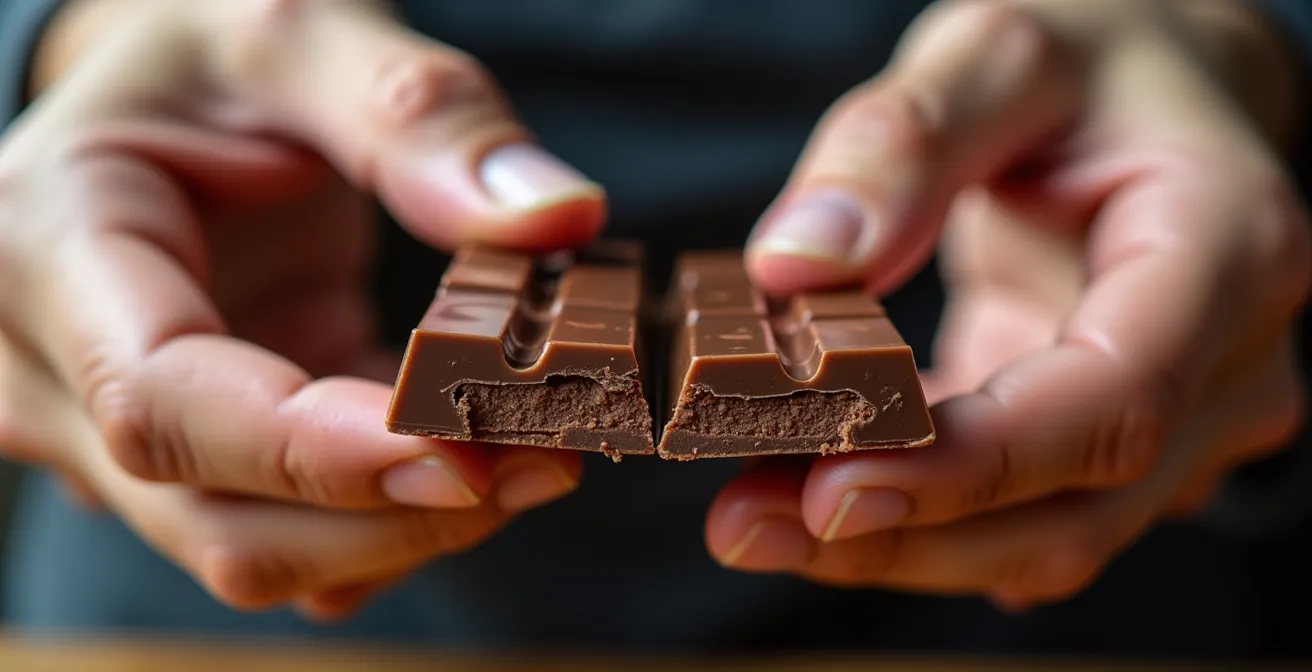
The “snap” of a well-tempered chocolate bar is a direct manifestation of its internal microstructure. Dr. Paul Dimick’s work in the material science of chocolate explains this phenomenon perfectly. Form V crystals are small, uniform, and pack together into a dense, highly ordered lattice. This rigid structure behaves like a brittle solid. When stress is applied, a crack propagates cleanly and rapidly through the ordered planes of the crystal lattice, producing a high-frequency sound we perceive as a sharp snap. In contrast, untempered chocolate, with its jumble of unstable crystal forms, behaves like a ductile material, bending and breaking with a dull thud. This dense packing also provides a superior barrier against moisture and oxygen, significantly enhancing shelf life by preventing both sugar bloom and lipid oxidation.
Why Overshooting by 1°C Destroys Your Beta Crystal Structure?
The stability of the Form V crystal lattice is exceptionally temperature-sensitive. While the working temperature for dark chocolate is often cited as 31-32°C, the actual melting point of pure Form V crystals is far more precise. Scientific measurements confirm that Form V crystals melt precisely at 33.8°C. Overshooting the working temperature, even to 34°C or 35°C, is not a minor error; it is a catastrophic event at the molecular level.
This is not a gradual melting process. The thermal energy introduced by that single extra degree is sufficient to overcome the intermolecular forces holding the entire triglyceride lattice together. It triggers a rapid, cascading failure of the crystal structure. As the seminal research by Wille & Lutton in the Journal of the American Oil Chemists’ Society describes it:
Overshooting to 35°C doesn’t just melt some crystals, it provides enough thermal energy to trigger a catastrophic collapse of the entire Form V lattice structure.
– Wille & Lutton, Journal of the American Oil Chemists’ Society
Once this collapse occurs, the cocoa butter reverts to a liquid state devoid of the necessary seed crystals. When the chocolate then cools, it will re-crystallize in an uncontrolled manner, forming a chaotic mix of unstable polymorphs (Forms I-IV). The result is a complete loss of temper, leading to a dull appearance, a soft texture, and a high susceptibility to fat bloom. The margin for error is therefore not a matter of degrees, but a single, critical thermodynamic threshold.
Why Fat Bloom Reappears Even After Correct Tempering?
The reappearance of fat bloom on a perfectly tempered chocolate bar is a source of immense frustration, but it is an thermodynamically inevitable process. The core of the issue lies in the distinction between kinetic and thermodynamic stability. Form V, the target of tempering, is only kinetically stable. This means it is the most stable and easily formed crystal structure under specific tempering conditions. However, it is not the most energetically stable form possible. That distinction belongs to Form VI, the true thermodynamic ground state.
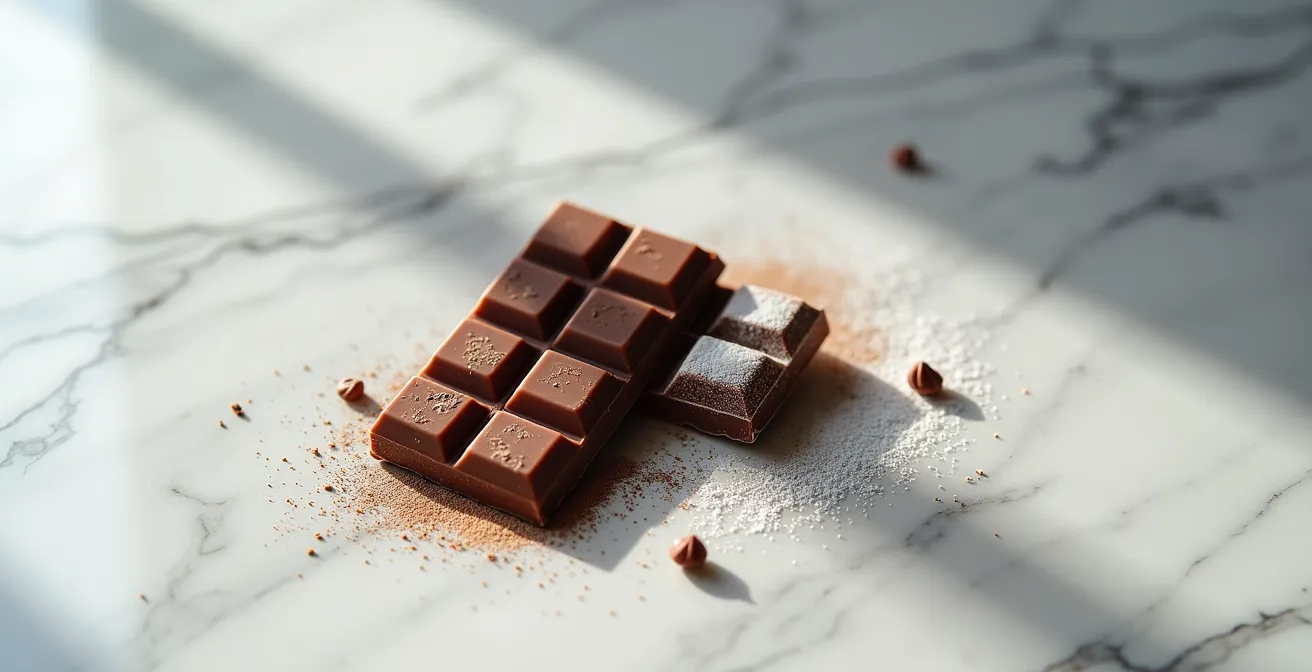
Over time, the triglycerides within the solid Form V lattice have enough molecular mobility to slowly rearrange themselves into the more compact, lower-energy Form VI configuration. This phase transition is the root cause of fat bloom. As Form VI crystals grow, they migrate to the surface, creating a dusty, grayish-white layer. The process is slow but relentless, and as noted in a leading analysis of chocolate chemistry, Form V is only a temporary state:
Form V is only ‘kinetically stable’ (the easiest to form under specific conditions), not ‘thermodynamically stable.’ The ultimate stable state is Form VI.
– Research published in Compound Interest, The Polymorphs of Chocolate analysis
Temperature fluctuations dramatically accelerate this transition. Storing chocolate in an environment with cycling temperatures provides the thermal energy needed for the molecules to overcome activation barriers and reorganize more quickly. Even under ideal conditions, studies indicate Form VI develops after about four months at a stable room temperature. Therefore, fat bloom is not necessarily a sign of poor tempering, but rather the visible evidence of a fundamental, unavoidable phase transition to a more stable energetic state.
How to Use Cocoa Butter to Thin Chocolate for Spraying?
Reducing the viscosity of chocolate for applications like spraying or enrobing is a common requirement, and adding cocoa butter is the standard method. From a rheological perspective, this process is about decreasing the volume fraction of solid particles (cocoa solids, sugar) within the liquid fat phase. Adding more liquid cocoa butter increases the lubrication between particles, allowing them to move past each other more freely, thus lowering the overall viscosity.
For a successful spray application, the viscosity must be sufficiently low to allow for proper atomization. While standard tempered chocolate has a viscosity of around 30-35 Pa·s, targets for a spray gun are much lower. In general, for spray gun application, viscosity must be below 25 Pa·s. To achieve this, melted and tempered cocoa butter is added to already tempered chocolate. The key is to ensure the added butter is itself in a tempered state (ideally containing Form V seed crystals) and at the correct working temperature to avoid shocking the existing crystal structure. Typically, additions of 10-20% cocoa butter by weight are used, but the exact amount depends on the chocolate’s initial fat content and the desired final fluidity.
Interestingly, cutting-edge research explores alternatives to simply adding more fat. For example, a 2021 study in Nature Communications demonstrated that the addition of specific phospholipids at a mere 0.1% level can act as a powerful crystallization accelerator. These molecules help template the formation of Form V crystals, achieving a stable structure rapidly without significantly altering the fat content. This points to a future where rheology can be controlled with molecular precision, not just bulk additions.
How to Calculate the Exact % of Butter to Add for Fountain Use?
Calculating the precise amount of cocoa butter for a chocolate fountain is a practical application of rheology. The goal is to achieve a continuous, flowing curtain of chocolate, which requires a specific viscosity range. If the chocolate is too thick, it will not flow properly; if it is too thin, it will be translucent and lack richness. Fountains operate at an elevated temperature (around 45°C) to keep the chocolate fluid, which is well above the melting point of Form V crystals, meaning the chocolate in a fountain is not in temper. For this application, professional chocolatiers target a viscosity of 40-60 Pa·s at 45°C.
To calculate the required addition, you must know the initial viscosity of your chocolate or, more practically, its fat content. A common rule of thumb is to add cocoa butter as 10-15% of the total chocolate weight. For a more precise method, you would use a rheometer to measure the chocolate’s viscosity as you add butter in small increments until the target is reached. However, in a professional kitchen, an iterative approach works best: start by adding 8% cocoa butter by weight, mix thoroughly, and observe the flow. Continue adding 1-2% at a time until the desired sheeting action is achieved. It is crucial to use a high-quality cocoa butter, as its own properties will affect the final mixture. The table below outlines the critical melting and working temperatures for different chocolate types when tempering, which provides context for the thermal environment of a fountain.
| Chocolate Type | Melting Temp | Cooling Temp | Working Temp |
|---|---|---|---|
| Dark | 45-50°C | 27°C | 31-32°C |
| Milk | 45°C | 27°C | 30-31°C |
| White | 40-45°C | 26°C | 29-30°C |
This table, based on guidelines from authoritative sources like the Ecole Chocolat, highlights that fountain operating temperatures are near the initial melting points, ensuring complete liquidity.
CBE vs. Pure Cocoa Butter: Can Consumers Taste the Vegetable Fat?
The ability of consumers to distinguish between pure cocoa butter and chocolate made with Cocoa Butter Equivalents (CBEs) is rooted in the physics of phase transitions. Pure cocoa butter, when properly tempered into Form V, has an exceptionally sharp melting profile. Its crystal lattice remains solid and firm up to a certain point, then rapidly collapses. This is because Form V cocoa butter melts sharply at 32-35°C, which is just below human body temperature (37°C). When a piece of chocolate is placed in the mouth, this rapid phase transition from solid to liquid creates a significant endothermic reaction, absorbing heat from the tongue. This absorption of heat is what the brain perceives as a pleasant, cooling, and creamy sensation.
CBEs, which are vegetable fats (often from palm oil or shea butter) blended to mimic the triglyceride composition of cocoa butter, do not replicate this melting behavior perfectly. They tend to have a broader, multi-stage melting range and often a slightly higher melting point. This slower, less defined transition lacks the distinctive cooling effect of pure cocoa butter. As a material science analysis in an American Chemical Society journal explains:
The brain interprets the rapid phase transition of cocoa butter as ‘creamy and cooling’, while the slower, multi-stage melt of a CBE is perceived as ‘waxy’ or ‘greasy’.
– Material science analysis, Chocolate polymorphism and sensory perception study
Therefore, even if the flavor is identical, the textural and thermal experience is not. The sensory difference is not a matter of taste but of thermodynamics. A trained palate, and even many average consumers, can detect this difference in mouthfeel, perceiving the CBE-containing product as having a waxy residue or a less clean finish, because some of its fat components remain solid at body temperature.
Key Takeaways
- Polymorphism is the central principle governing chocolate’s texture, snap, and stability; it is a matter of physics, not just process.
- The desirable Form V crystal is only kinetically stable, making the transition to the thermodynamically stable Form VI (fat bloom) inevitable over time.
- The sensory quality of chocolate is directly tied to the sharp phase transition (melting) of Form V crystals just below body temperature, a property that vegetable fat equivalents cannot perfectly replicate.
When Does Cocoa Butter Go Rancid in a Professional Kitchen?
The shelf life of cocoa butter is not only limited by the physical process of fat bloom but also by the chemical process of oxidative rancidity. This occurs when the unsaturated fatty acids in the triglycerides—primarily oleic acid—react with oxygen. This reaction breaks down the fat molecules, producing volatile aldehydes and ketones that create undesirable “off” flavors and aromas, often described as stale, painty, or cardboard-like. While cocoa butter is relatively stable due to its high content of saturated fatty acids and natural antioxidants (tocopherols), rancidity is a significant risk in a professional kitchen environment where it is exposed to several accelerating factors.
The primary catalysts for oxidation are heat, light, and exposure to oxygen and certain metals. Storing cocoa butter near a heat source like an oven or repeatedly melting and cooling it (heat cycling) provides the activation energy needed for oxidative reactions to begin. It is a critical rule that solid cocoa butter should never exceed 122°F (50°C) during melting or storage to minimize thermal degradation. Exposure to UV light, whether from sunlight or fluorescent fixtures, also powerfully catalyzes oxidation. Finally, contact with metals like copper or iron can initiate the reaction, making the choice of storage containers and equipment important.
Action Plan: Auditing Oxidation Risks for Cocoa Butter
- Light Exposure: Audit storage areas. Is the cocoa butter stored in opaque, airtight containers away from direct sunlight or harsh fluorescent lighting?
- Oxygen Contact: Review inventory practices. Are partial blocks of cocoa butter properly re-sealed? Prioritize using opened stock first as exposed surfaces oxidize faster.
- Heat Cycling: Check storage locations. Is the butter stored in a cool, dark, and temperature-stable area (ideally 12-20°C), away from ovens, proofers, or hot water lines?
- Metal Contamination: Inspect equipment. Are you using non-reactive containers and utensils, such as stainless steel or food-grade plastic, instead of copper or iron?
- Surface Area: Manage form factors. Use solid blocks for long-term storage and shavings or wafers for immediate use only, as their high surface area accelerates oxidation.
Mastering cocoa butter polymorphism transforms chocolate-making from a craft into a science. By understanding and controlling the crystallographic behavior of fat, you gain precise command over the final product’s texture, stability, and sensory profile, ensuring consistent excellence.