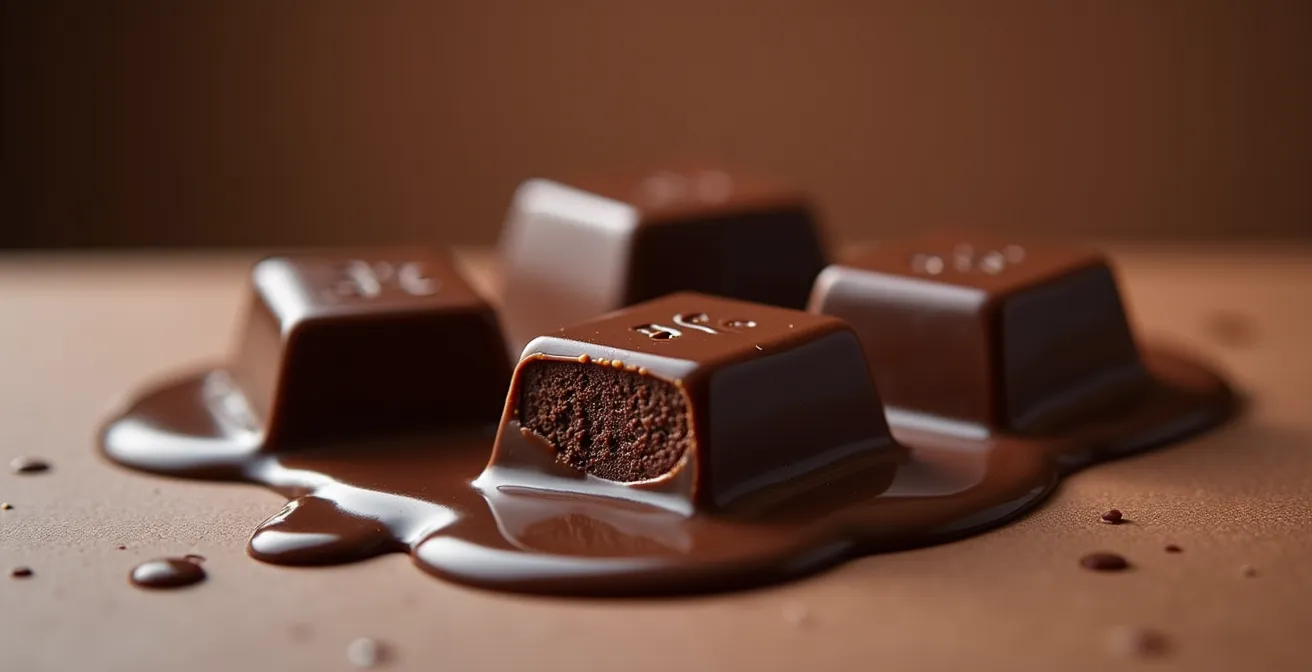
The long, complex finish of a fine chocolate is not a sign of vague “quality,” but a predictable, time-released cascade of chemical and physiological events.
- Flavor is physically trapped in cocoa butter and is only released as it melts at body temperature, creating a sequence of unfolding aromas.
- The most profound notes are detected not by the tongue, but through “retro-nasal olfaction”—the act of exhaling through the nose after swallowing.
Recommendation: To experience the full depth, you must slow down your tasting process to a deliberate, multi-minute ritual, allowing both heat and breath to unlock the chocolate’s hidden layers.
There is a profound difference between eating chocolate and truly tasting it. The former is a fleeting moment of sweetness; the latter can be a sensory narrative that lasts for twenty minutes. Many of us have experienced this phenomenon: a square of mass-market chocolate vanishes from memory as soon as it’s swallowed, while a single piece of artisanal chocolate leaves a ghost of flavor—a whisper of leather, a hint of cherry, a trail of smoke—that evolves and lingers long after. This enduring finish is the hallmark of greatness in the chocolate world.
Conventional wisdom often attributes this persistence to simple factors like a high cocoa percentage or the “quality” of the beans. While not entirely wrong, these explanations are incomplete. They are the chapter titles, not the story itself. They fail to explain the mechanics of the experience—why certain notes only appear seconds after the chocolate has melted, or why chewing a fine chocolate can paradoxically erase its complexity. The truth is far more intricate and fascinating, residing at the intersection of chemistry, physics, and human physiology.
The secret to the 20-minute finish isn’t magic; it’s a meticulously controlled, time-released event. The true key lies not in what you taste, but in *how* and *when* your body is allowed to perceive it. The journey from a solid square to a lingering aromatic memory is governed by the melting point of cocoa butter, the volatility of specific aroma compounds, and, most critically, the way you breathe.
This guide deconstructs that sensory timeline. We will explore the science behind delayed flavor release, the techniques to train your palate, the common errors that sabotage a tasting, and the very definition of a chocolate’s “finish.” By understanding these mechanisms, you can transform a simple pleasure into a profound and mindful experience.
To fully appreciate the journey from a solid piece to a lingering memory, this article breaks down the essential mechanisms and techniques. The following sections will guide you through the science and art of experiencing a chocolate’s true depth and persistence.
Summary: The Complete Guide to Understanding Chocolate’s Lingering Finish
- Why Do Some Flavors Appear Only After the Chocolate Melts?
- How to Train Your Nose to Detect Hidden Tobacco Notes?
- High % Cocoa vs. Flavor Depth: Which Matters More for Satisfaction?
- The Sensory Overload Error: Tasting Too Fast to Notice Depth
- When Does the “Finish” of a Chocolate Actually End?
- Why Does Overheating Chocolate Kill Its Fruity Notes Instantly?
- How to Identify the 3 Primary Aromatic Families in Fine Chocolate?
- How to Use a Single Bite as a Mindfulness Trigger?
Why Do Some Flavors Appear Only After the Chocolate Melts?
The initial taste of chocolate on your tongue is only the prologue to the full story. The most complex and intriguing flavors—the notes of red fruit, spice, or roasted nuts—often emerge seconds or even minutes later. This delay is not a subjective illusion; it is a direct consequence of solid-state physics and chemistry. Fine chocolate is essentially a stable suspension of cocoa solids and sugar particles encapsulated within a crystalline structure of cocoa butter, a concept we can call the melting matrix.
This matrix acts as a time-release capsule for flavor. The majority of what we perceive as “flavor” comes from hundreds of volatile aroma compounds. In their solid state, these compounds are locked within the fat. They cannot reach the olfactory receptors in your nose until they are liberated. This liberation process is triggered by one thing: heat. As a study on chocolate’s chemistry confirms, cocoa mass encapsulated in cocoa butter must melt to release these key compounds.
The magic happens at a very specific temperature. As recent research confirms that cocoa butter melts at 34-37°C, which is precisely human body temperature. As a square of chocolate slowly dissolves on your tongue, the fat liquefies, and the volatile compounds are finally freed. The more delicate, lighter molecules are released first, followed by heavier, more complex ones. This creates a carefully orchestrated sequence of flavors, a sensory timeline that unfolds precisely as the chocolate transitions from solid to liquid.
This process explains why chewing chocolate is a disservice to its complexity. Chewing accelerates the melting process unnaturally and overwhelms the palate, mixing all the flavor notes together at once instead of allowing them to appear in their intended order. True appreciation requires patience, letting body heat do the work of unlocking the chocolate’s hidden narrative.
How to Train Your Nose to Detect Hidden Tobacco Notes?
Detecting subtle, complex notes like leather, earth, or tobacco in chocolate has very little to do with your tongue. These are not tastes, but aromas. The primary tool for perceiving them is not your mouth, but your nose, via a mechanism known as retro-nasal olfaction. This is the act of perceiving aromas that travel from the back of your throat up into your nasal cavity as you exhale. It is the hidden sense that separates a novice taster from an expert.
When you let chocolate melt and then swallow, the warmth of your palate and throat continues to volatilize its aroma compounds. A gentle exhale through the nose at this moment sends a concentrated plume of these aromatic molecules directly to your olfactory receptors. This is where the magic happens and where the deepest, most complex notes are revealed. Training this sense is the key to unlocking a chocolate’s full profile.

Developing this skill requires conscious practice. You are essentially building a scent library in your brain and learning to connect the sensations in your mouth and nose. The process is methodical, transforming a passive act into an active investigation. The goal is to isolate and identify aromas that are otherwise lost in the initial burst of sweetness or bitterness.
Your Action Plan: Build Your Chocolate Scent Library
- Start with Reference Scents: Before tasting, actively smell real-world examples of notes you are looking for. Sniff a pouch of unlit pipe tobacco, a piece of wet leather, or damp forest soil to prime your brain.
- Practice the Retro-Nasal Exhale: Let a small piece of chocolate melt completely on your tongue for at least 30 seconds without chewing. Swallow, close your mouth, and then exhale slowly and gently through your nose. Notice what new aromas appear.
- Compare and Contrast: Taste two different single-origin chocolates side by side. Use the retro-nasal technique on each and focus on identifying the subtle variations and unique characteristics that distinguish them.
- Keep a Tasting Journal: Document your experience. Write down the specific aromas you detect and, crucially, *when* they appeared during the tasting process—initial melt, post-swallow, or in the lingering finish.
High % Cocoa vs. Flavor Depth: Which Matters More for Satisfaction?
In the world of fine chocolate, the percentage of cocoa has become a dominant marketing tool, often used as a shorthand for quality. Consumers are trained to believe that a higher number—85%, 90%, even 100%—is inherently better. However, this focus on percentage is a simplification that often misses the point. For true satisfaction and flavor depth, balance is far more important than sheer intensity.
A high cocoa percentage simply means there is less sugar. While this reduces sweetness and can allow more of the bean’s inherent character to show through, it is not a guarantee of complexity. In fact, when pushed to extremes, a very high cocoa content can become a liability. The overwhelming bitterness and astringency of a 90%+ bar can completely numb the palate, masking the delicate floral, fruity, or spicy notes that define a truly great chocolate. It’s like turning up the volume on a stereo so high that all you hear is distortion, not music.
The true goal of a master chocolate maker is not to maximize a single metric, but to achieve a harmonious balance where the cocoa’s unique flavor profile is expressed with clarity. This involves carefully selecting beans whose natural characteristics can shine at a specific percentage. A fruity Madagascan bean might be most expressive at 70%, while a nutty Ecuadorian bean might peak at 75%. Pushing either to 90% could erase what makes them special.
The following table, based on typical industry observations, illustrates how different cocoa contents influence the final profile, though it’s important to note that artisan chocolate can defy these general ranges. The data highlights that overwhelming bitterness can become a dominant, and sometimes negative, factor as percentages climb, as shown in a comparative analysis of chocolate types.
| Chocolate Type | Cocoa Content | Melting Range | Flavor Profile Impact |
|---|---|---|---|
| Dark Chocolate | 70-85% | 45-50°C | Complex, balanced bitterness |
| Dark Chocolate | 85%+ | 46-50°C | Overwhelming bitterness can mask subtleties |
| Milk Chocolate | 35-50% | 40-45°C | Creamy, less complex |
| White Chocolate | 0% | 37-43°C | Sweet, no cocoa flavor |
The Sensory Overload Error: Tasting Too Fast to Notice Depth
The single most common mistake in tasting fine chocolate is speed. In our fast-paced world, we are conditioned to consume quickly, but applying this habit to a complex food like chocolate is an act of sensory sabotage. Rushing the process—chewing immediately, swallowing quickly—creates a state of sensory overload that prevents your brain from registering the subtle, evolving notes that define a long finish.
The mechanism behind this failure is a well-understood neurological phenomenon called olfactory desensitization, or sensory adaptation. Your brain is wired to notice *changes* in stimuli. When exposed to a strong, constant signal, your olfactory receptors quickly become desensitized and stop sending signals to the brain. It’s why you stop noticing the smell of coffee after a few minutes in a café.

Chewing a piece of chocolate bombards your palate and nasal receptors with an intense, unvarying blast of flavor. This powerful signal causes your brain to “tune out” in self-defense. As Sheryl Barringer, a professor of Food Science, explains, this is a critical error:
If the flavor signal is too strong and too constant (from chewing), the brain’s olfactory receptors quickly become desensitized and ‘tune out’ the subtler notes.
– Sheryl Barringer, Professor of Food Science and Technology, Ohio State University
To avoid this, you must introduce the flavor slowly and deliberately. By letting the chocolate melt, you are creating a gentle, evolving stream of aroma molecules. This slow ramp-up allows your brain to process each new wave of flavor as it’s released from the melting cocoa butter. A pause of 30 seconds or more is not an affectation; it is a neurological necessity. It gives the chocolate time to melt and your brain the space to listen.
When Does the “Finish” of a Chocolate Actually End?
In the lexicon of tasting, the “finish” refers to the duration and character of flavors that remain after the chocolate has been swallowed. It is the final act of the sensory play. While the main body of flavor—the bold notes of fruit, nut, or cocoa—may be powerful, the quality of a chocolate is often judged by its epilogue. The finish is not just about length; it’s about what happens during that time. Does the flavor simply fade away, or does it transform into something new?
A truly great chocolate doesn’t just end; it evolves. The finish can be marked by the emergence of entirely new, subtle notes that were imperceptible during the initial melt. A chocolate that started with a bright, fruity acidity might transition into a warm, spicy finish. A bar with primary notes of roasted coffee might leave a lingering, delicate whisper of dried tobacco or cedar. This is the complexity of the finish, and it is a sign of exceptional bean quality and masterful production.
So, when does it officially end? There is no stopwatch answer, but the consensus among experts is that a finish is “over” when you can no longer detect any distinct, evolving aromatic character through retro-nasal olfaction. It’s the moment when the sensory narrative concludes, and all that remains is a general feeling or a simple, non-descript aftertaste. For a mass-produced candy bar, this might happen in under a minute. For a world-class, single-origin bar, the finish can continue to evolve for 15, 20, or even 30 minutes, offering a gentle, ever-changing reminder of the experience.
The length and complexity of the finish are directly tied to the quality and stability of the volatile compounds in the cocoa. Well-fermented and expertly roasted beans produce a wider spectrum of these compounds, including heavier molecules that are released more slowly and persist for longer. The ultimate test of a chocolate’s finish is to take a sip of water a few minutes after tasting. If new flavors suddenly bloom in your mouth, the finish is still very much alive.
Why Does Overheating Chocolate Kill Its Fruity Notes Instantly?
Anyone who has tried to melt chocolate in a microwave or on direct heat has likely encountered this tragedy: the vibrant, nuanced bar you started with becomes a one-dimensional, blandly “chocolatey” mass. This is especially true for fruity notes, which are the first casualties of excessive heat. This rapid flavor death is a simple matter of chemistry and the differing volatility of aroma compounds.
The delightful fruity and floral aromas in fine chocolate are primarily created by a class of chemical compounds called esters. These are small, lightweight, and extremely volatile molecules. Their volatility is what allows them to travel easily from the chocolate to your nose, creating bright, top-note sensations like raspberry, citrus, or passionfruit. However, this same volatility makes them incredibly fragile. When chocolate is gently heated to body temperature on the palate, these esters are released in a controlled manner.
When you overheat chocolate—even slightly above 50°C (122°F)—you trigger a catastrophic and irreversible event. The delicate esters don’t just melt out; they are rapidly destroyed or “flashed off,” evaporating into the air before you ever have a chance to perceive them. The energy is simply too high for their fragile structures to withstand. What you are left with are the more robust, heavier compounds that can tolerate higher temperatures, such as pyrazines, which are responsible for the roasted, nutty, and classic “chocolate” flavors.
This is why overheating results in a flavor profile that is flat and boring. You have effectively burned off the entire top end of the aromatic spectrum, leaving only the bass notes behind. It underscores the importance of tempering chocolate not just for texture (the “snap” and shine), but critically for the preservation of its full, complex flavor profile. A chocolate maker’s hard work in sourcing and processing can be undone in seconds by a careless moment with heat.
How to Identify the 3 Primary Aromatic Families in Fine Chocolate?
The flavor profile of a fine chocolate can be daunting in its complexity, with tasting notes that span from fruits and flowers to spices and wood. To navigate this landscape, it’s helpful to group these myriad aromas into a few primary families. While different experts use slightly different categories, most profiles can be understood through three fundamental aromatic groups. Learning to identify them provides a framework for your palate and a language to describe your experience.
These families are not mutually exclusive; a single chocolate can (and often does) exhibit characteristics from more than one group, creating layers of complexity. The goal is to identify the dominant character and then listen for the more subtle, secondary notes. This structured approach turns a confusing jumble of sensations into an organized and rewarding analysis.
The Three Primary Aromatic Families:
- Fruity & Floral: This is often the most surprising category for those new to fine chocolate. These notes come from the natural fermentation of the cocoa bean and are not added flavors. They can range from bright, acidic red fruits (raspberry, cherry, red currant) and citrus (grapefruit, orange) to deeper dark fruits (plum, fig). Floral notes are more subtle and can include hints of rose, jasmine, or orange blossom. Chocolates from Madagascar and parts of Peru are famous for these profiles.
- Roasted & Nutty: This family represents the more traditional “chocolatey” flavors that are developed during the roasting process. These notes are created by Maillard reactions and caramelization. They include a wide spectrum of aromas such as roasted nuts (almond, hazelnut), coffee, caramel, and baked goods (biscuit, brioche). This profile is common in chocolates from West Africa and Brazil.
- Earthy, Spicy & Woody: This group contains the deep, resonant bass notes of the chocolate’s flavor profile. Earthy notes might evoke damp soil, mushrooms, or humus. Spicy notes are reminiscent of cinnamon, clove, or black pepper. Woody aromas can range from fresh-cut cedar to old oak barrels and dried tobacco leaf. These complex, savory notes are often found in chocolates from Ecuador, Indonesia, or Papua New Guinea.
By using these three families as a guide, you can begin to deconstruct what you are tasting. Ask yourself: Is the primary sensation bright and fruity, warm and roasted, or deep and earthy? Once you identify the dominant family, you can then try to pinpoint the more specific notes within it.
Key Takeaways
- The long finish is a chemical event: Flavor is trapped in a cocoa butter matrix and released sequentially as it melts at body temperature.
- The key tasting technique is not taste, but smell: Retro-nasal olfaction (exhaling through the nose after swallowing) is essential for detecting complex, hidden notes.
- Slowness is a neurological necessity: Tasting too fast causes sensory overload, making your brain “tune out” the subtle, evolving flavors that define a great chocolate.
How to Use a Single Bite as a Mindfulness Trigger?
In a world of constant distraction, the act of tasting a fine chocolate can be more than just a gourmet pleasure; it can be a powerful anchor to the present moment. The slow, deliberate process required to appreciate its complexity is, by its very nature, an exercise in mindfulness. Using a single bite as a mindfulness trigger allows you to step out of the chaotic stream of thought and fully inhabit your senses, for a few minutes at least.
The practice is simple but profound. It involves treating the piece of chocolate not as food to be consumed, but as a singular object of focus. It begins before you even taste it. Observe its color, its sheen, the crisp sound it makes when you break it. Inhale its initial aroma. This is the first step in tuning out external noise and tuning into the immediate sensory data. When you finally place it on your tongue, the real work begins.
Instead of chewing, you simply let it be. Your only task is to observe. Notice the initial sensation of coolness, then the slow transformation as it begins to melt. Pay attention to the first waves of flavor. Are they sweet, bitter, acidic? As you swallow, follow the sensation down your throat. Then, with a slow exhale through the nose, focus entirely on the new aromas that emerge. This is the essence of the practice: a quiet, patient observation of an unfolding process. You are not judging or analyzing, merely noticing. This focused attention on a multi-sensory, evolving experience can be a surprisingly effective form of meditation.
This practice transforms a simple treat into a ritual of presence. It leverages the chocolate’s inherent complexity to demand your full attention, making it an ideal tool for anyone looking to cultivate a moment of calm and focus in their day. The long, 20-minute finish becomes a 20-minute guided meditation, led by the chocolate itself.
To begin this journey, the next logical step is to consciously apply these principles. Select a piece of high-quality dark chocolate, find a quiet space, and dedicate the next ten minutes to the simple, profound act of tasting. Notice the chronology, practice your breathing, and discover the hidden story in a single bite.