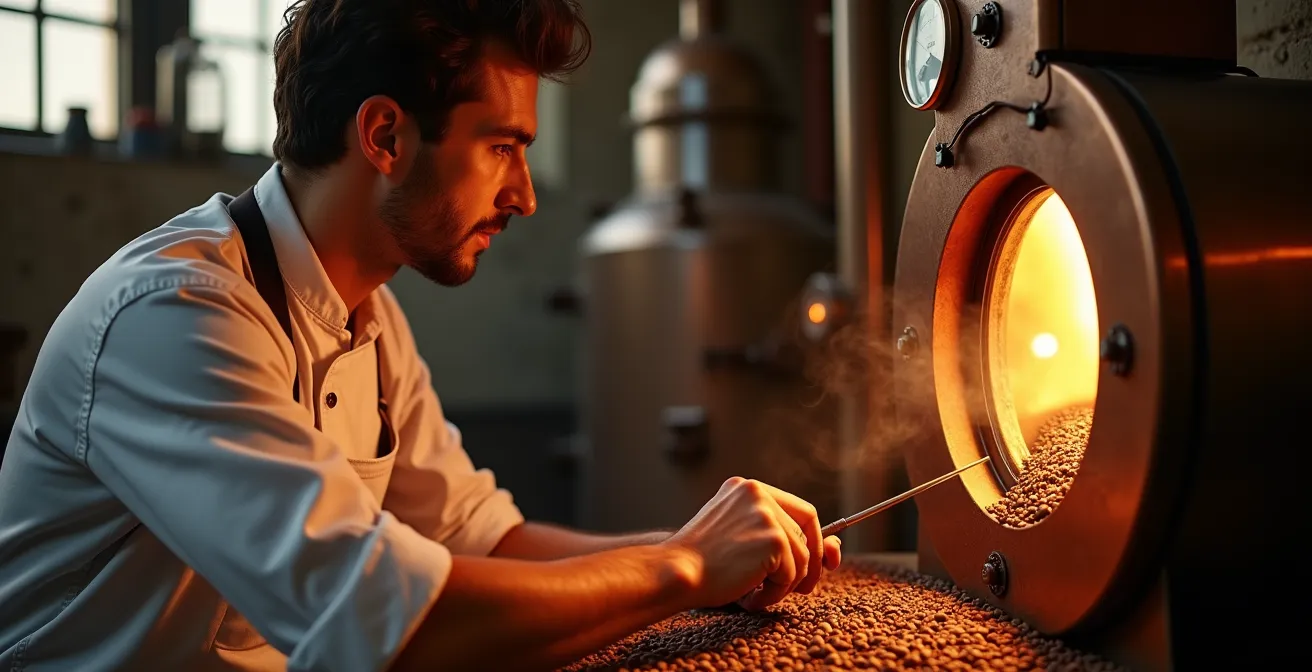
Mastering chocolate flavor is an act of precise chemical intervention, where roasting temperature serves not just to heat, but to selectively subtract, preserve, and transform the flavor precursors established during fermentation.
- High temperatures (above 130°C) cause the volatilization of delicate floral and fruity alcohol compounds, permanently erasing them from the final profile.
- Roasting is a negotiation with the bean’s origin; the goal is to enhance its inherent character, not to impose a uniform “roasted” taste.
Recommendation: Treat your roaster like a surgical tool. Profile every new batch with multiple low-temperature, extended-time samples to map its unique chemical potential before committing to a final profile.
For any artisan, whether a coffee roaster or a culinary enthusiast, the smell of roasting is the smell of transformation. With cocoa, we often hear the familiar advice: roast low for fruity notes, high for a classic chocolatey profile. This simplification, however, masks the profound chemical drama unfolding inside each bean. The Maillard reaction is only one part of the story; a successful roast is equally about what is lost as it is about what is gained. It’s a delicate process of chemical subtraction, where a few degrees can mean the difference between a vibrant, origin-expressive chocolate and a flat, generic one.
The common approach focuses on a target flavor, pushing the beans toward it with heat. But what if this approach is fundamentally flawed? What if the true art lies not in creating flavor from scratch, but in carefully curating the vast library of flavor precursors already developed during fermentation? This perspective shifts the roaster’s role from a simple cook to a chemical editor. Your job is to understand which volatile compounds to preserve, which acidic notes to gently evaporate, and which precursors to encourage into their final, delicious forms. Every degree is a decision that has an irreversible impact on the final note.
This guide delves into the science behind that decision-making process. We will dissect how specific temperature thresholds dictate flavor, explore practical methods for profiling beans, and identify the critical mistakes that can erase weeks of careful cultivation and fermentation in a matter of minutes. By understanding roasting as a targeted intervention, you can unlock the true potential hidden within each cocoa bean.
This article provides a detailed examination of the critical role temperature plays in every stage of the chocolate-making process. The following sections will guide you through the intricate chemistry and practical techniques needed to master the art of cocoa roasting.
Summary: Mastering Temperature in the Journey to Chocolate Flavor
- Why You Lose Delicate Floral Notes if You Roast Above 130°C?
- How to Profile Roast Cocoa Beans Using a Standard Convection Oven?
- Light vs. Dark Roast: Which One Respects the Bean’s Origin?
- The Roasting Mistake That Makes Your Chocolate Taste Like Ash
- When to Stop the Heat to Prevent Carry-Over Cooking in Cocoa Beans?
- Why Fermentation Is the Most Critical Step for Flavor Development?
- Why Does Overheating Chocolate Kill Its Fruity Notes Instantly?
- What Really Happens During the 30-Day Journey from Tree to Bar?
Why You Lose Delicate Floral Notes if You Roast Above 130°C?
The most sought-after and fragile notes in fine chocolate—floral, fresh fruit, and candy-like aromas—are not created in the roaster. They are the direct result of a high concentration of specific alcohols and esters formed during fermentation. Roasting’s primary role concerning these compounds is not creation, but preservation. These volatile compounds are incredibly sensitive to heat and begin to evaporate or degrade at relatively low temperatures. Think of them as the top notes in a perfume; they are the first to disappear when heat is applied.
The threshold of 130°C is a critical tipping point. While the Maillard reaction, responsible for “roasty” and “nutty” flavors, accelerates optimally above 140°C, this intensity comes at a steep cost. Chemical analysis shows that pushing temperatures into this range initiates a cascade of destructive events for delicate notes. Firstly, the volatilization of desirable alcohols increases exponentially. Secondly, the phenolic content, which can introduce bitterness and mask subtler flavors, tends to increase. Finally, this aggressive heat consumes the very building blocks of flavor. Detailed research confirms that at these higher temperatures, more than 70% of the bean’s reducing sugars can be consumed, fundamentally altering the bean’s potential away from its delicate origin character.
To protect these notes, a roaster must adopt a strategy of thermal gentleness. Experts often recommend keeping the roast within an optimal range of 110-116°C, especially for beans known for their floral character. This involves starting with a lower charge temperature (around 80-90°C) to prevent initial thermal shock and extending the roast time to 25-30 minutes for even development without scorching the surface or boiling off the precious volatile compounds within.
How to Profile Roast Cocoa Beans Using a Standard Convection Oven?
A standard convection oven is an excellent and accessible tool for profiling cocoa beans, provided you understand how to manage its aggressive heat transfer. Unlike a drum roaster, a convection oven uses forced hot air, which can easily scorch the exterior of the beans before the interior is properly roasted. The key is to control the environment to promote even development. Start by spreading the beans in a single, even layer on a perforated baking sheet. This allows hot air to circulate freely around each bean, minimizing hot spots and ensuring a uniform roast.
The roasting process itself is a two-stage event. The first stage is about drying, where the primary goal is to remove residual moisture. You’ll often hear a faint “crack” as water vapor escapes the bean. After this initial phase, the second stage—the flavor development or Maillard reaction—begins. A successful profile hinges on managing the transition between these two stages. For delicate beans like Criollo or Trinitario, you might start with a higher initial temperature for a few minutes to kickstart the drying process, then drastically reduce the heat to gently coax out the flavors without destroying them.
Because every batch of beans is different in size, density, and moisture content, a one-size-fits-all approach is doomed to fail. Profiling requires systematic testing. The table below offers a starting point for different bean types, but your senses—smell and taste—are the ultimate instruments. Sample a bean every minute or two as you approach the end of the roast. When the aroma shifts from raw and acidic to your desired profile, the roast is done.
This comparative table provides baseline parameters for roasting different cocoa varietals in a convection oven. Use these as a guide, but always adjust based on sensory feedback.
| Bean Type | Initial Temp | Roasting Temp | Time | Key Indicator |
|---|---|---|---|---|
| Criollo/Trinitario | 150°C (5 min) | 110-120°C | 15-20 min | Delicate floral preservation |
| Forastero | 190°C (5 min) | 130-140°C | 20-25 min | Full chocolate development |
| Mixed Size Batch | 170°C (5 min) | Lower temp after moisture release | Varies by size | Even browning across sizes |
Light vs. Dark Roast: Which One Respects the Bean’s Origin?
The debate between light and dark roasting is often framed as a matter of preference, but for the craft chocolate maker, it’s a question of philosophy. Which approach truly honors the bean’s terroir and the farmer’s hard work? The answer is nuanced: the most respectful roast is not a predetermined color, but a profile tailored to the specific chemical makeup of the bean. A dark roast is not inherently disrespectful, nor is a light roast always superior. The goal is to unlock a bean’s highest potential, which may require different strategies.
A light roast is typically employed to preserve the delicate, volatile compounds responsible for fruity, floral, and acidic notes. It’s a minimalist intervention designed to let the bean’s inherent origin character shine through. However, if a bean possesses high levels of unwanted acidity (like excessive acetic acid from fermentation), a light roast might fail to “cook it off,” resulting in a sharp, unbalanced chocolate. Conversely, a dark roast excels at developing deep, rich, “chocolatey” notes from pyrazines. But if applied to a delicate, floral bean, it will obliterate its unique character, replacing it with a generic, monolithic roasted flavor.
The true master stroke of roasting lies in this balance, as articulated by chocolatier Michael Laiskonis of the ICE Chocolate Lab when discussing a particularly challenging bean:
A bean from Madagascar, known for its bright fruitiness, may need a longer roast to rid it of excess acidity, yet not such a deep roast that those desired fruity notes are driven off.
– Michael Laiskonis, ICE Chocolate Lab
This highlights that respecting origin is about responsive, intelligent roasting. It requires a deep understanding of the raw material. Many expert chocolatiers taste the beans raw to identify their base flavors and potential off-notes, which informs their roasting strategy.
Case Study: Arcelia Gallardo’s Multi-Roast Comparison Method
To systematically determine the ideal profile, Brazilian chocolatier Arcelia Gallardo of Mission Chocolate developed a simple yet powerful methodology. For every new batch of beans, she performs three distinct sample roasts: one light, one medium, and one dark. By tasting the results of each, she can objectively decide which profile best expresses the bean’s unique characteristics. This data-driven approach removes guesswork and ensures the final roast is a deliberate choice that honors the bean’s origin, rather than a profile imposed by habit.
The Roasting Mistake That Makes Your Chocolate Taste Like Ash
There is no flavor defect more offensive to a roaster’s palate than the taste of ash. It’s a sign of a catastrophic failure in temperature control—the complete carbonization of the organic material. This acrid, burnt flavor is the ghost of flavor compounds that have been utterly destroyed by excessive or uneven heat. While the typical roasting temperature range is wide, spanning from 121-177°C (250-350°F), the window for a perfect roast is narrow. The ashy mistake happens when parts of the bean—or entire beans—wildly overshoot this window.
The primary culprit is often not the overall oven temperature, but a lack of uniformity. Several factors contribute to this devastating error:
- Broken Bean Fragments: Small, broken pieces of nib have a much higher surface-area-to-mass ratio. They roast exponentially faster than whole beans and will turn to carbon long before the main batch is ready.
- Uneven Bean Size: In a mixed batch, smaller beans will fully roast and begin to burn while larger beans are still in the drying phase. This is a guaranteed recipe for inconsistency and off-flavors.
- “Tipping”: This occurs when a part of the bean, typically a sharp edge or the thin germ, makes prolonged contact with a hot surface (like the wall of a drum roaster). This contact point scorches, creating a localized spot of burnt flavor that can taint the entire batch. Flat or germinated beans are especially prone to this.
Preventing an ashy taste requires rigorous preparation and attention to detail before and during the roast. It’s about creating a homogenous roasting environment where every piece of cocoa has an equal opportunity to develop its flavor potential without being sacrificed to uncontrolled heat. The following checklist outlines the essential steps to safeguard your batch from this fatal flaw.

Action Plan: Avoiding Roasting Defects
- Initial Sorting: Before roasting, meticulously hand-sort your beans. Remove all broken fragments, flat beans (which are mostly shell), and any beans that show signs of germination, as these are the most likely to burn.
- Batch by Size: Separate your sorted beans into distinct batches based on size (e.g., large, medium, small). Roast each batch separately with a profile adjusted for its mass and density to ensure uniform heat penetration.
- Monitor Temperature Bounds: Adhere strictly to established temperature ranges. For most beans, roasting between 120-160°C for 5-35 minutes provides a safe and effective window for flavor development without approaching the carbonization point.
- Check for Fragments Post-Winnowing: Even after a careful roast, some fragments may exist. Before grinding, perform a final check after winnowing to ensure no tiny, over-roasted particles make it into your grinder.
- Calibrate Your Equipment: Regularly check your roaster or oven for hot spots. Understanding your equipment’s unique heating pattern is critical for preventing scorching and tipping.
When to Stop the Heat to Prevent Carry-Over Cooking in Cocoa Beans?
One of the most challenging aspects of roasting is learning to anticipate the future. When you cut the heat, the roasting process doesn’t simply stop. The beans possess significant thermal inertia; their internal mass retains heat and continues to “cook” for several minutes after being removed from the roaster. This phenomenon, known as carry-over cooking, can easily turn a perfectly judged roast into an over-roasted one. Mastering the end of the roast is about stopping not when the beans are done, but when they are moments away from being done.
Professional roasters rely on precise measurements and sensory cues to make this critical decision. While aroma is a key indicator, internal bean temperature provides an objective data point. For instance, extensive testing at culinary institutes shows that roasters might start sampling beans when the internal mass temperature reaches 235-240°F (113-116°C), but they will often pull the batch from the heat at 245-275°F (118-135°C), knowing the temperature will continue to climb. The exact moment depends on the bean’s size, density, and the desired final profile.
The moment the beans are removed from the heat, a race against time begins. The goal is to dissipate the stored thermal energy as quickly as possible to halt the chemical reactions of roasting. Failure to cool the beans rapidly will allow the Maillard reaction and sugar caramelization to continue unchecked, pushing the flavor profile into darker, more bitter, and less nuanced territory. This is why the cooling process is just as critical as the heating process itself.
To combat carry-over cooking, rapid, active cooling is non-negotiable. As one in-depth guide on the art of roasting explains, chocolate makers must “snuff out the reaction” immediately. For small batches, this can be achieved by spreading the beans on a large metal cooling rack, often with fans or air conditioning directed at them. Professional operations utilize dedicated cooling carts where a vacuum powerfully draws ambient air through the bed of hot beans, dropping their temperature to room temperature in a matter of minutes. This aggressive cooling locks in the intended flavor profile, preserving the roaster’s precise work.
Why Fermentation Is the Most Critical Step for Flavor Development?
A roaster, no matter how skilled, cannot create flavor from nothing. The roasting process is not alchemy; it is a chemical reaction that relies entirely on the ingredients—the flavor precursors—that are already present in the bean. The development of these essential precursors, primarily free amino acids and reducing sugars, does not happen on the farm or in the roaster. It happens during the wet, microbial-rich, and scientifically complex process of fermentation.
During fermentation, a succession of yeasts and bacteria break down the sweet pulp surrounding the cocoa beans. This process generates heat and creates a specific chemical environment inside the bean. Complex proteins and carbohydrates are broken down into simpler, more reactive components. It is this breakdown that creates the pool of amino acids and sugars that will later fuel the Maillard reaction during roasting. A poorly fermented bean is chemically barren; it lacks the necessary building blocks for complex flavor development. Roasting such a bean, no matter the profile, will only yield a flat, bitter, or one-dimensional taste.
The quality of fermentation directly dictates the potential of the final chocolate. An under-fermented bean, often identifiable by its purple interior and astringent taste, lacks sufficient precursors. A roaster must compensate with a lower, slower roast to try and develop what little flavor is there. An over-fermented bean may have excessive acetic acid, requiring a hotter, shorter roast to drive off the vinegary notes. A well-fermented bean, however, is a canvas rich with potential, allowing the roaster to fully express its origin.
The quality of fermentation is therefore the primary variable a roaster must understand and adapt to. The following table illustrates how to adjust roasting parameters based on fermentation quality indicators.
| Fermentation Quality | Visual Indicator | Roasting Adjustment | Expected Outcome |
|---|---|---|---|
| Well-fermented | Dried in sun, rested 3-12 months | Standard profile | Full flavor development |
| Over-fermented | Dark, vinegar smell | Higher initial temp, shorter time | Reduce excess acidity |
| Under-fermented | Purple interior, astringent | Lower temp, extended time | Develop missing flavors |
Why Does Overheating Chocolate Kill Its Fruity Notes Instantly?
While roasting transforms the bean, heat remains a potent force—and a significant threat—throughout the rest of the chocolate-making process. The delicate fruity notes that survive the roast are still vulnerable. Overheating *finished* chocolate, particularly during grinding, refining, and conching, can instantly destroy these volatile compounds, often with no chance of recovery. This is a different chemical event than roasting; it’s about protecting a finished or semi-finished product.
During grinding and refining, immense friction is generated as granite wheels or steel rollers break down cocoa nibs and sugar into microscopic particles. This friction creates heat. If this temperature is not carefully controlled, it can easily exceed the danger zone. According to data from industrial chocolate processing, temperatures should be kept below 120-130°F (49-54°C) during these stages. Above this threshold, two destructive things happen: the sugar and milk powders (if present) can begin to caramelize, introducing unintended cooked or burnt flavors. More critically, the remaining volatile fruity esters, which are responsible for those bright top notes, are driven off by the heat.
Conching, the process of aerating and kneading liquid chocolate for hours or even days, is another critical control point. While it’s essential for developing smoothness and removing any lingering undesirable acidity (like acetic acid), it is also a process of evaporation. Research shows that many volatile organic compounds (VOCs) related to sweet, floral, and fruity notes are removed during this extended period of heating and agitation. An overly long or overly hot conche can strip a chocolate of its vibrant origin character, leaving it smooth but muted and uninteresting.
Key Takeaways
- Flavor Is Born in Fermentation: The potential for complex flavor is determined by the creation of chemical precursors (amino acids and sugars) during fermentation. Roasting can only unlock what is already there.
- Roasting Is a Selective Act: The goal of roasting is not just to create flavor, but to selectively preserve delicate volatile compounds while transforming others. Every degree is a decision.
- Temperature Control Is Absolute: From roasting to cooling to conching, managing heat is the single most critical factor in preserving the bean’s intended flavor profile and preventing irreversible defects.
What Really Happens During the 30-Day Journey from Tree to Bar?
The journey from a vibrant cocoa pod on a tree to a finished chocolate bar is a month-long marathon of controlled biological and chemical transformations. Each step is a critical control point where flavor can be enhanced, altered, or destroyed. Roasting, while pivotal, is just one intense moment in this extended narrative. Understanding the full timeline provides the context needed to appreciate why every preceding step matters so deeply.
The process begins the moment the pod is harvested. The first two weeks are dominated by two key stages that happen at or near the farm:
- Fermentation (Days 1-7): This is where the magic begins. Beans are piled in boxes or heaps, and a succession of microbes breaks down the surrounding pulp. This generates heat and creates the crucial flavor precursors. However, it’s a double-edged sword; undesirable compounds like acetic acid (vinegar) are also produced and must be managed.
- Drying (Days 8-14): After fermentation, the beans have a high moisture content. They are spread out in the sun or in specialized dryers to reduce their moisture to about 7-8%. This step halts the fermentation process, stabilizes the beans for transport, and prevents mold growth.
The second half of the journey typically happens at the chocolate maker’s facility. After a period of resting (days 15-29) where the beans stabilize further, the final, intense transformation begins on “Day 30.” This is where the roaster’s craft comes into play, followed by the mechanical processes that create the final product. As the team at French Broad Chocolates demonstrates in their bean-to-bar factory, each subsequent step is about refining the potential created in the first 29 days. Roasting removes the last bit of moisture and develops nutty, roasty pyrazines. Winnowing separates nib from shell. Refining and conching create the smooth texture, and tempering gives the final bar its signature snap and shine.
This entire 30-day journey is a testament to the fact that great chocolate is not made, but guided. From the farmer’s careful fermentation to the roaster’s precise application of heat, every stage is a deliberate act aimed at preserving and expressing the unique story of the bean.
By understanding each of these critical control points, you can move beyond simply following a recipe and begin to make deliberate, informed decisions that elevate your chocolate from good to truly exceptional. Start by profiling your next batch of beans not as a task, but as a conversation with their origin.