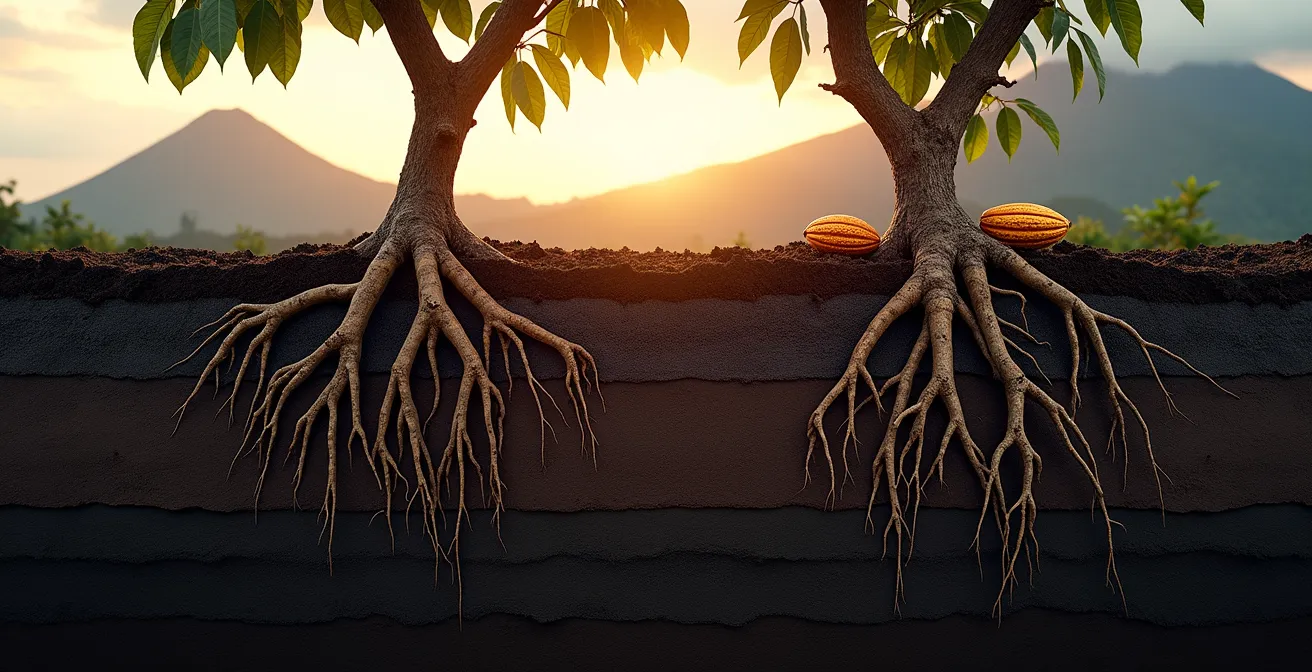
The unique acidity and flavor of volcanic cocoa is a direct, predictable chemical result of the soil’s specific mineral composition and pH, which acts as a master switch during fermentation.
- Soil pH is the gatekeeper, determining whether crucial minerals like iron and manganese are “bioavailable” for the cocoa tree to absorb.
- Specific minerals, once absorbed, act as catalysts that influence which types of acids (e.g., fruity tartaric vs. sharp acetic) develop in the bean.
Recommendation: To truly appreciate chocolate, start tasting single-origin volcanic bars with the same attention to specific mineral and acid notes that you would a fine wine.
If you appreciate the flinty notes of a Chablis grown on Kimmeridgian marl or the robust tannins of a Cabernet from Napa’s volcanic soils, you already understand the essence of terroir. It’s the intimate dialogue between a plant, the soil it grows in, and the climate that surrounds it. For years, the world of fine chocolate has whispered about terroir, often attributing the unique flavors of certain origins to the vague notion that volcanic soil is simply “rich in minerals.” This explanation, however, is as unsatisfying as calling a grand cru wine merely “good grape juice.”
The truth is far more scientific and fascinating. The influence of volcanic soil on cocoa is not about a simple addition of minerals; it’s about a complex geochemical process. The real secret lies in how the soil’s specific pH level acts as a master switch, controlling the bioavailability of these minerals. It determines which nutrients the cocoa tree can actually absorb and utilize. This process fundamentally alters the bean’s internal chemistry, loading it with specific precursor compounds that will later define its entire acid and flavor profile during fermentation and roasting.
This article moves beyond the romanticized concept of terroir and delves into the pedology—the soil science—that dictates flavor. We will explore how specific volcanic geographies create distinct taste profiles, why some beans are better “terroir translators” than others, and how climate change threatens to erase these unique geochemical signatures forever. It’s time to approach the chocolate bar with the same analytical palate and appreciation for origin that one brings to a bottle of wine.
To fully explore this complex relationship between soil and flavor, this guide breaks down the key aspects of volcanic cocoa terroir, from specific regional profiles to the very future of our most cherished heirloom varieties. The following sections will guide you through this fascinating journey.
Summary: Unlocking the Geochemical Secrets of Volcanic Cocoa
- Why Cocoa from Coastal Regions Tastes Saline without Added Salt?
- How to Map the 4 Main Flavor Profiles of South American Cocoa?
- Madagascar vs. Ecuador: Which Terroir Produces Better Berry Notes?
- The Climate Threat: Will We Lose Specific Terroirs by 2050?
- How to Protect Heirloom Varieties from Hybridization Risks?
- Why Are Pure Criollo Beans Considered the “Prince of Cocoas”?
- Why Trinitario Beans Offer the Best Balance for Craft Chocolate Makers?
- Why Madagascar Chocolate Makes Fruitier Mousses Than Ghanaian Varieties?
Why Cocoa from Coastal Regions Tastes Saline without Added Salt?
A sophisticated palate might detect a subtle, intriguing saline or mineral note in chocolate from coastal volcanic islands, a characteristic that seems baffling without any added salt. The explanation lies not in sodium chloride, but in the complex mineral uptake governed by soil science. Coastal soils, even volcanic ones, are constantly exposed to marine aerosols. These are microscopic particles of seawater, rich in magnesium, potassium, and other mineral salts, that are carried by the wind and deposited on the soil and the cocoa trees themselves.
The cocoa tree’s root system doesn’t passively absorb everything. Its uptake is governed by the soil’s Cation Exchange Capacity (CEC), a measure of the soil’s ability to hold and release positively charged mineral ions. In these coastal environments, the CEC may favor the absorption of ions like magnesium (Mg²⁺) and potassium (K⁺) from these marine deposits. While not “salt” in the culinary sense, these minerals, when present in trace amounts in the finished chocolate, can trigger the same taste receptors on our tongue, creating a perception of minerality or salinity. It’s a testament to how terroir can impart flavors that are analytically present, even if they’re not what we conventionally expect.
How to Map the 4 Main Flavor Profiles of South American Cocoa?
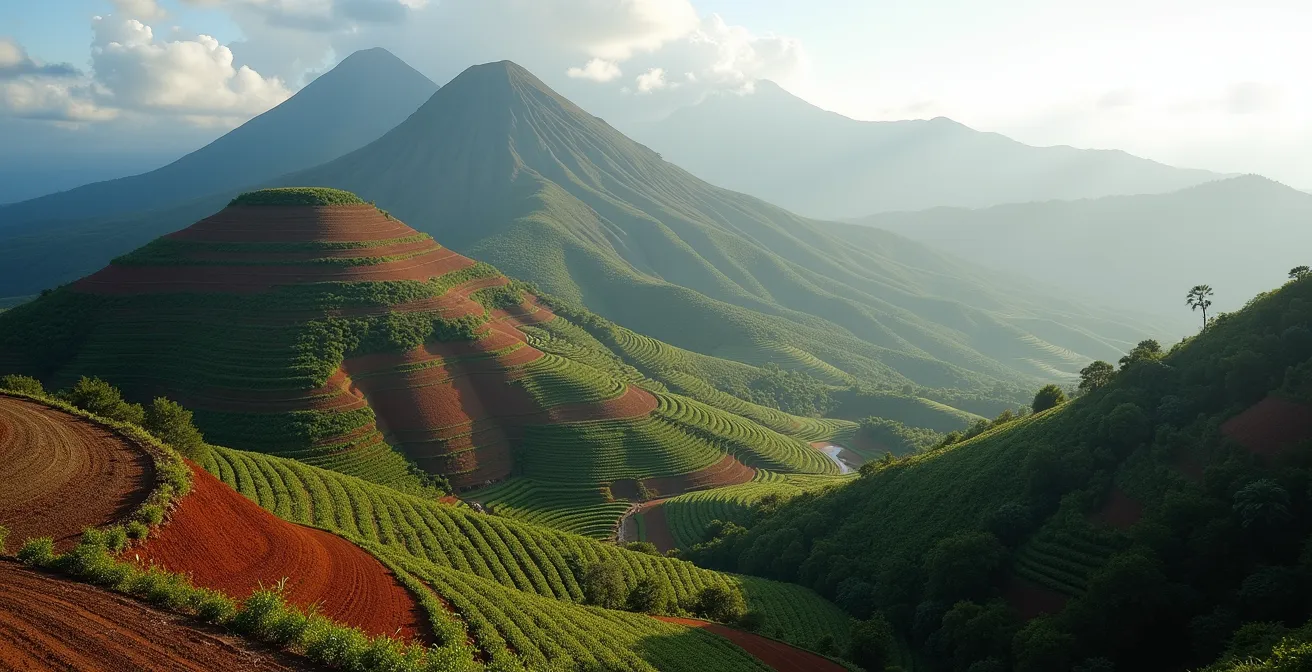
Mapping the flavor profiles of South American cocoa, particularly from the Andean volcanic chain, is an exercise in geological and atmospheric stratification. The continent’s vastness, exemplified by producers like Ecuador which, with its unique volcanic soil conditions, produces approximately 365,000 tonnes annually, offers a dizzying array of terroirs. However, from an agronomic perspective, we can group them into four primary profiles based on altitude and soil composition.
This image of Andean plantations showcases the visible differences in soil and elevation that create distinct flavor zones.
We can broadly categorize these profiles as follows:
- High-Altitude Volcanic Ash: Found on the upper slopes, these young, dark, porous soils with excellent drainage tend to produce beans with bright, floral, and highly acidic profiles. The cooler temperatures and specific mineral balance often lead to delicate, tea-like notes.
- Mid-Slope Lateritic Clays: As we move down, the soil becomes older, redder, and richer in iron and aluminum. These soils retain more moisture and foster beans with a classic red fruit and nutty character, balanced by a firm tannic structure.
- Lower Valley Alluvial Deposits: In the valleys, soils are a mix of eroded volcanic material and organic matter. This fertile ground produces robust, less acidic beans with deep, earthy, and traditional “chocolatey” notes, often with hints of tobacco or wood.
- Amazonian Basin Edge: Where the Andes meet the Amazon, the soils are more acidic and influenced by the rainforest biome. This unique interface can produce beans with exotic, often surprising notes of tropical fruit, spice, and a distinct “wild” funk.
Madagascar vs. Ecuador: Which Terroir Produces Better Berry Notes?
When chocolatiers and connoisseurs seek out pronounced berry notes, the conversation almost invariably turns to Madagascar. While Ecuador produces exceptional cocoa, the specific, vibrant red fruit character is a signature of the Malagasy terroir. The term “better” is subjective, but from a geochemical standpoint, Madagascar’s soil is uniquely predisposed to creating these flavors. The reason lies in its ancient, weathered volcanic soils, which are fundamentally different from the younger soils of the Andean chain.
Madagascar’s landmass is ancient, and its soils are predominantly lateritic—deeply weathered, iron-rich clays. This high concentration of bioavailable iron is the crucial factor. Gabriel Castrillo, a leading expert from the Food Systems Institute at the University of Nottingham, provides the definitive scientific explanation:
Madagascar’s unique iron-rich lateritic soils and specific Trinitario genetics favor the production of citric and tartaric acids, creating intense red berry and citrus notes with bright, sharp acidity
– Gabriel Castrillo, Food Systems Institute, University of Nottingham
Here, the connection is explicit: more iron in the soil leads to a higher concentration of specific fruit acids in the bean. Ecuadorean cocoa, grown on younger volcanic soil with a different mineral profile, may express more floral, nutty, or banana-like notes, but the sharp, tangy, red-berry explosion is the direct geochemical signature of Madagascar’s iron-rich earth. It’s a perfect example of soil chemistry translating directly into sensory experience.
The Climate Threat: Will We Lose Specific Terroirs by 2050?
The intricate geochemical signatures that define unique cocoa terroirs are profoundly fragile, and the greatest threat they face is climate change. The delicate balance of temperature, rainfall, and humidity that has shaped these soils over millennia is being rapidly disrupted. For the critical cocoa-growing regions of West Africa, for example, the IPCC Climate Change 2014 report projects a 3.8°F (2.1°C) increase by 2050. Such a change is not merely a matter of plants feeling a bit warmer; it’s a fundamental threat to the very existence of terroir.
This split image powerfully illustrates the stark reality: a thriving terroir on one side, and its climate-stressed, barren future on the other.
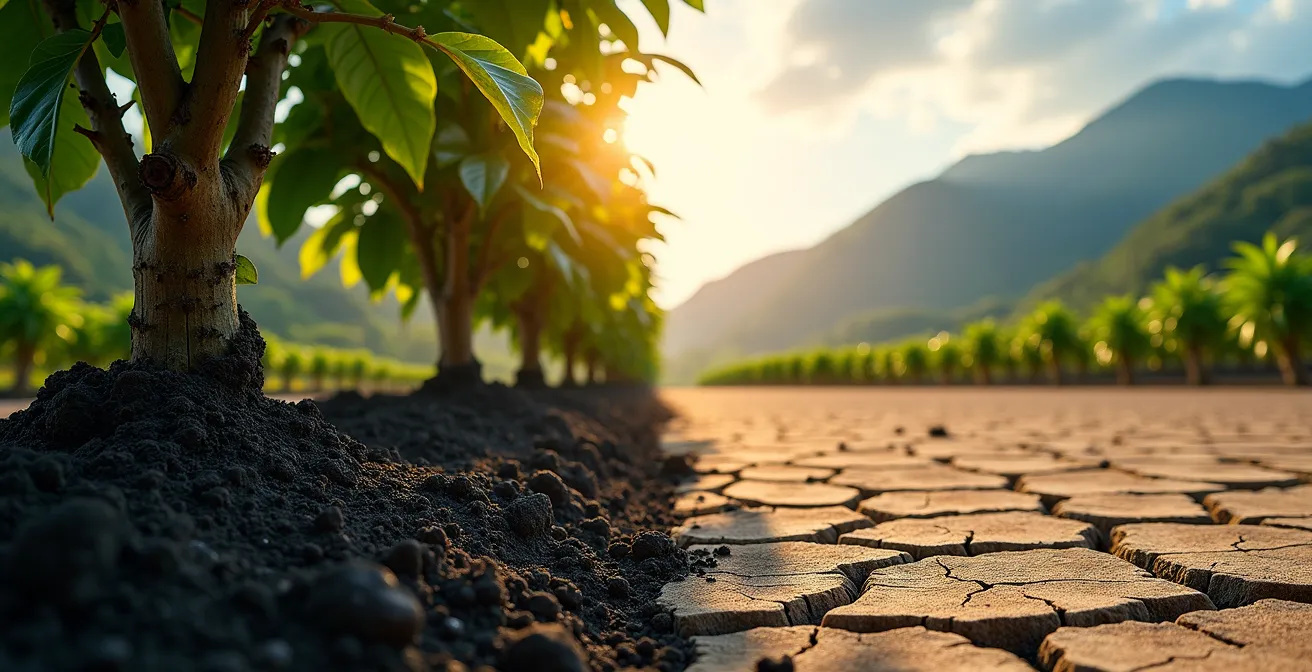
A temperature increase and altered rainfall patterns trigger a disastrous cascade of events in the soil. Higher temperatures accelerate the decomposition of organic matter, depleting the soil’s nutrient-holding capacity. Droughts can increase soil salinity and alter its pH, locking up essential minerals and making them unavailable to the cocoa tree. Conversely, extreme rainfall can lead to erosion, washing away the precious topsoil that contains the unique mineral fingerprint of the terroir. The result is a homogenization of flavor. The unique, vibrant notes of a specific volcanic slope are muted, replaced by generic, stress-induced flavors. We are not just at risk of losing cocoa; we are at risk of losing its diversity and complexity, effectively erasing centuries of geological history from our palates.
How to Protect Heirloom Varieties from Hybridization Risks?
Protecting the world’s heirloom cocoa varieties is a two-front battle. On one front is the climate threat, and on the other, an insidious economic pressure: hybridization. Fine or flavor cocoa, which includes the legendary Criollo and fine Trinitario clones, represents a tiny fraction of global production. The ICCO reports that fine or flavor cocoa represents less than 5% of total world production. The vast majority is bulk Forastero, bred for high yields and disease resistance, not flavor complexity. When these high-yield, genetically dominant hybrids are planted near heirloom groves, cross-pollination is inevitable. This genetic “dilution” can wipe out the unique characteristics of an heirloom variety in a single generation, forever losing the traits that allow it to express its terroir so beautifully.
Preservation, therefore, requires a proactive, science-based strategy focused on genetic purity and terroir integrity. As detailed in climate research, a multi-faceted approach is our best defense. The following plan outlines the critical steps needed to safeguard these irreplaceable genetic assets.
Action Plan: Preserving Volcanic Cocoa Terroirs
- Establish Terroir Sanctuaries: Designate specific volcanic slopes with unique soil profiles as protected zones. Create wide buffer zones around them planted with non-cocoa crops to prevent pollen contamination from hybrid varieties.
- Implement Agroforestry Systems: Re-introduce or maintain a canopy of native shade trees. This is not just for shade; it creates a stable microclimate, moderates soil temperature and moisture, and contributes to soil health through leaf litter.
- Monitor Soil Geochemistry: Conduct quarterly soil tests to track pH, mineral content, and organic matter. This data provides an early warning system for terroir signature changes and allows for targeted soil amendments to maintain its integrity.
- Create Genetic Seed Banks: Establish secure, cryogenically preserved seed banks for heirloom varieties, ensuring each sample’s origin is meticulously documented to its specific volcanic location. This is the ultimate insurance policy against extinction.
- Foster Cooperative Purity Programs: Work with farmer cooperatives to implement controlled, manual pollination programs for seed production. This guarantees genetic purity and provides farmers with a premium for their crucial role in preserving these valuable varieties.
These strategies are not just about saving a plant; they are about preserving a library of flavors, a living connection to the geological history of our planet. The effort requires collaboration between scientists, governments, and, most importantly, the farmers who are the daily custodians of this priceless heritage.
Key Takeaways
- Soil pH is the master controller, acting as the gatekeeper that determines which minerals in volcanic soil are actually available for the cocoa tree to absorb.
- Specific minerals directly influence the development of specific acid profiles; for example, high bioavailable iron in Madagascar’s soil leads to the characteristic red berry (tartaric/citric) notes.
- Terroir is a fragile system; climate change threatens to erase these unique geochemical signatures by altering soil moisture, temperature, and pH, leading to a homogenization of flavor.
Why Are Pure Criollo Beans Considered the “Prince of Cocoas”?
Criollo’s regal title, the “Prince of Cocoas,” is earned not through arrogance but through its inherent elegance, complexity, and profound rarity. It is the closest genetic link to the wild cocoa first domesticated by the Maya. From a production standpoint, it is an agronomist’s nightmare: low-yielding, highly susceptible to disease, and incredibly demanding of its environment. Research confirms that pure Criollo varieties represent less than 5% of global production, requiring a very narrow soil pH of 5.5-6.5. This pickiness is precisely why it is so treasured; it can only thrive in the most ideal terroirs, and when it does, the results are sublime.
Unlike robust hybrids, Criollo lacks bitterness and astringency, offering instead a delicate, complex profile of nuts, caramel, and soft red fruits. The role of volcanic soil here is to elevate this inherent elegance. The superior drainage of volcanic soils prevents water stress, and their unique mineral composition provides the building blocks for its legendary aromatic profile.
Case Study: The Mineral Advantage of Volcanic Criollo
A pivotal study published in Scientific Reports analyzed Criollo beans from the volcanic soils of Colombia. The findings were stark: the volcanic-grown beans showed 45% higher mineral content (specifically iron, copper, and manganese) compared to the same genetic variety grown in non-volcanic regions. Iron levels reached 45 mg/kg in volcanic soil versus only 24 mg/kg in standard soils. This mineral richness was directly correlated with enhanced development of complex aromatic compounds during fermentation and a measurable reduction in astringent polyphenols, scientifically validating the “elegance” and complexity that connoisseurs have prized for centuries.
Criollo is the ultimate expression of terroir. It doesn’t just grow in a soil; it translates its most subtle geochemical nuances into pure flavor, making it the undisputed benchmark for quality in the world of fine chocolate.
Why Trinitario Beans Offer the Best Balance for Craft Chocolate Makers?
If Criollo is the delicate prince, then Trinitario is the capable and charismatic diplomat. This variety is a natural hybrid, born from a cross between the fragile, flavorful Criollo and the hardy, productive Forastero. This genetic heritage gives it the best of both worlds: it retains a significant portion of Criollo’s flavor complexity while inheriting the resilience and adaptability of Forastero. For a craft chocolate maker, this balance is invaluable. It provides a bean that is both exceptionally flavorful and economically viable.
Agronomically, its key advantage is its wider tolerance for different soil conditions. While Criollo demands a narrow pH, data from the ICCO shows that Trinitario hybrids, which account for approximately 15% of global production, tolerate a much broader pH range of 5.0-7.5. This adaptability allows it to be grown in a wider variety of terroirs, but its true genius is how it expresses those terroirs. Dr. Balu M. Balasubramanian, a respected expert in the bean-to-bar community, captures its essence perfectly:
Trinitario’s genetic diversity makes it highly adaptable and particularly good at expressing the nuances of the soil it’s grown in – it acts as a ‘terroir translator’, especially in volcanic regions where it develops exceptional Criollo-like complexity
– Dr. Balu M. Balasubramanian, CocoaTown Bean to Bar Workshop
The term “terroir translator” is perfect. A craft maker working with Trinitario from a volcanic region like Madagascar can expect bright, fruity notes. From a different volcanic soil in Ecuador, they might find more floral or nutty expressions. Trinitario faithfully captures and communicates the geochemical signature of its home soil, offering a diverse and reliable palette of flavors for the discerning chocolatier to work with.
Why Madagascar Chocolate Makes Fruitier Mousses Than Ghanaian Varieties?
The answer to why a mousse made with Madagascar chocolate bursts with bright, fruity notes while one from Ghanaian cocoa offers a deeper, more classic chocolate flavor lies in the fundamental difference in their soil of origin and its impact on acid chemistry. It’s a clear demonstration of terroir’s influence surviving all the way through to a complex culinary preparation. At a basic level, the difference is quantifiable; comparative analysis reveals that on average, Madagascar cocoa shows 0.26% acidity versus Ghana’s 0.18%. But the story is more complex than just “more acid.”
The key is the type and stability of the acids. As we’ve established, Madagascar’s iron-rich volcanic soils promote the creation of tartaric and citric acids—the same acids found in berries and citrus fruits. Ghanaian soils, which are generally older, non-volcanic, and have a different mineral composition, tend to produce beans with lower, less complex acid profiles. The true test comes during processing, especially when alkalization (the “Dutch process”) is used to mellow flavor.
Case Study: Acid Stability During Dutch Processing
Alkalization raises cocoa powder’s pH, which can neutralize acidity. However, it affects different acids differently. The robust, complex fruit acids developed in Madagascar’s volcanic-grown beans are more stable and partially survive the alkalization process. They remain present to “pop” through the fat and sugar of a mousse. In contrast, the simpler acid structures in Ghanaian beans are more easily neutralized, allowing the deeper, roasted, and mellow chocolate notes to become dominant. The process, designed to reduce acidity, paradoxically highlights the superior stability of the acids born from volcanic terroir.
So, the fruitiness of the Madagascar mousse is not an illusion; it’s the direct, audible echo of its volcanic, iron-rich soil, a flavor signature strong enough to be heard even after fermentation, roasting, and being blended into a rich dessert.
The journey from a volcanic slope to a finished chocolate bar is a story written in chemistry. Your next step as a connoisseur is not simply to find the “best” chocolate, but to begin tasting with a new intention. Seek out single-origin bars from these distinct terroirs and challenge your palate to identify their unique geochemical signature. The exploration of terroir in chocolate has only just begun.