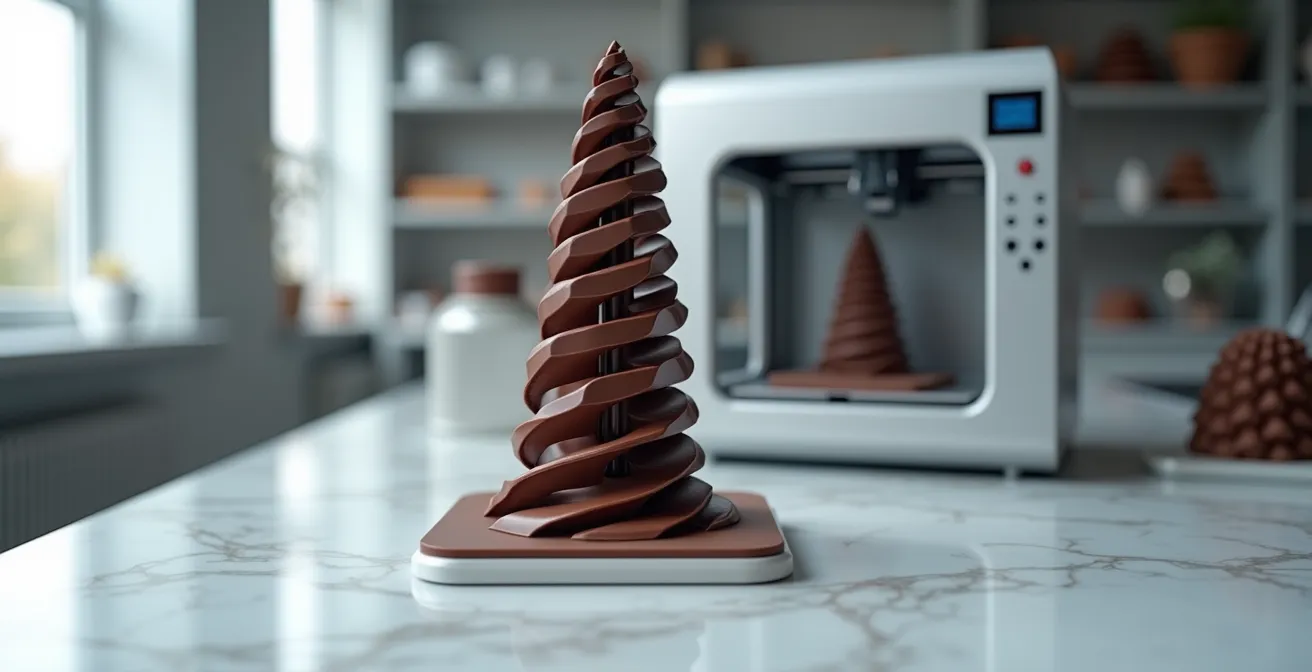
3D printing is redefining chocolate not as a confection, but as a programmable material where geometry directly engineers the sensory experience.
- It enables the design of internal structures that control texture, melt-rate, and the sequential release of flavors.
- It unlocks new possibilities by combining advanced material science for molds with novel ingredients like cacaofruit pulp.
Recommendation: Shift focus from simply creating complex external shapes to architecting the internal geometry to design a specific, repeatable tasting journey.
For decades, the pinnacle of chocolate design was a glossy shell, a satisfying snap, and an elegant shape. Chocolatiers relied on manual artistry, traditional molds, and time-honored techniques to delight the senses. The most advanced discussions often revolved around the origin of the bean or the percentage of cacao. While these elements remain crucial, a new technological wave is reshaping the very definition of chocolate craftsmanship. We see glimpses of this future in intricate, web-like chocolate lattices that seem impossible to make by hand, but this is only scratching the surface.
The common discourse on 3D printed chocolate often stops at “it makes complex shapes.” This perspective misses the true revolution. The real innovation lies not in what the chocolate looks like, but in how it behaves, feels, and tastes. What if a single bite could offer a journey through multiple textures? What if flavor wasn’t a uniform blend, but a programmed sequence released as the chocolate melts? This isn’t science fiction; it’s the emerging field of computational gastronomy.
This article moves beyond the novelty of complex aesthetics. We will explore how 3D printing provides the tools to architect chocolate at a micro-level, turning it into a programmable matter. We’ll delve into how this technology is fundamentally altering our approach to flavor pairings, sugar alternatives, mold making, and even the emotional connection we have with what we eat. We are entering an era where chocolatiers are becoming sensory architects, designing not just a product, but a meticulously scripted experience.
To fully grasp this paradigm shift, we will deconstruct the key technological and material innovations that are making it possible. This guide examines the critical questions facing the modern chocolatier, from the evolution of flavor to the science of a perfect shine in this new landscape.
Summary: Architecting Chocolate: A Blueprint for the Future of Design
- Yuzu and Matcha: Are Asian Flavors Still Innovative in 2025?
- How to Use Inulin fibers to Replace Sugar in Chocolate Mousse?
- Silicone vs. Thermoforming: Which Allows More Complex Shapes?
- Cacaofruit Pulp: How to Use the Sweetener of the Future?
- Augmented Reality: How to enhance the Tasting Experience Digitally?
- Why Does Bean-to-Bar Couverture Require Different Tempering Curves?
- How to Achieve Mirror-Like Shine on Your Molded Bonbons?
- Polycarbonate vs. Silicone: Which Mold Material Gives Gloss?
Yuzu and Matcha: Are Asian Flavors Still Innovative in 2025?
The initial wave of yuzu, matcha, and pandan felt revolutionary, introducing a new palette to the Western pastry world. Today, they are staples. True innovation in 2025 is no longer about discovering an exotic ingredient, but about creating unexpected and sublime pairings. This is where computational gastronomy comes into play. Instead of relying solely on intuition and traditional pairings, we can now use technology to analyze ingredients at a molecular level, uncovering affinities the human palate might never have conceived.
The future of flavor isn’t the ingredient itself, but the intelligence used to combine it. This data-driven approach allows for the creation of truly novel experiences, which is essential for differentiation in a rapidly growing market. By moving beyond the familiar, designers can create signature flavor profiles that are both surprising and harmonious, justifying a premium position in a global chocolate market projected to see significant growth. As one industry expert notes in their research on computational flavor pairing, the potential is vast.
AI can analyze the molecular compounds of yuzu and matcha to predict and suggest novel pairings with unconventional ingredients based on shared volatile molecules.
– Industry Expert, Computational Flavor Pairing Research
3D printing becomes the perfect delivery system for these complex pairings. It allows a chocolatier to deposit different ganaches in specific zones within a single bonbon, ensuring the consumer experiences the AI-generated pairing in a controlled, sequential manner. This transforms a simple flavor into a constructed narrative.
How to Use Inulin fibers to Replace Sugar in Chocolate Mousse?
While the title mentions mousse, the true futuristic application of inulin fiber lies in the solid, structured world of 3D printed chocolate. Here, inulin transcends its role as a mere sugar substitute and becomes a key component of sensory architecture. By replacing sugar with inulin, a natural prebiotic fiber, we can not only create healthier confections but also precisely engineer their mechanical properties. Inulin can be integrated into the chocolate paste to build internal lattices and support structures that would be impossible with traditional sugar-based recipes.
This allows a designer to control the texture and snap of the final product with unprecedented precision. Imagine a chocolate shell that is dense and crisp on the outside, but gives way to a porous, rapidly melting interior. This is achieved by programming the 3D printer to create different infill densities and patterns within a single piece. Research shows that these internal geometries have a measurable impact on the physical strength and, by extension, the textural experience. For instance, specific printing patterns can dramatically alter the force required to fracture the chocolate, a key element in its sensory perception. A cross-support structure can increase chocolate’s structural strength significantly, creating a more robust and satisfying snap without adding a single gram of sugar.
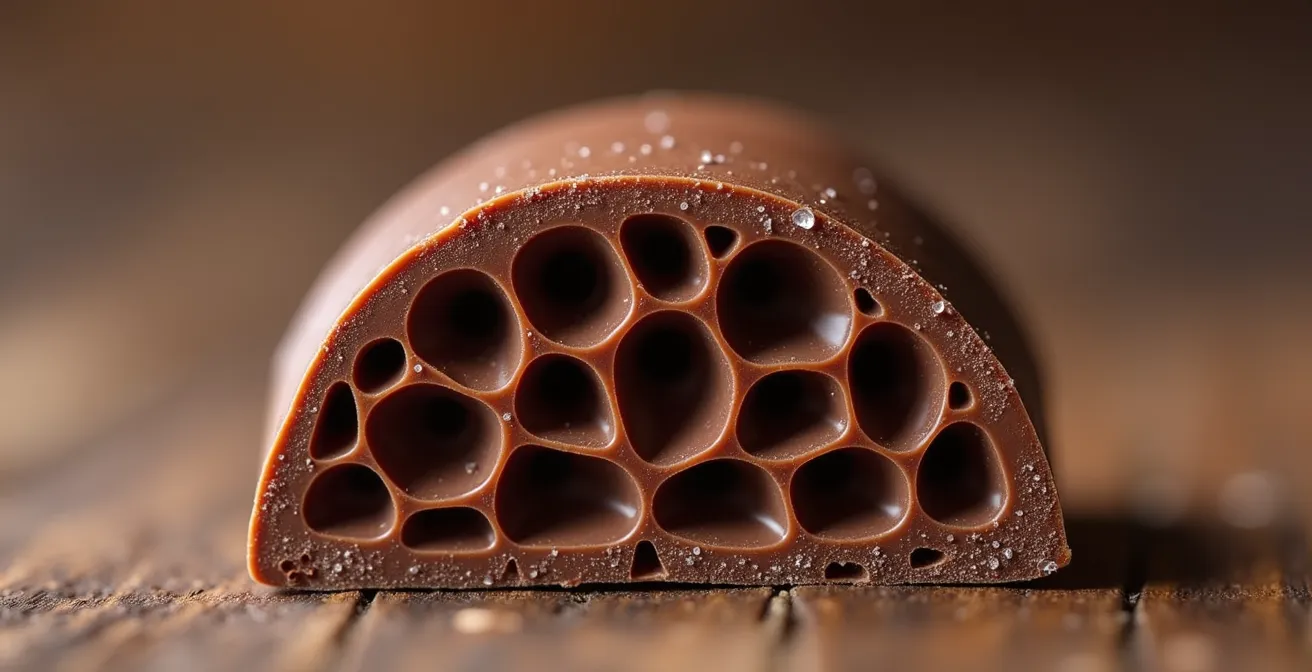
As the image above illustrates, we are now able to design the hidden internal world of chocolate. This is not just about reducing sugar; it’s about using functional ingredients like inulin to build novel textures from the inside out, creating a multi-textural journey in a single bite. This is a fundamental shift from homogenous mixtures to architected food experiences.
Silicone vs. Thermoforming: Which Allows More Complex Shapes?
The traditional debate between flexible silicone for easy demolding and rigid thermoformed plastic for sharpness often forces a compromise. Silicone can struggle with ultra-fine details and sharp angles, while traditional thermoforming has limitations with undercuts and complex negative spaces. However, 3D printing renders this “versus” debate obsolete by revolutionizing the creation of the *master molds* themselves. The new paradigm is not about choosing one material over the other, but using 3D printing to elevate the potential of thermoforming to new heights.
The process, as demonstrated by companies like Formlabs, involves 3D printing a “positive” master of the desired chocolate shape with incredible detail. This master is then used to vacuum-form a thin, food-safe plastic sheet over it, creating a “negative” mold that is both highly detailed and cost-effective for production. This hybrid approach combines the geometric freedom of 3D printing with the speed and material properties of thermoforming. As a result, designs with sharp facets, intricate textures, and even slight undercuts—previously the domain of painstaking manual work or impossible to achieve—become viable for series production.
This technological leap is quantifiable. Where manual mold making is limited by the artist’s hand, advanced 3D printing technology for chocolate molds can achieve resolutions down to the micron level. This precision means that the digital design is translated to the final chocolate with near-perfect fidelity. The question is no longer which material is better, but how to leverage 3D printing to create masters that push the boundaries of what any mold material was previously capable of.
Cacaofruit Pulp: How to Use the Sweetener of the Future?
For centuries, the pulpy fruit surrounding the cocoa bean was largely considered a waste byproduct of chocolate production. Today, thanks to significant technological advancements in harvesting and stabilization, this cacaofruit pulp is emerging as a “new” ingredient—a naturally sweet, tangy nectar that offers a sustainable and exciting alternative to refined sugar. Its flavor profile is a world away from chocolate, with bright notes of lychee, citrus, and pear. The challenge—and opportunity—for the futuristic chocolatier is how to integrate this volatile, liquid-rich ingredient without compromising the structure and stability of the chocolate.
This is where the precision of 3D printing becomes indispensable. Traditional methods like enrobing or one-shot depositing are too crude for the delicate and precise placement that cacaofruit pulp requires. Using a multi-extruder 3D printer, a designer can create a bonbon with a standard tempered chocolate shell while simultaneously depositing a tiny, hermetically sealed pocket of pure cacaofruit pulp at its core. This is the essence of programmable matter: engineering a structure that holds two chemically distinct ingredients separate until the moment of consumption.
This approach allows the consumer to first experience the snap and richness of the chocolate, followed by a surprising burst of bright, fruity pulp. It’s a sensory narrative that is impossible to write with conventional methods. As noted by food technology experts, the very existence of cacaofruit as a viable ingredient is a testament to innovation. According to a report from Coherent Market Insights, premium chocolate makers are increasingly leveraging such technologies to create value and reduce waste, turning a former byproduct into a star ingredient.
Augmented Reality: How to enhance the Tasting Experience Digitally?
The experience of a fine chocolate has always been confined to the physical senses: the aroma, the snap, the melt, the taste. But what if we could add another layer to this experience—a digital one? Augmented Reality (AR) offers a portal to enhance the tasting journey, transforming a simple piece of chocolate into an interactive story. This is the concept of Digital Terroir, where the story of the chocolate is as important as the product itself.
Imagine a consumer pointing their smartphone at a geometrically complex, 3D-printed bonbon. Instantly, their screen overlays a visualization of its intricate internal structure, showing the different layers of ganache they are about to taste. A tap could reveal a video of the specific farm in Peru where the cacao beans were grown, or an animation explaining the AI-driven logic behind its unique flavor pairing. This technology bridges the gap between the creator’s vision and the consumer’s perception, adding depth and emotional resonance to the experience.

This digital enhancement isn’t a gimmick; it’s a powerful tool for brand storytelling and consumer education. For the chef, it’s a way to communicate the immense thought and technology that went into creating the piece. For the consumer, it elevates the act of eating from simple consumption to an immersive, multi-sensory event. The 3D-printed chocolate, with its unique and machine-readable geometry, acts as the physical key—a QR code of sorts—that unlocks this rich digital world, making the invisible story of its creation visible.
Why Does Bean-to-Bar Couverture Require Different Tempering Curves?
Commercial couverture is engineered for consistency. It has a standardized fat content and crystal structure, allowing it to behave predictably within a standard tempering curve. Bean-to-bar chocolate, conversely, is a wilder, more variable material. The fat content can fluctuate based on the bean’s origin, the season of harvest, and the conching process. This variability means that a one-size-fits-all tempering curve is a recipe for disaster, leading to poor crystallization, a crumbly texture, and a dull finish. Each unique batch of bean-to-bar chocolate requires its own specific temperature-time pathway to achieve the stable Beta-V crystal form that gives chocolate its signature snap and gloss.
This is where the intelligence of modern chocolate 3D printers becomes a game-changer. Machines like the Cocoa Press are not just simple extruders; they are sophisticated crystallization engines. They feature advanced heating and cooling systems capable of holding temperatures with extreme precision. For example, a system that can adapt on the fly is essential for this work. The Cocoa Press 3D printer demonstrates that temperature precision to ±0.1°C is required for optimal results. This level of control allows a designer to program a custom tempering curve specifically for the bean-to-bar chocolate being used.
The printer can execute this multi-stage temperature profile automatically, ensuring the chocolate is perfectly in temper at the exact moment of deposition. This removes the guesswork and manual labor traditionally associated with tempering finicky, small-batch chocolates. It transforms tempering from a dark art into a repeatable science, allowing chocolatiers to consistently showcase the unique character of their bean-to-bar creations in geometrically complex forms.
How to Achieve Mirror-Like Shine on Your Molded Bonbons?
A flawless, mirror-like shine is the ultimate hallmark of a master chocolatier. Traditionally, this is achieved through a combination of perfectly tempered chocolate and meticulously polished polycarbonate molds. The smoother the mold surface, the higher the gloss. However, the pursuit of a perfect surface is reaching the limits of manual polishing. The future of shine lies not in more elbow grease, but in the realm of advanced material science applied directly to the mold’s surface.
The next generation of polycarbonate molds will be treated with manufacturing techniques borrowed from the semiconductor and aerospace industries. These are processes that create surfaces far smoother than any hand-polishing could ever achieve.
The use of plasma polishing or atomic vapor deposition can create an ultra-smooth, flawless surface on polycarbonate molds that is physically impossible to achieve with manual polishing.
– Material Science Researcher, Advanced Manufacturing Techniques
When perfectly tempered chocolate, with its stable Beta-V crystals, makes contact with such an atomically smooth surface, it sets into a near-perfect replica, resulting in a spectacular, liquid-like gloss. While these industrial techniques are not yet in every kitchen, the principle can be applied today. The key is to treat your molds as a critical optical surface. Any microscopic scratch, smudge, or residue will be faithfully imprinted on the chocolate’s surface, scattering light and dulling the shine. Achieving a mirror gloss is a function of minimizing surface imperfections at a microscopic level.
Action Plan: Auditing Your Molds for Maximum Gloss
- Assess Surface Integrity: Using a magnifying light, inspect every cavity for micro-scratches. Any mold with visible scratches in a high-light area should be retired from use for mirror-finish bonbons.
- Verify Chemical Purity: Ensure no residue from previous use, cleaning agents, or polishing compounds remains. Wash with warm, soft water and a pH-neutral detergent, then dry completely with a lint-free cloth.
- Test Surface Energy: A perfectly clean polycarbonate surface is hydrophobic. Place a tiny droplet of distilled water inside a cavity. It should bead up tightly. If it spreads out, it indicates a film of residue is present.
- Polish with Precision: If polishing, use only soft, medical-grade cotton balls or microfiber cloths designed for optical lenses. Apply gentle, circular motions. Never use abrasive powders or cloths.
- Final Inspection: Before filling, give the mold a final blast of clean, dry, compressed air to remove any microscopic dust particles that may have settled.
Key takeaways
- 3D printing transforms chocolate from a simple food into a “programmable matter,” where geometry dictates texture and flavor release.
- The future of innovation lies in “computational gastronomy”—using AI for flavor pairing—and “sensory architecture” to design the tasting experience.
- Advanced material science, both in ingredients like inulin and in mold surface treatments like plasma polishing, is becoming as important as culinary skill.
Polycarbonate vs. Silicone: Which Mold Material Gives Gloss?
The answer is unequivocally polycarbonate. While silicone offers superior flexibility for easy demolding of complex shapes, its surface properties are not conducive to a high-gloss finish. Silicone is a soft, porous material at a microscopic level. When liquid chocolate sets against it, it picks up this slightly matte, imperfect texture. Polycarbonate, on the other hand, is a hard, rigid, non-porous polymer. When polished to a flawless finish, it provides an optically smooth surface for the chocolate to crystallize against, resulting in a brilliant, mirror-like shine.
The difference lies in surface energy and hardness. Polycarbonate’s hard surface resists the micro-abrasions that dull a finish over time and allows the tempered chocolate to contract slightly upon cooling. This slight shrinkage is what allows the bonbon to release easily from a rigid mold, and it’s a critical step for creating the tension that contributes to a glossy surface. This is why industrial-scale production of high-end chocolates overwhelmingly relies on polycarbonate. The bakery and confectionery segment, which is a massive driver of this market, understands this principle well. In fact, according to market analysis, the bakery and confectionery products segment accounts for over a third of the entire 3D food printing market revenue, and the demand for quality finishes is paramount.
Pioneering facilities like Barry Callebaut’s Mona Lisa 3D Studio are prime examples. They have industrialized the art of 3D printed chocolate, and for their molded creations that require a perfect sheen, they rely on systems that use highly polished polycarbonate molds. This industrial application proves the material’s superiority for achieving gloss at scale, solidifying its status as the material of choice for any chocolatier prioritizing a brilliant finish over flexible demolding.
The era of chocolate as a simple confection is ending. We are now armed with tools that allow us to design with intention at every level, from the molecular pairing of flavors to the sequenced release of textures and the digital story that accompanies the final bite. 3D printing is not just another tool in the kitchen; it is the catalyst for a new discipline of sensory architecture. The principles are established, and the technology is here. The only remaining question is what kind of experiences you will choose to build.