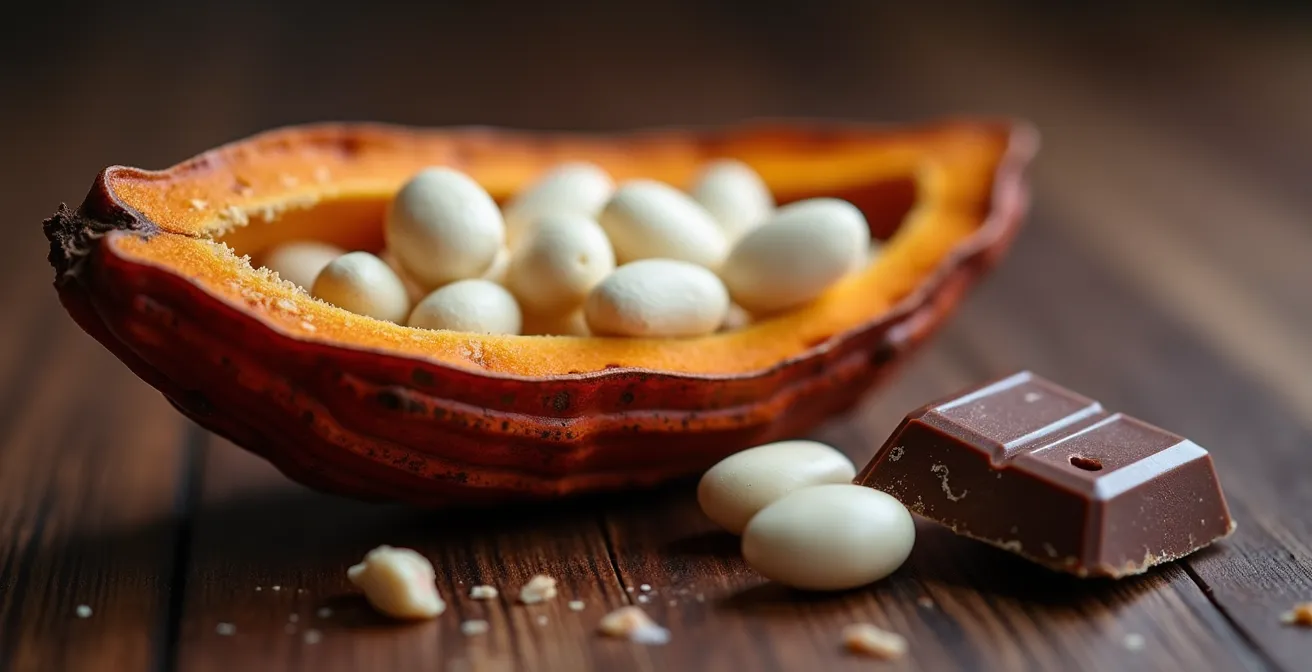
Criollo cacao’s mythical status isn’t marketing; it’s a direct consequence of an ancient genetic blueprint that dictates both its unparalleled flavor and its extreme agricultural fragility.
- Its unique, low-tannin genetics create a naturally creamy and sweet profile, devoid of the bitterness found in lesser beans.
- A lack of genetic diversity, a byproduct of its pure lineage, makes it exceptionally vulnerable to disease, rendering each harvest a high-stakes gamble.
Recommendation: The true connoisseur appreciates Criollo not just for its taste, but for the immense agricultural risk and profound heritage that each bar represents.
In the vast world of chocolate, a chasm separates the everyday confection from the artisan bar. While one offers a simple, sweet comfort, the other presents a complex tapestry of flavors, a sensory journey dictated by the very DNA of the bean. For the true collector of taste, one name echoes with an almost mythical reverence: Criollo. This is not just another cacao; it is an heirloom, an artifact of agricultural history, often called the “prince of cocoas.” But this title is not merely a testament to its sublime taste; it’s an acknowledgment of its precarious existence.
The common narrative speaks of rarity and high cost, but this barely scratches the surface. To truly understand Criollo is to move beyond the price tag and into the realm of genetics, history, and agricultural science. Why does this bean command such a premium? The answer lies in its unique genetic code, a double-edged sword that grants it an unmatched aromatic signature while simultaneously rendering it one of the most fragile and challenging crops in the world. It is a story of purity at a price, a quest for flavor that pushes the boundaries of farming.
This exploration will delve into the very essence of Criollo. We will dissect its genetic makeup to understand its flavor, analyze the economic and agricultural risks that define its value, and provide the connoisseur’s tools to distinguish the authentic from the imitation. This is the journey into the heart of the Criollo conundrum, a pursuit of the myth and the reality of the world’s most treasured cacao.
This article provides a comprehensive look into the world of Criollo cacao, exploring its unique characteristics from the soil to the palate. The following sections will guide you through its complex identity.
Summary: The Complete Guide to Criollo, the Prince of Cocoas
- Why Mass-Market Chocolate Lacks the 600+ Flavor Compounds of Artisan Bars?
- How Does Volcanic Soil Change the Acidity of Cocoa Beans?
- Why Do You Pay 50% More for True Criollo Genetics?
- How to Identify a Cut Criollo Bean by Its White Interior?
- Pure Criollo vs. High-Quality Trinitario: Can You Taste the Difference?
- The Farming Risk: Why Criollo Trees Are So Susceptible to Disease?
- When to Harvest Criollo Pods for Peak Aromatic Complexity?
- Why Trinitario Beans Offer the Best Balance for Craft Chocolate Makers?
Why Mass-Market Chocolate Lacks the 600+ Flavor Compounds of Artisan Bars?
The fundamental difference between a mass-produced candy bar and a fine artisan chocolate lies in the genetic source of its primary ingredient. The vast majority of the world’s chocolate is made from Forastero cacao, a robust, high-yield variety prized for its disease resistance and productivity, not its flavor. It delivers a one-dimensional, strong “chocolatey” taste. Artisan chocolate, however, seeks out rare, heirloom varieties that possess a complex genetic blueprint capable of producing over 600 aromatic compounds. At the apex of this hierarchy sits Criollo.
Considered the original cacao, consumed by the Maya centuries ago, Criollo is a genetic treasure. Its defining characteristic is a natural absence of tannins, the polyphenols that typically impart bitterness and astringency to cacao. This genetic anomaly gives pure Criollo an unparalleled natural sweetness, creaminess, and roundness on the palate. While other beans require long conching times and high sugar content to mask bitterness, Criollo’s profile is inherently delicate and complex, revealing notes of nuts, caramel, and soft red fruits without aggressive processing.
This genetic purity, however, is the very source of its rarity. As a result of centuries of selective cultivation that prized flavor over resilience, Criollo has been marginalized by hardier hybrids. According to in-depth research from industry experts, it is estimated that pure Criollo varieties now account for just 0.01% of global cacao production. This makes every bar of pure Criollo chocolate not just a treat, but a taste of living history and a near-extinct flavor profile.
How Does Volcanic Soil Change the Acidity of Cocoa Beans?
While the genetic blueprint of a cacao bean sets the potential for its flavor, the environment in which it is grown—the terroir—writes the final aromatic signature. Among the most dramatic influencers of terroir is the soil itself, and volcanic soil, in particular, has a profound impact on a bean’s final taste profile, especially its acidity. Rich in minerals like magnesium, iron, potassium, and sulphur, this dark, fertile earth acts as a natural flavor catalyst.
Volcanic soils are typically well-draining and have a specific pH that influences how the cacao tree absorbs nutrients. This unique mineral uptake can temper a bean’s inherent malic or citric acidity, transforming sharp, aggressive notes into a more complex, balanced, and pleasant brightness. It doesn’t eliminate acidity but rather refines it, adding layers of nuance that might be perceived as a subtle spiciness or a deep, earthy undertone that complements the primary flavors of the bean.
This paragraph introduces the powerful effect of terroir. The illustration below captures the unique environment where cacao trees thrive in rich, dark volcanic earth, with misty mountains providing a dramatic backdrop.

A prime example of this terroir imprint is found in the “Javablond” Criollo. This is the same genetic strain as the famed Chuao Criollo from Venezuela, but when grown in the volcanic soil of Java, its flavor profile is completely transformed. The Javablond develops distinct spice notes and a smoky hint of tobacco, a profile entirely absent in its Venezuelan counterpart. This demonstrates unequivocally how a powerful terroir like volcanic soil can rewrite a bean’s inherent flavor code, creating a unique and geographically specific tasting experience.
Why Do You Pay 50% More for True Criollo Genetics?
The premium price of Criollo chocolate is a direct reflection of fundamental agricultural economics: immense risk and extremely low yield. While modern hybrid cacao trees (like CCN-51) are bred for productivity, a Criollo tree remains a wild, untamed heirloom. It is a poor producer by nature, and this inefficiency is the primary driver of its cost. The numbers are stark: while a high-yield hybrid can produce 2-3 kg of dry beans per year, data from cacao specialists shows that a Criollo tree yields only 0.5 kg per year on average.
A farmer therefore needs four to six times the amount of land and labor to produce the same quantity of Criollo as they would a standard hybrid. This alone makes it a challenging business proposition. But the economic risk is compounded by the tree’s fragility, which we will explore later. This combination of low yield and high risk means that only dedicated, passionate farmers are willing to undertake its cultivation. The high price is not a matter of luxury branding; it is the minimum required to make growing this fragile bean economically viable.
The value of this heritage was proven on the world stage in 2021. Christopher Fadriga, a farmer in Negros, Philippines, submitted his heirloom Criollo beans to the prestigious International Cocoa Awards. His beans, which trace their lineage back 400 years to seeds from the Spanish Galleon Trade, earned a gold rating, standing out among 235 samples from the world’s top cacao-producing nations. This recognition validates that true, verifiable Criollo genetics carry an intrinsic, award-winning quality that justifies the premium.
How to Identify a Cut Criollo Bean by Its White Interior?
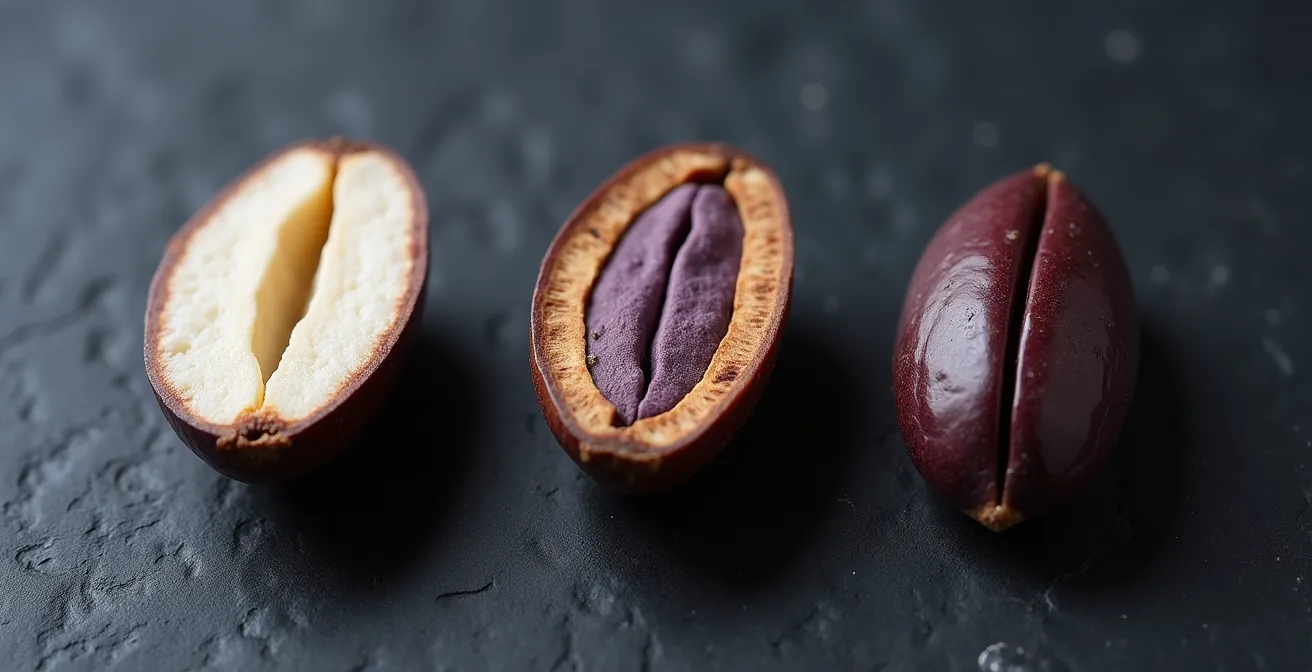
For a connoisseur, being able to visually identify a true Criollo bean is a mark of expertise. While genetic testing is the only way to be 100% certain of purity, the most reliable physical indicator is the color of the bean’s interior upon being cut. Unlike the deep, uniform purple of a Forastero bean, a pure Criollo bean is distinguished by its strikingly pale interior. This is due to a low concentration of anthocyanins, the pigments responsible for red and purple colors.
The ideal color for the most prized Criollo, like the Porcelana variety, is a porcelain white or creamy white. However, it’s important to approach this test with a historian’s nuance. Some ancestral Criollo strains, which may have trace amounts of hybrid DNA from centuries past, can exhibit faint violet marbling or a light purple hue. This does not necessarily disqualify them as high-quality Criollo, but rather speaks to their unique lineage. The key is the absence of the deep, opaque purple that characterizes the more common and bitter Forastero.
The image below provides a clear comparison, showing the distinct porcelain white of a cut Criollo bean next to the mottled Trinitario and the deep purple Forastero, offering a visual key for identification.
This visual inspection is an essential skill, but it requires practice and a well-trained eye. To assist in this process, consider the following steps as a field guide for identifying these precious beans.
Your Field Guide: Verifying Criollo Beans
- Examine the Interior Color: Look for a porcelain white to creamy white coloration, which is the hallmark of the purest Criollo varieties like Porcelana.
- Check for Pigment Absence: Note the near-complete lack of deep purple pigmentation. True Criollo has minimal anthocyanins.
- Assess Subtle Hues: Observe any light purple tinges or faint violet marbling. These can still indicate valuable ancestral Criollo strains.
- Compare with Controls: Contrast the bean with a known Forastero (deep, uniform purple) and Trinitario (a mottled, varied palette) to calibrate your eye.
- Acknowledge Limitations: Remember that while the white interior is a strong indicator, only genetic testing can confirm 100% Criollo purity.
Pure Criollo vs. High-Quality Trinitario: Can You Taste the Difference?
For the discerning palate, distinguishing between a pure Criollo and a high-quality Trinitario is a fascinating exercise. While Trinitario is itself a fine flavor cacao—a hybrid of Criollo and Forastero—the tasting experience is notably different. The difference lies not in “good” versus “bad,” but in character and subtlety. Criollo’s profile is defined by its elegance and softness, while Trinitario typically presents a bolder, more assertive character.
The initial attack of a Criollo on the palate is remarkably gentle. Its extremely low bitterness allows delicate primary notes of fresh nuts, soft florals, and subtle caramel to emerge immediately. The chocolate base is refined and acts as a quiet backdrop rather than the main event. Its most defining feature is its finish: exceptionally long, clean, and complex, lingering for minutes without a trace of astringency. The texture is another giveaway, often feeling incredibly fine and creamy due to its high cocoa butter content and lack of harsh compounds.
The following table, based on extensive tasting profiles, breaks down the key sensory differences between these two elite cacao varieties. This comparative analysis is a vital tool for any flavor collector looking to refine their palate and understand the nuances that define the world’s best chocolates.
| Characteristic | Pure Criollo | High-Quality Trinitario |
|---|---|---|
| Initial Attack | Soft, delicate | Bolder, more pronounced |
| Primary Notes | Fresh nuts, delicate florals | Fruity acidity (citrus, red berries) |
| Bitterness Level | Very low to absent | Pleasant, well-integrated |
| Chocolate Base | Subtle, refined | More pronounced chocolatey character |
| Finish | Exceptionally long, clean | Medium-long with complexity |
| Texture | Extremely fine, creamy | Smooth with more structure |
As this detailed breakdown of cacao varieties shows, a high-quality Trinitario is a superb chocolate, often exhibiting a beautiful fruity acidity and a more robust “chocolatey” character. However, it lacks the ultimate delicacy and the exceptionally clean, prolonged finish that is the unique and unmistakable aromatic signature of pure Criollo.
The Farming Risk: Why Criollo Trees Are So Susceptible to Disease?
The agricultural fragility of Criollo is the dark side of its genetic purity. The very traits that make its flavor so unique also make it a farmer’s nightmare. The core of the problem lies in its shallow gene pool. Centuries of domestication focused solely on preserving its exceptional flavor profile have resulted in a plant with virtually no natural defenses against common but devastating cacao diseases.
As one expert guide on cacao explains, this lack of genetic diversity means Criollo trees lack the resistance genes for widespread diseases like Witches’ Broom and Frosty Pod Rot. These genes are abundant in the wild and robust Forastero population, which has evolved to survive in harsh environments. Criollo, by contrast, is like a thoroughbred racehorse—finely tuned for one purpose but delicate and susceptible to a host of ailments. A single outbreak can wipe out an entire harvest, a catastrophic financial loss for a farmer who has already invested heavily in a low-yield crop.
This risk is not abstract. The cacao industry as a whole is constantly battling disease. In the 2023/24 season, it was reported that the two major producers Côte d’Ivoire and Ghana, accounting for over 60% of global production, were facing significant challenges from disease and adverse weather. If the hardy Forastero that dominates these regions is struggling, the immense risk undertaken by a Criollo farmer becomes starkly clear. They are cultivating a fragile artifact in a hostile world, and this gamble is factored into every bean.
When to Harvest Criollo Pods for Peak Aromatic Complexity?
For a cacao as delicate as Criollo, the moment of harvest is not just a logistical step; it is the single most critical point in determining the final quality of the bean. The window for peak ripeness is incredibly narrow, often lasting just a few days. Harvesting even a day too early or a day too late can irrevocably compromise the bean’s potential for complex flavor development. This precision is what separates a good Criollo from a truly transcendent one.
An experienced farmer relies on a combination of senses to identify this perfect moment. They will shake the pod to listen for the faint rattle of detached beans, observe the pod’s color as it shifts to its characteristic yellow or red, and feel for a subtle give when the husk is gently pressed. Harvesting too early means the sugars in the pulp have not fully developed, starving the subsequent fermentation of its necessary fuel. This results in a flat, uninspired flavor.
Conversely, waiting too long is even more disastrous. The beans may begin to germinate inside the pod, a process that introduces a harsh bitterness and destroys the delicate flavor precursors that define the Criollo profile. The goal is to harvest when the pulp’s sugar content (measured in Brix) is at its absolute maximum, providing the optimal fuel for the fermentation process where the 600+ aromatic compounds are truly born. This obsessive focus on timing is a hallmark of the world’s finest cacao producers.
Key Takeaways
- Criollo’s value is rooted in its unique genetics, which yield a low-bitterness, complex flavor but also create extreme agricultural fragility.
- Visual identification of true Criollo relies on its white or pale interior, a result of low anthocyanin content.
- The premium price is a direct economic consequence of extremely low yields and high susceptibility to disease, not artificial scarcity.
Why Trinitario Beans Offer the Best Balance for Craft Chocolate Makers?
While Criollo holds the crown for rarity and delicacy, its agricultural and economic challenges make it an impractical choice for many craft chocolate makers. This is where Trinitario, its hybrid descendant, finds its purpose. Born from a cross between Criollo and Forastero, Trinitario was a fortunate accident of nature that created what many consider the perfect compromise: a bean with much of the flavor complexity of its Criollo parent and the hardiness and higher yield of its Forastero one.
As a result, Trinitario has become the workhorse of the fine flavor chocolate world. While still considered a specialty bean, analysis shows that Trinitario beans make up less than 10% of the world’s cacao, making it significantly more available than the near-mythical Criollo. This accessibility allows craft makers to produce exceptional chocolate at a more approachable price point, bringing complex flavor profiles to a wider audience. Trinitario is known for its bright, fruity notes and a more pronounced “chocolatey” base, offering a different but equally compelling tasting experience.
Its role as the ideal middle ground is perfectly summarized by experts in the field. This perspective highlights its dual nature, combining the best attributes of its parentage:
Trinitario is the ultimate compromise: the ‘best of both worlds’. It combines the hardiness and higher yield of Forastero with much of the aromatic complexity of Criollo. Famous varieties like Chuao or Ocumare from Venezuela are world-renowned and rival Criollos in complexity and price.
– Bar & Cocoa
Ultimately, Trinitario’s existence doesn’t diminish Criollo’s status; it enhances it. It allows Criollo to remain what it is: a precious, rare artifact for special occasions, while Trinitario carries the banner of fine flavor for the passionate daily connoisseur. It provides the perfect balance of quality, availability, and economic viability for the craft chocolate industry.
By appreciating the genetic heritage, agricultural challenges, and sensory nuances of Criollo, the flavor collector embarks on a deeper journey. The next logical step is to seek out these rare chocolates and begin the personal exploration of their unparalleled taste.
Frequently Asked Questions about Criollo Cacao
What are the key indicators that Criollo pods are ready for harvest?
Ripe Criollo pods can be identified by shaking to hear beans rattle inside, the pod developing its characteristic red or yellow color, and a slight give when gently pressed. The optimal window is extremely narrow – just a few days.
Why is harvest timing more critical for Criollo than other varieties?
Criollo’s delicate flavor profile requires precise timing. Harvesting too early means flavor precursors haven’t developed, while waiting too long risks bean germination inside the pod, creating bitterness that ruins the subtle profile.
How does harvest timing affect fermentation quality?
At peak ripeness, the pulp has maximum sugar content (Brix level) and ideal pH, serving as optimal ‘fuel’ for fermentation. This directly impacts the development of Criollo’s characteristic 600+ aromatic compounds.