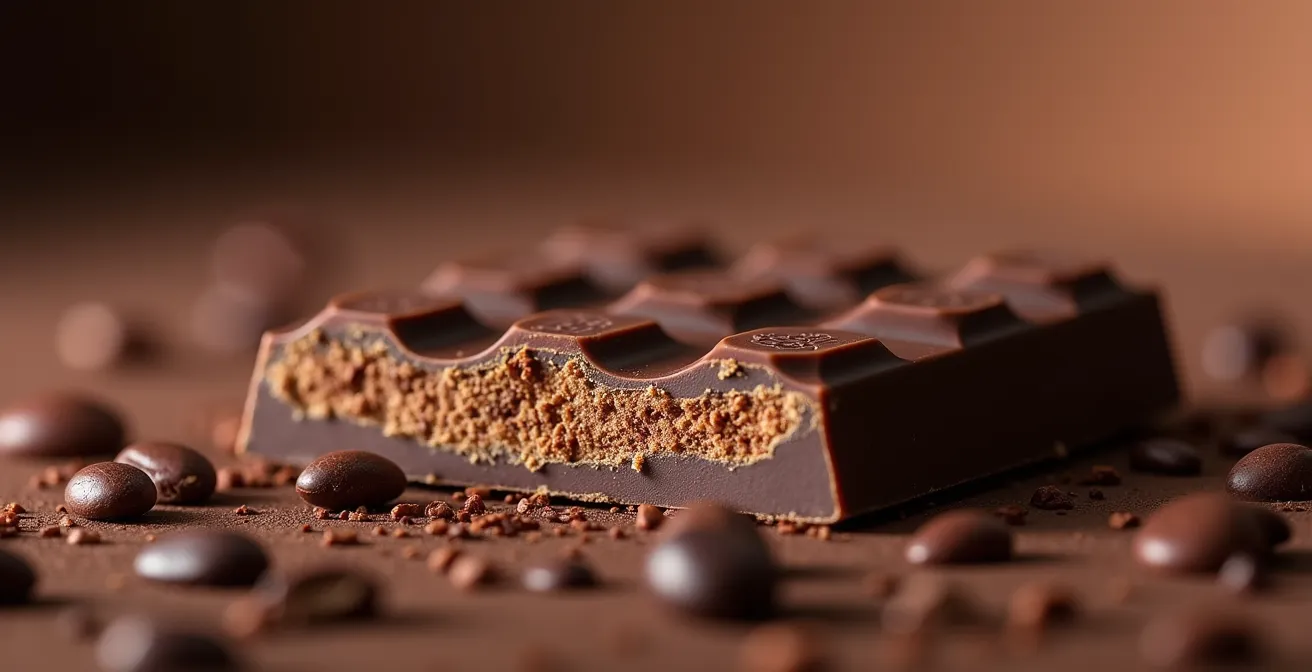
Dismissing milk chocolate is a connoisseur’s biggest mistake, and the rise of ‘dark milk’ is the proof.
- This category isn’t about adding sweetness, but about using milk solids for sophisticated “flavor modulation” via complex chemistry like the Maillard reaction, creating notes of toffee and caramel impossible in pure darks.
- From a culinary standpoint, the milk proteins in high-cacao dark milk give it a superior structural stability, making it the preferred choice for technically demanding applications like mousses and ganaches.
Recommendation: Approach dark milk not as a compromise, but as a distinct and complex category to be explored with the same rigor and curiosity you apply to single-origin dark chocolates.
For the dedicated chocolate purist, the world is often black and white. There is dark chocolate—the noble, complex, terroir-driven expression of the cacao bean—and then there is… everything else. Milk chocolate, in this view, is often relegated to the realm of childhood nostalgia and unsophisticated palates; a sweet, one-dimensional confection where the nuance of the bean is buried under an avalanche of sugar and milk powder. It’s a common stance, a badge of honor for those who appreciate the bitter, acidic, and fruity notes of a 75% Madagascan or a 90% Peruvian bar.
But what if this purist stance, this dismissal of an entire category, is based on an outdated premise? What if, within the craft chocolate movement, artisans are using milk not to dilute flavor, but to amplify and transform it? A new category is quietly emerging from the workshops of the world’s best chocolatiers, one that challenges the very definition of “fine chocolate.” This is the world of dark milk chocolate, a sophisticated and scientifically fascinating domain that leverages advanced food science to create flavor profiles that are complex, compelling, and utterly unique.
This is not a compromise between dark and milk. It is a category engineered for nuance. It’s where the Maillard reaction is intentionally coaxed to produce profound caramel notes, and where milk solids act as a “flavor modulator,” softening the sharp edges of a bean to let more subtle notes of nut and brioche shine through. For the true connoisseur, ignoring dark milk is no longer a sign of a refined palate; it’s a missed opportunity to explore the next frontier of chocolate innovation.
This guide will deconstruct the science, culinary applications, and tasting principles of this exciting trend. We will explore why it has become a secret weapon for pastry chefs and why a dark chocolate snob, armed with new knowledge, might just find their next obsession in a bar that proudly contains milk.
Summary: The Sophisticated World of Dark Milk Chocolate
- 40% vs. 60%: Where Does Milk Chocolate Become “Dark Milk”?
- Maillard Reaction: Why Does Some Milk Chocolate Taste Like Toffee?
- Blue Cheese and Milk Chocolate: Why Does This Pairing Work?
- Mousse vs. Ganache: Where Does Milk Chocolate Shine Best?
- The Snobbery Mistake: Dismissing Milk Chocolate as “For Kids”
- Why Artisanal Chocolate Costs 3x More Than Industrial Bars?
- How Does Volcanic Soil Change the Acidity of Cocoa Beans?
- How to Identify the 3 Primary Aromatic Families in Fine Chocolate?
40% vs. 60%: Where Does Milk Chocolate Become “Dark Milk”?
For a dark chocolate aficionado, percentages are everything. They are a shorthand for intensity, purity, and quality. But the term “dark milk” deliberately blurs these familiar lines, creating a category that defies simple classification. So, where is the boundary? While there’s no legally binding global standard, a strong consensus has formed within the craft chocolate community. Generally, dark milk chocolate begins where high-end milk chocolate ends, typically featuring a cacao content of 40% and soaring up to 65% or even higher. For context, most mass-market milk chocolate bars contain between 10% and 30% cacao.
However, many craft chocolate makers are setting new standards with a 55% minimum cacao content for their dark milk offerings. This high percentage ensures that the foundational flavor profile is still driven by the origin of the bean, with its inherent fruity, nutty, or earthy notes. The milk is no longer the star of the show; it’s a supporting actor, present in just the right amount to soften acidity and add a layer of creamy complexity.
Technically, “dark chocolate” doesn’t mean anything. It doesn’t have a formal definition, according to the USDA. Instead it’s actually part of the umbrella term “sweet chocolate,” which can include up to 12 percent milk solids.
– The Kitchn, Dark Milk Chocolate Is a Real Thing
This ambiguity in official definitions is precisely what gives artisans the freedom to innovate. They are not bound by rigid rules, but by the pursuit of flavor. For the connoisseur, this means letting go of the strict “dark vs. milk” binary and learning to evaluate these bars on a new spectrum—one where cacao percentage and milk content coexist to create something entirely new and compelling.
Maillard Reaction: Why Does Some Milk Chocolate Taste Like Toffee?
One of the most captivating characteristics of a great dark milk chocolate is its pronounced notes of caramel, biscuit, and toffee. These are not flavors added via inclusions; they are created from within the chocolate itself during processing, thanks to a beautiful piece of food chemistry known as the Maillard reaction. This is the same chemical process responsible for the browning of bread crust, the searing of a steak, and the roasting of coffee beans. It occurs when amino acids (from proteins) and reducing sugars react under heat, creating a cascade of hundreds of new aromatic compounds.
In chocolate making, the Maillard reaction happens during roasting and, most importantly for dark milk, during conching. Conching is a long process of grinding and aerating chocolate to refine its texture and flavor. When you have milk solids (containing both protein and lactose, a sugar) present alongside high-cacao content, the conditions are perfect. The extended processing times reveal that the Maillard reaction is what creates the signature caramel flavor of dark milk chocolate.
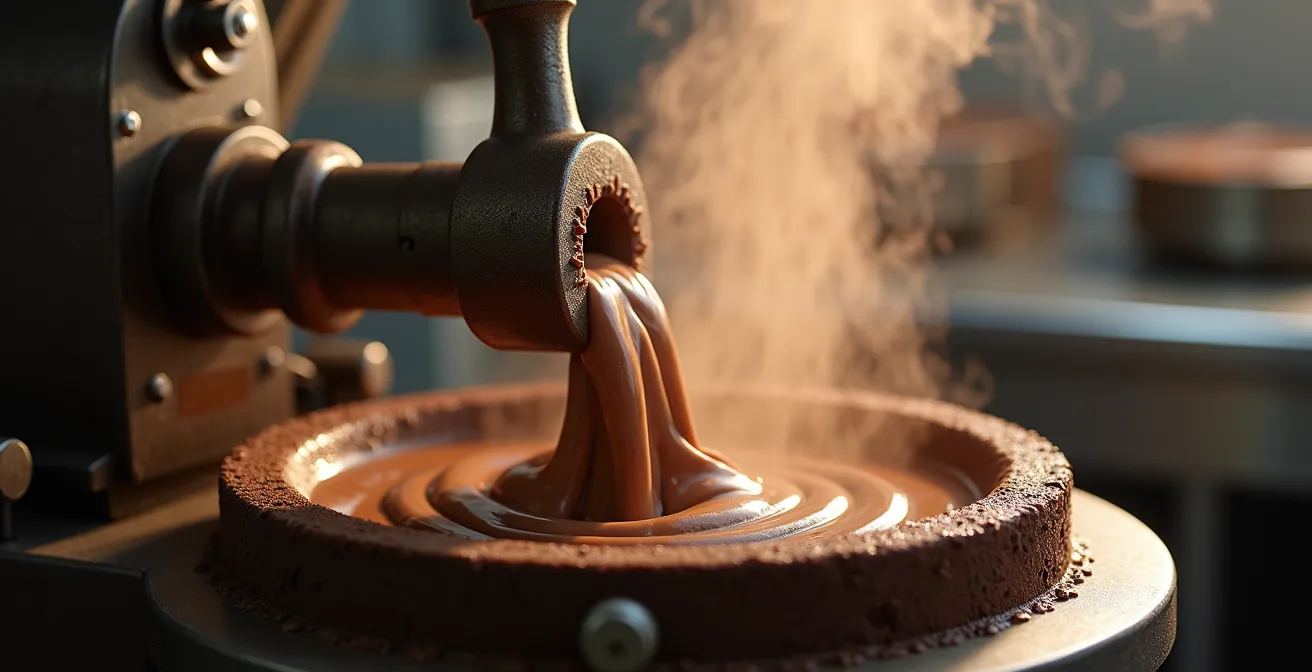
This is where dark milk truly distinguishes itself. Pure dark chocolate, lacking milk proteins and sugars, cannot undergo the Maillard reaction in the same way. It develops its flavor primarily through roasting and the reduction of acidic volatile compounds. Dark milk, however, has this extra tool in its flavor development arsenal, allowing a chocolatier to build a deeper, warmer, and more complex base of “brown” flavors that perfectly complements the cacao’s origin notes.
Case Study: Zotter’s 70/30 “No Sugar Added” Innovation
Pioneering chocolatier Zotter created a revolutionary product that is technically a 70% dark chocolate but contains 30% milk content, with no added sugar. This bar fits no traditional category. The result is creamy and mild like a milk chocolate but with the intensity and soft snap of a high-cacao bar. It showcases how milk can be used to temper the intensity of 100% cacao while adding richness, creating a new experience entirely.
Blue Cheese and Milk Chocolate: Why Does This Pairing Work?
Pairing chocolate with cheese is a classic connoisseur’s game, but the idea of matching a funky, salty blue cheese with a *milk* chocolate might seem counterintuitive. The conventional wisdom would be to reach for a powerful, bitter dark chocolate to stand up to the cheese. Yet, a high-cacao dark milk often creates a more harmonious and mind-bendingly delicious pairing. The secret lies not in opposing flavors, but in shared molecular compounds.
This is a principle straight out of molecular gastronomy. Both aged cheese and dairy products (like the milk solids in the chocolate) are rich in butyric acid, a fatty acid that contributes to their distinctive tangy and “cheesy” flavors. When you taste them together, these shared compounds don’t clash; they resonate and amplify one another. The salt in the blue cheese heightens the caramel notes from the chocolate’s Maillard reaction, while the chocolate’s creaminess mellows the sharp bite of the cheese, resulting in a perfectly balanced, sweet-and-savory experience that tastes almost like a salted caramel cheesecake.
Think about coffee — also a naturally bitter and acidic substance made from roasted seeds. When you add cream to coffee, the dairy fat and milk solids in the cream cut a lot of the bitterness and acidity of the coffee, allowing other flavor notes to shine through. Similarly, milk powder acts as a flavor modulator in chocolate, bringing out some flavors and muting others.
– Chocolate Disorder, Obsession: dark milk chocolate
This concept of milk as a “flavor modulator” is crucial. It’s not just about adding sweetness or creaminess. It’s a strategic tool that a chocolatier uses to fine-tune the final profile of a bar, suppressing harsh acidity to allow more delicate, underlying flavors of the cacao to emerge. This is what makes dark milk such a versatile partner for bold foods like blue cheese.
Your Action Plan: The Molecular Pairing Experiment
- Start with room temperature dark milk chocolate (55-60% cacao) for optimal melting.
- Select an aged blue cheese with visible veining for maximum umami compounds.
- Place a small piece of chocolate on your tongue and let it begin to melt.
- Add a small crumble of blue cheese while the chocolate is still melting to activate the shared butyric acid compounds.
- Notice how the dairy fats from both elements harmonize, creating a unified, creamy texture and a third, emergent flavor.
Mousse vs. Ganache: Where Does Milk Chocolate Shine Best?
Beyond the tasting bar, a chocolate’s true character is often revealed in the kitchen. For pastry chefs, the technical performance of a chocolate is just as important as its flavor. While high-percentage dark chocolates are prized for their intensity, they can be notoriously finicky. Their high cacao butter content and low level of emulsifiers can make them prone to splitting in ganaches or creating overly dense, heavy mousses. This is where dark milk emerges as a culinary superstar, offering a superior balance of flavor and structural integrity.
The key lies in the milk proteins (casein and whey) and milk fat. These components act as powerful natural emulsifiers, helping to create and maintain a stable bond between the fat (cacao butter, milk fat) and water (from cream or other liquids). This results in smoother, glossier, and more resilient ganaches that are less likely to break or become grainy. In a mousse, the proteins help build a stronger, more flexible foam structure, allowing for more air to be incorporated. The result is a mousse that is lighter, more aerated, and has a luxuriously silky texture, all while delivering a rich, complex chocolate flavor.
The lower freezing point of dark milk chocolate, due to its sugar (lactose) and milk solid content, also makes it ideal for ice creams and sorbets, resulting in a creamier final product with fewer ice crystals. For a dark chocolate purist, this might be a revelation: the very ingredient they disdained—milk—is the key to unlocking superior texture and technical performance in their favorite desserts.
This table from Hotel Chocolat shows how dark milk’s unique composition gives it a technical edge in several classic pastry applications. The milk isn’t a flaw; it’s a feature that enhances performance.
| Application | Traditional Dark (70%) | Dark Milk (55-65%) | Key Advantage |
|---|---|---|---|
| Ganache | Can split if overheated | More stable emulsion | Milk proteins stabilize |
| Mousse | Dense, intense | Lighter, more aeration | Better foam structure |
| Ice Cream | Can crystallize | Creamier texture | Lower freezing point |
| Pot de Crème | Sometimes too bitter | Balanced sweetness | Ideal cocoa/cream ratio |
The Snobbery Mistake: Dismissing Milk Chocolate as “For Kids”
Perhaps the biggest barrier for dark chocolate lovers is a deeply ingrained cultural bias: the idea that milk chocolate is simplistic, overly sweet, and “for kids.” It’s a perception that expert Clay Gordon eloquently captured, comparing it to a wine that doesn’t get the respect it deserves. This is the snobbery mistake—judging an entire, diverse category by its most basic, mass-produced examples. It’s akin to dismissing all red wine because you once had a bad glass of generic table wine.
“Milk chocolate,” expert Clay Gordon writes in Discover Chocolate, “is the white Zinfandel of the chocolate world: It doesn’t get the respect it deserves.”
– Clay Gordon, Discover Chocolate
The reality is that consumer preference is not so black and white. Market data shows that milk chocolate accounted for approximately 60% of total chocolate sales in 2023. This isn’t a niche product; it’s the dominant form of chocolate consumed worldwide. Craft chocolate makers see this not as a problem, but as an enormous opportunity: to take the familiar, comforting profile of milk chocolate and elevate it with high-quality beans, sophisticated processing, and a connoisseur’s attention to detail. They are reclaiming milk chocolate from the candy aisle and placing it squarely in the world of fine food.
For the dark chocolate snob, the challenge is to approach a dark milk bar with an open mind. To set aside the prejudice and engage the senses, just as they would with a single-origin dark. To search for the subtle tasting notes, appreciate the creamy texture, and admire the complex chemistry that created it. The “snobbery mistake” is assuming there is nothing to find. The connoisseur’s triumph is discovering the rich, complex world that was hiding in plain sight all along.
Why Artisanal Chocolate Costs 3x More Than Industrial Bars?
Any seasoned chocolate buyer knows that a craft chocolate bar comes with a premium price tag. This isn’t arbitrary; it reflects a fundamental difference in philosophy, ingredients, and process. The principles that justify the cost of a high-end dark chocolate bar apply with equal, if not greater, force to artisanal dark milk. It begins with the most important ingredient: the cacao. Artisans work with “fine flavor” cacao, sourced directly from specific farms or cooperatives, for which they pay a significant premium—often several times the commodity market price—to ensure quality and ethical practices.
The process is also far more labor-intensive. Industrial chocolate is made in massive quantities with a focus on speed and uniformity. Artisanal makers work in small batches, where they can meticulously control every variable. This includes custom roast profiles for each specific bean origin and significantly longer conching and refining times—sometimes up to 72 hours—to develop flavor complexity and achieve a silken texture. When making dark milk, another high-cost ingredient is added: high-quality milk powder, often sourced from specific dairy farms, which is vastly different from the cheap skim milk powder used in industrial bars.
Ultimately, consumers are paying for expertise and intent. As the premium chocolate market grows, brands have educated consumers to associate high-cacao content with health benefits and luxury. According to a market analysis by Grand View Research, this “affordable luxury” trend is a major driver, with brands like Lindt & Sprüngli successfully marketing the wellness aspects of their 85% and 90% cocoa bars. Artisans are now applying this same logic to dark milk, framing it not as a candy, but as an indulgence crafted with the same level of care, quality ingredients, and health-consciousness as its dark chocolate counterparts.
How Does Volcanic Soil Change the Acidity of Cocoa Beans?
The concept of terroir—the idea that the soil, climate, and environment of a specific place impart unique characteristics to a food—is central to the appreciation of fine wine, coffee, and dark chocolate. A dark chocolate connoisseur can often identify the bright, fruity notes of a Madagascan bean versus the earthy, nutty profile of an Ecuadorian one. This same principle is critical in selecting the perfect cacao for a world-class dark milk chocolate, and volcanic soil offers a distinct advantage.
Cacao beans are naturally acidic. While this acidity can be a desirable, bright note in some dark chocolates, it can clash unpleasantly with the lactic acid and proteins in milk, creating a sour or tangy off-flavor. Cacao grown in rich, mineral-dense volcanic soil, however, often has a naturally lower acidity. The soil composition acts as a buffer, leading to beans with a smoother, rounder, and more grounded flavor profile. These are often described as having notes of minerals, earth, or tobacco.
This lower acidity makes them the perfect canvas for dark milk chocolate. The chocolatier doesn’t have to fight against the bean’s inherent sharpness. Instead, the creamy, caramel notes developed during the Maillard reaction can harmonize beautifully with the bean’s mellow base flavor. Regions like Nicaragua, Guatemala, and parts of Ecuador with volcanic terroir are therefore highly sought after for producing beans destined for dark milk. The result is a chocolate that is perfectly integrated, where the cacao and the milk complement each other rather than compete, creating a seamless and sophisticated tasting experience.
Key Takeaways
- Dark milk is a distinct category (40-65%+ cacao), not a simple hybrid, defined by craft consensus rather than legal standards.
- Its signature toffee/caramel notes are a result of the Maillard reaction between milk solids and cacao during conching, a chemical process absent in pure dark chocolate.
– For culinary use, dark milk offers superior structural stability for smoother ganaches and lighter mousses due to the emulsifying power of milk proteins.
How to Identify the 3 Primary Aromatic Families in Fine Chocolate?
Tasting fine chocolate is a sensory skill, and the principles a dark chocolate lover has honed are perfectly transferable to exploring dark milk. The goal is to move beyond the simple assessment of “sweet” or “bitter” and deconstruct the complex bouquet of aromas. In the world of fine chocolate, these aromas are often grouped into primary families. While dark chocolate often emphasizes the fruity and floral families, a great dark milk bar is a masterclass in the cooked, nutty, and roasted families, which are amplified by the presence of milk.
The first and most dominant family to look for is the Cooked/Toasted group. These are the direct result of the Maillard reaction we’ve discussed. As you warm a piece of chocolate in your mouth, actively search for specific notes. Is it the sharp sweetness of hard caramel, the soft richness of toffee, the buttery flavor of brioche, or the comforting scent of malt? These “brown” flavors form the foundation of a good dark milk.
Next, search for the underlying Nutty family. These notes often come from both the cacao bean’s origin and the roasting profile. Can you detect the specific character of roasted almonds, hazelnuts, or even walnuts? In a dark milk, these nutty notes are often rounded and softened, appearing less sharp and more integrated than they might in a bitter dark bar. Finally, you can still find the Fruity family, though it may be more subtle. The milk solids tend to mute the bright, sharp acidity of red fruits, allowing the softer notes of dried fruits like raisins, figs, or prunes to come forward. The challenge, and the pleasure, is to find these delicate notes hiding behind the creamier base. This complexity is driving significant interest, and in the premium segment, milk premium chocolate accounted for a revenue share of 46.7% in 2024, showing its immense commercial and sensory appeal.
The journey from a dark chocolate purist to a well-rounded connoisseur requires curiosity and an open mind. By understanding the science, appreciating the culinary artistry, and applying refined tasting skills, you can unlock a whole new frontier of chocolate. The next time you select a bar, challenge your own palate. Explore a high-cacao dark milk and begin your journey into this complex and rewarding world.
Frequently Asked Questions on Why “Dark Milk” Chocolate Is the New Trend for Connoisseurs?
Why do volcanic soil beans work better for dark milk chocolate?
Volcanic soil typically produces beans with lower natural acidity, which prevents clashing with milk proteins and creates a more harmonious flavor profile.
Which volcanic regions produce ideal beans for dark milk?
Nicaragua, Guatemala, and parts of Ecuador with volcanic soil produce beans with mineral notes that complement rather than compete with milk solids.
How does terroir affect the Maillard reaction in processing?
Beans from volcanic regions often have unique mineral compositions that can accelerate or modify the Maillard browning during conching, creating distinctive caramel notes.