Trinitario isn’t just a compromise bean; it’s a dynamic genetic toolbox offering the perfect strategic start for a craft chocolatier.
- It combines the desirable, complex flavors of Criollo with the robust, disease-resistant nature of Forastero.
- Its inherent variability allows makers to unlock and design unique flavor profiles through controlled post-harvest processing.
Recommendation: Instead of viewing Trinitario as a ‘safe’ choice, approach it as an opportunity to master flavor expression by controlling both agricultural and fermentation variables.
For a new bean-to-bar chocolatier, the choice of a primary cacao bean is a foundational decision, shaping everything from agricultural risk to the final flavor profile of your signature bars. The market presents a seemingly simple trichotomy: the fragile, exquisitely flavored Criollo; the robust, powerfully chocolatey but less nuanced Forastero; and the hybrid, Trinitario. Many will frame Trinitario as a simple compromise, an easy middle ground. This perspective is not only limiting, it’s fundamentally incorrect.
The true value of Trinitario for a craft maker doesn’t lie in compromise, but in its inherent potential. Viewing it not as a static hybrid, but as a dynamic genetic toolbox, is the key. Its parentage isn’t just a historical footnote; it is a living blueprint for resilience and complexity. Mastering Trinitario is an education in itself—a journey into how terroir, farm management, and post-harvest technique can be leveraged to express a vast spectrum of flavors.
But what if the real advantage isn’t just its balanced nature, but its very variability? This guide will deconstruct the Trinitario bean from an agronomist’s perspective, moving beyond the platitudes. We will explore its dramatic origins, the science behind its genetic potential, and the precise techniques required to manage its expression from tree to bar. This is not about finding a forgiving bean; it is about learning to actively conduct an orchestra of flavors, making Trinitario the most strategic, and ultimately most rewarding, choice for the aspiring craft chocolatier.
To navigate this deep dive into the world of Trinitario, this article breaks down its essential aspects, from its historical roots to practical tasting protocols, providing a complete roadmap for the discerning chocolate maker.
Summary: Why Trinitario Beans Offer the Best Balance for Craft Chocolate Makers?
- Why Trinitario Was Created After the 1727 Disaster in Trinidad?
- How to Manage Trinitario Trees for Both Yield and Flavor Complexity?
- Trinitario vs. Ancestors: How Much Criollo DNA Is Actually Left?
- The Visual Trap: Confusing Amelonado with Trinitario Pods
- How to Ferment Trinitario to Unlock Its Full Fruity Potential?
- Why Are Pure Criollo Beans Considered the “Prince of Cocoas”?
- Why High-Quality Forastero Is Essential for Structured Ganaches?
- Pure Criollo vs. High-Quality Trinitario: Can You Taste the Difference?
Why Trinitario Was Created After the 1727 Disaster in Trinidad?
The story of Trinitario begins not with careful breeding, but with a cataclysm and a miracle of nature. In 1727, a disaster, often called the “Blast,” decimated the plantations of the delicate, native Criollo beans on the island of Trinidad. To rebuild the industry, farmers introduced hardier, more resilient Forastero trees from the Amazon basin. What happened next was a stroke of botanical serendipity: the remaining Criollo trees naturally cross-pollinated with the new Forastero arrivals. The result was a new, spontaneous hybrid that possessed the best of both parents: the complex, aromatic flavor profile of Criollo and the robust, disease-resistant “hybrid vigor” of Forastero.
This natural hybrid was named Trinitario, after its island of origin. Its success was so profound that it was subsequently spread across the globe, and today, while it originates from a single island, Trinitario beans represent approximately 12% of the world’s cocoa production, almost exclusively for fine and flavor chocolate. Understanding this origin is crucial; Trinitario is not a manufactured product but a living testament to nature’s ability to create balance and resilience.
Case Study: Trinidad & Tobago Fine Cocoa Company’s Trinitario Renaissance
To see the modern potential of this historic bean, look no further than its home. Established in 2013, the Trinidad & Tobago Fine Cocoa Company has revitalized the island’s legacy. By expanding capacity from 60 to 100 metric tonnes by 2023, they are actively reclaiming Trinitario’s premium heritage. Their success, including 7 Academy of Chocolate Awards and having their chocolates presented to Queen Elizabeth II, demonstrates how modern makers can leverage Trinitario’s unique story and quality to create world-class products, proving its status far beyond a simple ‘compromise’ bean.
This dramatic origin story provides the key to understanding the bean’s dual character, a subject we will explore further. It’s the foundation upon which its agricultural and flavor potential is built.
How to Manage Trinitario Trees for Both Yield and Flavor Complexity?
Managing a Trinitario plantation is an exercise in balancing opposing forces. Unlike its parent cultivars, which have more predictable traits, Trinitario demands a more nuanced approach. The goal is not merely to maximize yield, but to guide the tree’s genetic expression towards complex flavor. This requires thinking less like a bulk commodity farmer and more like a vintner, tending to the specific needs of the terroir and the individual plant.
Key management strategies focus on a concept known as “phenotypic plasticity“—the ability of a single genotype to produce different physical traits in response to environmental conditions. For Trinitario, this means that pruning techniques, shade management, and soil nutrition have a direct and significant impact on the final flavor profile of the beans. Aggressive pruning might increase pod count but can lead to less concentrated flavors. Conversely, a well-managed canopy that allows for dappled sunlight can enhance the development of the delicate fruity and floral notes inherited from its Criollo ancestry.
We look at chocolate very similarly to winemaking. Every tree will have different flavors, ranging from earthy to fruity, acidic to bitter. This reflects the minerals in the soil and the amount of sunlight and water each tree receives.
– Patrick, Co-founder of Bibamba Chocolate, Bibamba Artisan Chocolate
Therefore, the craft-oriented grower must focus on creating a stable, nutrient-rich environment. This includes regular soil analysis, targeted fertilization to correct deficiencies, and integrated pest management that avoids harsh chemicals which could affect flavor. It’s a hands-on process that treats the plantation as an ecosystem, where every input is a lever that can be pulled to influence the final quality of the bean. The reward for this meticulous management is a bean that is not just high-yielding but also rich in the aromatic precursors that are the building blocks of exceptional chocolate.
Trinitario vs. Ancestors: How Much Criollo DNA Is Actually Left?
The name “Trinitario” is a broad classification, not a monolithic genetic marker. It represents a vast population of cultivars resulting from centuries of both natural and deliberate hybridization between the Criollo and Forastero gene pools. The critical question for a chocolatier is: how much of the prized Criollo flavor genetics remains? The answer is: it varies tremendously. This variability is not a flaw; it is Trinitario’s greatest strength and its most interesting challenge.
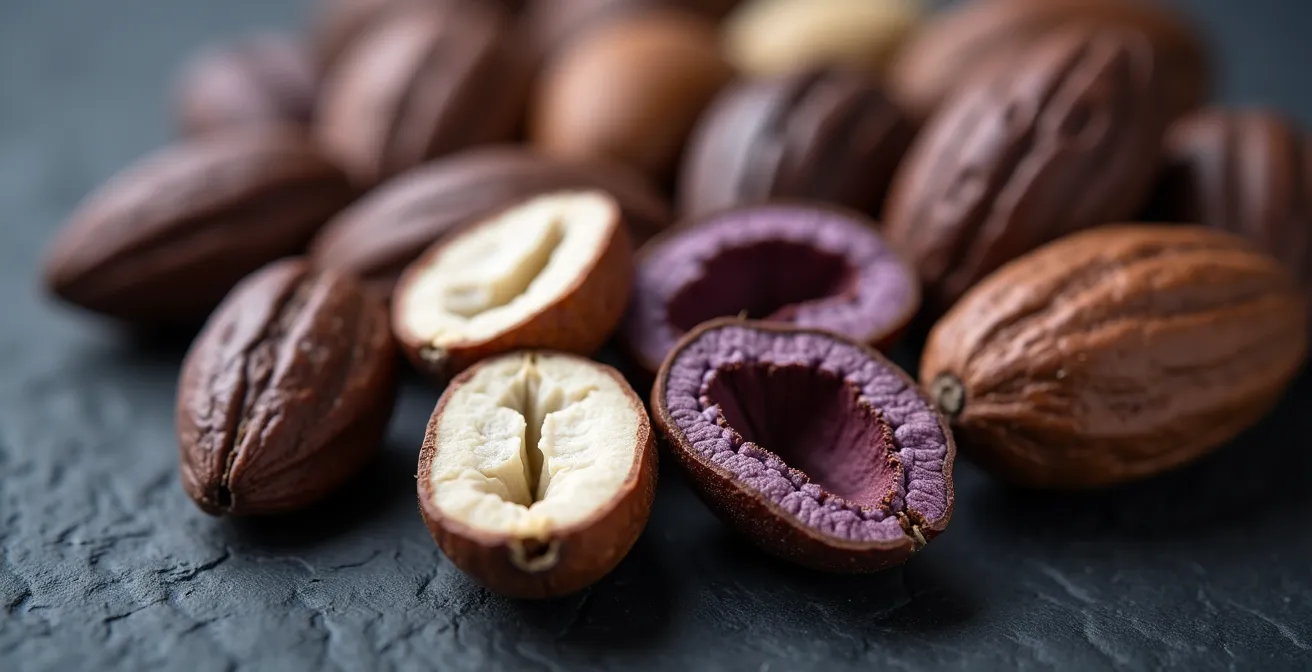
Visually, this genetic diversity is most apparent in the bean itself. A cut test of pure Criollo beans reveals white or very pale violet cotyledons (bean interiors), a sign of low anthocyanin content, which correlates with lower bitterness. Pure Forastero beans are a deep, dark purple. A batch of Trinitario beans, however, will display a mosaic of colors: from white and pale pink to light and dark purple, all within the same pod or from the same tree. This is the “genetic toolbox” in its most literal form—a physical manifestation of its hybrid heritage.
This genetic spectrum directly translates to a flavor spectrum. Some Trinitario strains, like those found in parts of Venezuela, are very close to their Criollo ancestors, offering delicate nutty and fruity notes. Others, from regions like Cameroon, lean closer to their Forastero heritage, providing a more robust, classic “chocolatey” base. As a chocolatier, sourcing Trinitario is about understanding this spectrum and seeking out the specific genetic expressions that align with your desired flavor profile.
The following table, based on industry consensus, provides a clear overview of where Trinitario sits in the global cacao landscape.
| Variety | Global Production Share | Genetic Profile | Key Characteristics |
|---|---|---|---|
| Criollo | Less than 5% | Pure native genetics | Delicate, low bitterness, complex fruity notes |
| Trinitario | 10-15% | Hybrid: Criollo x Forastero | Balanced flavor and resilience, wide taste spectrum |
| Forastero | 80-85% | Pure Amelonado lineage | Hardy, high yield, strong cocoa flavor |
The Visual Trap: Confusing Amelonado with Trinitario Pods
For a new chocolatier sourcing beans, one of the most critical field skills is accurate botanical identification. The greatest risk lies in confusing the highly variable Trinitario pods with those of its ancestor, the Amelonado variety of Forastero. Given that West Africa produces 81% of the world’s cocoa, overwhelmingly of the Forastero type, this is a common and costly mistake. Paying a premium for “Trinitario” that is, in fact, standard Amelonado can derail a chocolate maker’s flavor goals before the beans are even fermented.
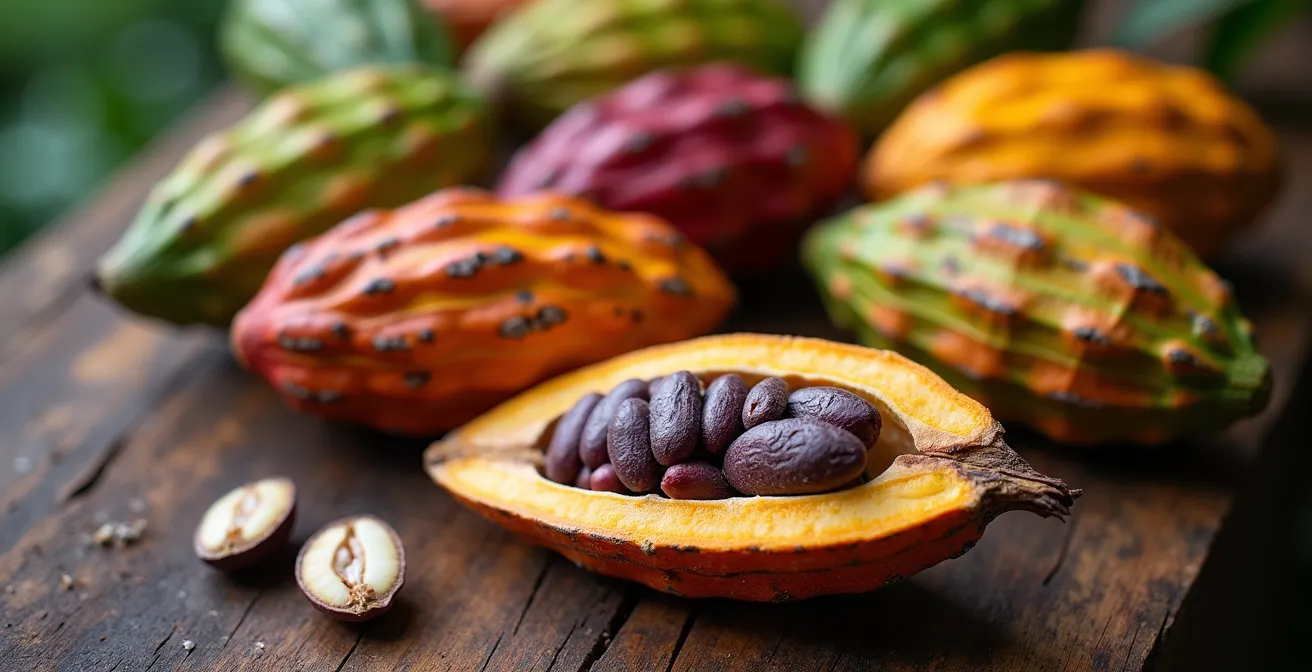
While DNA testing is the only definitive method, a trained eye can spot key morphological differences. Amelonado pods are typically uniform, smooth, and melon-shaped (hence the name) with shallow ridges. Trinitario pods, by contrast, exhibit greater diversity in shape and texture. They often have a more elongated form, sometimes with a characteristic “bottleneck” at the stem, and their ridges are generally deeper and more pronounced. The color variation is also a tell-tale sign; a field of Amelonado will be relatively uniform, while a Trinitario plantation is a kaleidoscope of greens, yellows, oranges, and deep reds, reflecting its diverse genetic makeup.
To avoid this visual trap, it is essential to follow a systematic identification protocol when evaluating a potential source. This field-level due diligence is non-negotiable for ensuring you are acquiring the genetic potential you are paying for.
- Check pod shape: Trinitario pods are medium to large with a characteristic bottleneck, while Amelonado are rounder with shallower ridges.
- Examine surface texture: Trinitario shows deeper ridges and more pronounced texture variations.
- Observe color range: Trinitario pods display diverse hues from red and orange to green or purple depending on the strain.
- Perform cut test: A cross-section of Trinitario beans reveals mixed white, light purple, and dark purple cotyledons.
- Assess pod diversity: A key indicator is that Trinitario plantations show far greater pod color and shape variation than the more uniform Amelonado crops.
How to Ferment Trinitario to Unlock Its Full Fruity Potential?
A Trinitario bean’s genetic potential is just that—potential. The process that transforms this potential into palpable flavor is fermentation. This is arguably the most critical stage for a craft chocolate maker, and it’s where Trinitario’s hybrid nature truly shines. Its robust Forastero genes provide a good sugar and pulp content, fueling a strong fermentation, while its Criollo heritage provides the complex aromatic compounds that this fermentation will develop and refine.
The key to successful Trinitario fermentation is meticulous temperature and moisture control. The goal is to cultivate a sequence of specific microbial activities—first yeasts, then lactic acid bacteria, and finally acetic acid bacteria—that break down the pulp, reduce bitterness, and create the precursors for the fruity, floral, and nutty notes characteristic of fine chocolate. This is often achieved using a cascade system of wooden boxes, which allows for controlled turning and aeration.
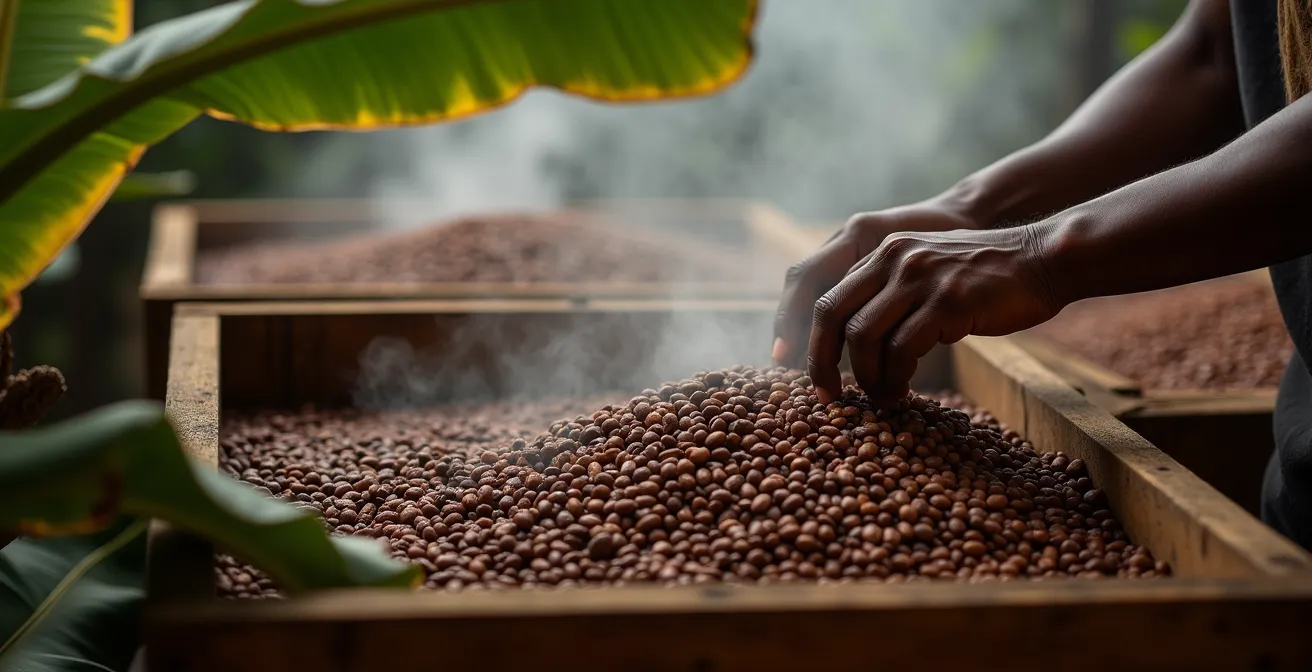
A prime example of this mastery is seen at Kokoa Kamili in Tanzania. Starting in 2012, they revolutionized the region’s Trinitario processing by creating a central fermentery. They purchase wet beans at a premium from around 3,000 local farmers and then apply a highly controlled, 6-day cascade fermentation protocol, using banana leaves to maintain heat and humidity. This standardized, expert-led approach achieves remarkably consistent and vibrant fruity flavor profiles that have become a gold standard for craft makers worldwide. It proves that post-harvest processing is not just a step; it is the art of flavor design.
For the chocolatier, this means that sourcing is not just about the bean’s origin, but about the fermenter’s skill. A well-fermented Trinitario is a symphony of flavor; a poorly fermented one, regardless of its genetic quality, will be one-dimensional and astringent.
Why Are Pure Criollo Beans Considered the “Prince of Cocoas”?
To fully appreciate the genius of Trinitario, one must first understand the reverence for its “noble” parent, Criollo. Dubbed the “Prince of Cocoas,” Criollo represents the historical pinnacle of flavor. It is the original cacao cultivated by the Maya and Aztec civilizations, and its beans are renowned for their exceptional aromatic complexity and lack of bitterness. A bar of pure Criollo chocolate is a delicate experience, offering subtle notes of nuts, caramel, red fruits, and a gentle finish with very little astringency.
This exceptional quality, however, comes at a steep price. From an agricultural standpoint, Criollo is a high-maintenance, low-reward proposition. The trees are incredibly fragile, highly susceptible to a host of pests and diseases, and produce significantly lower yields than other varieties. This fragility is the primary reason for its scarcity. Today, Criollo beans represent less than 5% of global cocoa production, making them a rare and expensive luxury good.
For a new bean-to-bar chocolatier, starting with pure Criollo is a high-risk endeavor. The supply chain is tenuous, the cost is prohibitive, and its delicate flavor can be easily destroyed by the slightest inconsistency in roasting or processing. It is a bean for seasoned masters who have perfected their craft. While it serves as the ultimate flavor benchmark, its lack of agricultural resilience makes it an impractical foundation for a new business. It represents the flavor potential that Trinitario inherits and makes accessible.
Key takeaways
- Trinitario is not a single bean type, but a diverse genetic population born from a natural hybrid of Criollo and Forastero.
- Its value lies in its ‘genetic toolbox’, offering a balance of Criollo’s complex flavor and Forastero’s resilience.
- Mastering Trinitario involves actively managing its variability through farming and post-harvest techniques to design a specific flavor profile.
Why High-Quality Forastero Is Essential for Structured Ganaches?
On the other end of the spectrum from the delicate Criollo is the workhorse of the chocolate world: Forastero. Accounting for the vast majority—around 80-85% of global production—Forastero is synonymous with reliability and intensity. Its defining characteristic is a robust, straightforward, and intensely “chocolatey” flavor profile, driven by high levels of tannins. While often criticized by fine flavor purists for lacking complexity, this very quality makes it indispensable in certain applications, particularly in confectionery.
Forastero’s high cocoa butter content and robust molecular structure make it the ideal backbone for ganaches, mousses, and enrobing. When creating a ganache, the goal is a stable emulsion of chocolate and cream that is smooth, glossy, and holds its shape. Forastero provides the necessary structural integrity. Its powerful cocoa flavor stands up to the dilution from cream, sugar, and other ingredients, ensuring a product that still tastes decisively of chocolate. A ganache made with a delicate Criollo would see its subtle notes completely overwhelmed and lost.
Even for a bean-to-bar maker focused on single-origin bars, understanding Forastero is crucial. It represents the “base note” in the symphony of cocoa flavors. Its sturdiness and assertive character are the very traits that were bred into Trinitario to give it life. Forastero is the genetic insurance policy that allows Trinitario to be grown successfully, providing the canvas upon which the more delicate Criollo notes can be painted.
Actionable checklist: Selecting Forastero for Ganache Structure
- Verify High Cocoa Butter Content: Select beans from smooth, yellow-green pods, which often indicate higher fat content essential for a smooth emulsion.
- Choose Established Regions: Source from West Africa for consistency and reliability, or from Ecuador for Nacional, a Forastero subtype with unique floral notes.
- Test Bean Hardness: The physical robustness of Forastero beans ensures they grind consistently and emulsify well, creating a stable ganache.
- Assess Fermentation Quality: A well-fermented Forastero develops a stronger, less astringent chocolate backbone, providing structure without harshness.
- Consider the Roast Profile: Forastero’s hardiness allows it to tolerate higher roasting temperatures, which can enhance structural properties without introducing burnt flavors.
Pure Criollo vs. High-Quality Trinitario: Can You Taste the Difference?
This is the ultimate question for the craft chocolatier. After all the discussion of genetics and history, the final judgment happens on the palate. Can a well-cultivated, perfectly processed Trinitario truly stand up to the legendary flavor of a pure Criollo? The answer is a resounding yes, though the experience is different. It’s not about being identical, but about offering a complete and arguably more dynamic tasting journey.
A pure Criollo bar is an experience in subtlety and elegance. The flavor is delicate, with a long, evolving finish and very low astringency. A high-quality Trinitario, on the other hand, is a more assertive and multi-layered experience. It often opens with bright, fruity acidic notes (from its Forastero side) before mellowing into the more complex nutty or floral notes of its Criollo parentage. There is a solid chocolatey base that underpins the entire experience, giving it a satisfying depth that some find lacking in the more ethereal Criollo.
The Trinitario flavour profile is actually complex but also complete — delicate notes from Criollo and robust chocolate flavour from Forastero. It’s truly special.
– Chef Gabriella Cugno, Chocolatier & Consultant, Trinitario Trinidad
The best way to understand this is to conduct a comparative tasting. This protocol will help you isolate the distinct characteristics of each bean and appreciate the unique balance that Trinitario offers. This is the final and most convincing piece of evidence for its suitability as a craft maker’s foundational bean.
- Preparation: Start with 70% bars of each variety at room temperature (21-23°C) to allow aromas to express themselves.
- Aroma: Break and smell each piece. Note Trinitario’s more assertive, often fruity aroma compared to Criollo’s more subtle, nutty, or earthy scents.
- First Taste: Let a small piece melt slowly on your tongue. Identify Trinitario’s typically bright, acidic opening versus Criollo’s much milder, gentler entry.
- Mid-Palate: As it melts, observe Trinitario’s solid chocolatey base, a foundation that supports its other flavors. Contrast this with Criollo’s more delicate, layered complexity that can feel less grounded.
- Finish: Compare the conclusion. Trinitario often has a balanced, clean finish with a hint of pleasant astringency. Criollo’s finish is famously long and smooth, with almost no astringency at all.
Ultimately, the choice to work with Trinitario is a choice to engage with the full spectrum of what cacao can be. It is a commitment to craftsmanship, an embrace of complexity, and the first step in designing a chocolate that is uniquely and unforgettably yours. Begin your journey by sourcing beans not just based on origin, but on the skill of the fermenter and the genetic promise within the pod.