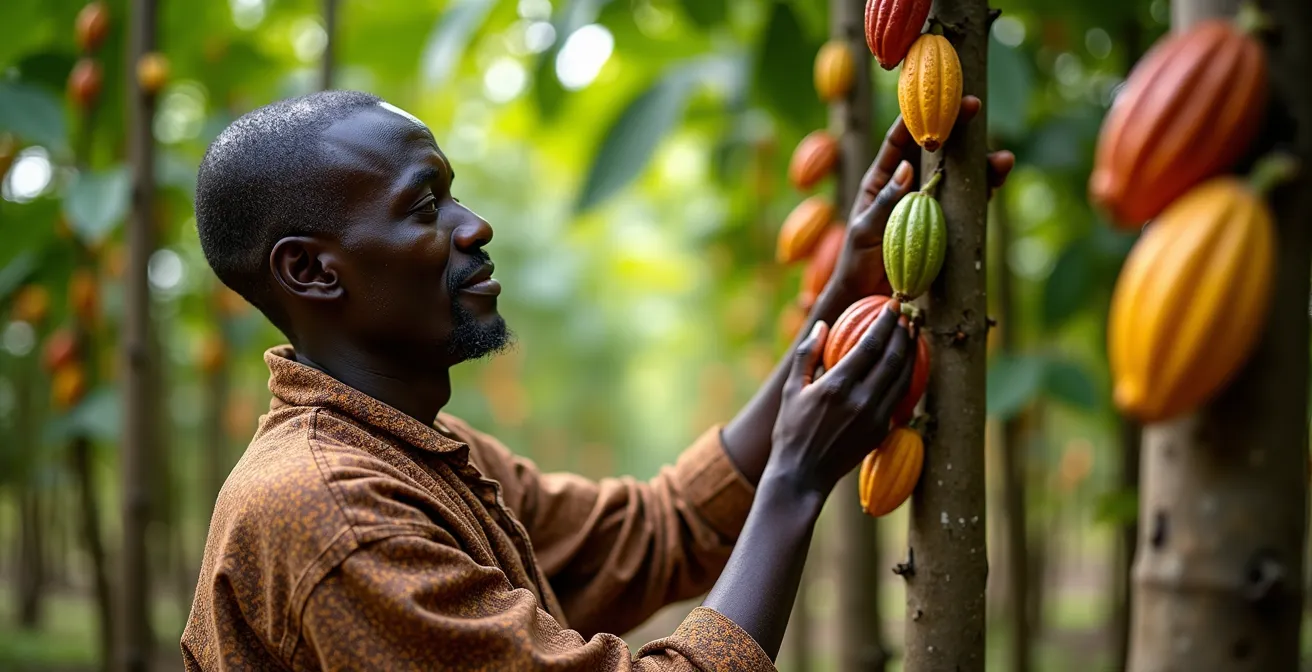
Contrary to popular belief, a ‘sustainable’ label is not a guarantee of ethical practice; true impact comes from understanding the entire value chain.
- The price of cheap chocolate is directly paid by farmers, with many living in extreme poverty while brands capture up to 90% of the value.
- Genuine ethical brands offer radical transparency, detailing farm locations and payment structures, unlike greenwashing brands with vague claims.
Recommendation: Shift from a passive ‘label shopper’ to an active ‘supply chain investigator’ by demanding proof of impact, not just promises.
That chocolate bar in your hand represents the end of a long, complex journey. For many of us, the decision to buy a bar with a green frog or a “Fair Trade” logo feels like a definitive act of good. We pay a little more, confident that our choice supports a farmer somewhere far away. But what if that feeling of certainty is misplaced? The chocolate industry is rife with certifications and sustainability claims, yet the brutal reality for millions of cocoa farmers, particularly in West Africa, remains unchanged: poverty, debt, and an industry linked to devastating deforestation.
The common advice—”look for a label”—is a starting point, but it’s no longer enough. The system has become a maze of corporate programs, competing certifications, and clever marketing that can obscure as much as it reveals. This is where the real power of an ethical consumer lies. The crucial shift isn’t just about choosing one logo over another. It’s about learning to perform a kind of “value chain forensics,” understanding the mechanisms that either trap farmers in poverty or empower them to build prosperous, sustainable futures.
This guide moves beyond the surface-level advice. We will dismantle the economics of cheap chocolate, equip you with a framework to distinguish genuine transparency from sophisticated greenwashing, and explore how everything from harvest cycles to the volcanic soil beneath the cocoa tree can become a tool for economic justice. It’s time to transform your purchase from a hopeful guess into a conscious, informed, and truly impactful investment in a better world.
To navigate this complex but crucial topic, this article breaks down the key levers of impact. We’ll explore the economic realities, the truth behind labels, the environmental costs, and the hidden factors in cultivation and production that determine a farmer’s livelihood.
Summary: A Guide to Truly Ethical Chocolate Consumption
- Why Cheap Chocolate Always Means Poverty for Farmers?
- How to Verify if a “Sustainable” Label Is Genuine or Just Greenwashing?
- Direct Trade vs. Fair Trade: Which One Truly Benefits the Plantation?
- The Hidden Link Between Your Snack and Deforestation in West Africa
- When to Buy Chocolate to Support Harvest Cycles and Agroforestry?
- How Does Volcanic Soil Change the Acidity of Cocoa Beans?
- What Really Happens During the 30-Day Journey from Tree to Bar?
- Why Does Bean-to-Bar Couverture Require Different Tempering Curves?
Why Cheap Chocolate Always Means Poverty for Farmers?
The low price of mass-market chocolate is not a feat of efficiency; it’s a direct subsidy paid by the people least able to afford it: the cocoa farmers. The economics of the global cocoa supply chain are brutally skewed. While brands and retailers enjoy high margins, the farmers at the origin of this multi-billion dollar industry are often trapped in a cycle of poverty. The consequence is not just a lack of income, but a cascade of social disasters, including the persistence of child labor, as families are forced to make impossible choices to survive.
The statistics are a stark indictment of the status quo. In Côte d’Ivoire and Ghana, which together produce over 60% of the world’s cocoa, the situation is dire. A 2021 study revealed that up to 58% of cocoa farming households live below the World Bank’s extreme poverty line. An even more shocking 90% of these farmers do not earn a living income, meaning they cannot afford a basic, decent standard of living covering food, housing, education, and healthcare. This isn’t an accident; it’s a feature of a system where value is concentrated at the top.
This gross imbalance of power and profit is confirmed by industry watchdogs. As Fairtrade International states, the distribution of wealth is profoundly unequal:
Brands and retailers are estimated to capture a whopping 90% of the value in cocoa supply chains, while just 7.5% accrues to bean exporters, smallholder farmers and workers.
– Fairtrade International, Fairtrade Risk Map 2024
This means that for every dollar you spend on a non-ethically sourced chocolate bar, as little as seven cents trickles down to the entire country of origin, to be split between exporters, workers, and the farmers themselves. Choosing cheap chocolate doesn’t mean you’ve found a bargain; it means you’ve bought a product whose true cost is being borne by farming families thousands of miles away.
How to Verify if a “Sustainable” Label Is Genuine or Just Greenwashing?
In response to consumer demand for ethical products, chocolate wrappers are now covered in logos and sustainability claims. But how can you tell if a brand is truly committed to change or simply engaging in “greenwashing”—using marketing to create a misleadingly positive public image? The key is to move beyond passively accepting a logo and actively investigate a brand’s claims. True sustainability is radical transparency, not a vague promise.
A certification is a good starting point, but not all are created equal. Some programs are rigorous, with third-party audits and guaranteed minimum prices, while others are little more than internal corporate initiatives with no independent oversight. It is also crucial to distinguish agricultural certifications from labor-focused ones. A label like “USDA Organic” certifies that the beans were grown without certain pesticides, which is an important environmental standard, but it does not guarantee that the farmers were paid a living wage or that no child labor was used. You must look for certifications that explicitly address farmer income and labor rights.
This is where your investigative work begins. The following checklist provides a framework for digging deeper than the label.
Your Verification Plan: 5 Steps to Unmask Greenwashing
- Demand Third-Party Proof: Look for well-established, independent certifications like Fairtrade International or Fair Trade USA. Crucially, check their websites for publicly available audit reports and standards. A brand that is proud of its practices will make this information easy to find.
- Scrutinize the Supply Chain: Visit the chocolate company’s website. Do they provide detailed information about their supply chain? Look for specifics: the names of the cooperatives they work with, the regions or even specific farms, and the percentage of premiums paid. Vague statements like “we support our farmers” are a red flag.
- Check for ‘All-In’ Certification: Does the certification apply to all ingredients, or just the cocoa? Some brands use a certified logo but only a small percentage of their total ingredients are certified. The strongest commitments often state, “All that can be Fairtrade, is Fairtrade.”
- Consult Independent Scorecards: Don’t just take the brand’s word for it. Use independent resources like Green America’s Chocolate Scorecard or Mighty Earth’s ratings. These organizations do the deep-dive research to rank brands on their actual performance, not just their marketing.
- Look for Metrics, Not Mantras: A transparent brand provides concrete proof of its impact. Search for transparency reports with specific metrics (e.g., “$50,000 in premiums paid to the XYZ cooperative,” or “funded the construction of 3 wells in Ghana”) rather than empty platitudes.
To aid your investigation, understanding the different standards is critical. As the following comparative data from a comprehensive analysis by Ethical Consumer shows, key differences in minimum price guarantees and audit structures separate the robust certifications from the weaker ones.
| Certification | Minimum Price Guarantee | Premium Payment | Third-Party Audit | Child Labor Monitoring |
|---|---|---|---|---|
| Fairtrade International | Yes ($2,400/ton) | $240/ton | FLOCERT (ISO certified) | Required |
| Rainforest Alliance | No | Variable | Yes | Recommended |
| Fair Trade USA | Yes | $200/ton | SCS Global | Required |
| Company Programs | No | Variable | Often internal only | Variable |
Direct Trade vs. Fair Trade: Which One Truly Benefits the Plantation?
Beyond the world of mass-market certifications, two powerful models have emerged to create more equitable supply chains: Fair Trade and Direct Trade. While both aim to improve farmer livelihoods, they operate on different principles. Understanding their distinction is key to making a more nuanced ethical choice. Neither is universally “better”; their effectiveness depends on the context and the integrity of their execution.
Fair Trade is a formalized system designed to provide a safety net for farmers. It operates through third-party certification (like Fairtrade International or Fair Trade USA) that guarantees a minimum price for cocoa, protecting farmers from volatile market fluctuations. On top of this, a fixed “Fair Trade Premium” is paid to the farmers’ cooperative. This additional fund is used democratically by the community for development projects like building schools, clean water wells, or improving healthcare facilities. Fair Trade USA reports that since 2002, over $1.25 million in these premiums has been paid by certified companies for such community projects. The strength of Fair Trade is its scale and its structured, audited approach to creating a baseline of support.
Direct Trade, on the other hand, is a more relational model. It’s not a formal certification but a philosophy practiced primarily by smaller, craft chocolate makers. In this model, the chocolate maker bypasses the middlemen (commodity brokers and exporters) and builds a personal relationship directly with a farmer or cooperative. They negotiate prices together, often paying a significant premium far above the market or Fair Trade rate, specifically for high-quality, flavorful beans. This model emphasizes quality over quantity and fosters a collaborative partnership.

The benefit of Direct Trade is the potential for much higher incomes for farmers and a focus on improving quality, which can make their businesses more resilient long-term. The chocolate maker gets exceptional beans, and the farmer is rewarded directly for their skill. The challenge is its lack of a third-party-audited standard; the ethics of the relationship depend entirely on the integrity of the chocolate maker. It is a model built on trust and verifiable transparency.
The Hidden Link Between Your Snack and Deforestation in West Africa
The ethical cost of cheap chocolate is not only human; it is environmental. A vast, hidden link connects the global appetite for chocolate to the alarming destruction of West Africa’s last remaining rainforests. For decades, the pressure to produce more cocoa on a limited income has driven a relentless expansion of farming into protected forest areas. This is not the work of large, malicious corporations clear-cutting land; it is often the result of thousands of smallholder farmers, trapped in poverty, who see no other option for survival than to clear a new patch of forest for cultivation.
The scale of this destruction is staggering. Advanced satellite mapping has revealed the devastating impact of this agricultural expansion. According to groundbreaking research published in *Nature Food*, cocoa cultivation drives over 37% of forest loss in protected areas in Côte d’Ivoire and 13% in Ghana. These are not just trees being lost; they are critical habitats for endangered species like chimpanzees and forest elephants, and their destruction has profound consequences for regional climate stability and biodiversity.
For a long time, the complexity of the cocoa supply chain, with its millions of small, scattered farms, made it nearly impossible to trace beans back to their source and hold companies accountable for deforestation. However, technology and collaboration are finally providing a path forward. This brings us to a crucial point of action and hope, where data is becoming the most powerful tool against deforestation.
Case Study: Using Satellite Technology to Create Accountability
The West Africa Cocoa dataset, developed by the World Resources Institute (WRI) in partnership with 19 major chocolate companies, represents a breakthrough in supply chain transparency. Using Sentinel satellite data and artificial intelligence, this project has mapped over 2.2 million cocoa farms. This unprecedented collaboration created the first-ever shared map of deforestation risk areas, enabling companies to monitor forest loss in their specific supply chains in near real-time through platforms like Global Forest Watch Pro. This system moves traceability from a vague promise to a verifiable reality, making it possible to identify and exclude cocoa grown in illegally deforested areas.
This technological leap means that “zero-deforestation” can finally become more than a marketing slogan. As a consumer, you have the power to support brands that have invested in these traceability systems and can prove their cocoa is not contributing to the destruction of these vital ecosystems.
When to Buy Chocolate to Support Harvest Cycles and Agroforestry?
A truly committed ethical consumer can go even deeper, aligning their purchasing habits with the natural rhythms of the cocoa harvest and the principles of sustainable agriculture. This level of consciousness moves beyond simply choosing a brand to understanding *how* and *when* your purchase provides the most support. It’s about seeing chocolate not as a year-round, uniform commodity, but as a seasonal agricultural product with a story.
In many cocoa-growing regions, farmers face a “lean season”—a difficult period between harvests when income dries up, leading to debt and food insecurity. Supporting brands that offer pre-harvest financing is one of the most impactful actions you can take. These companies provide crucial capital to farmers *before* the harvest, allowing them to manage their farms and families without resorting to high-interest loans. Furthermore, by looking for bean-to-bar makers who stamp a harvest date (e.g., ‘Autumn 2023 Harvest’) on their packaging, you are directly connecting your purchase to a specific farming cycle and ensuring you are buying fresh, high-quality beans.
Another powerful way to support farmers’ year-round stability is to choose chocolate grown in agroforestry systems. Unlike monoculture plantations where only cocoa is grown, agroforestry integrates cocoa trees with a variety of other crops and native shade trees. This biodiversity creates a healthier, more resilient ecosystem that requires fewer chemical inputs.
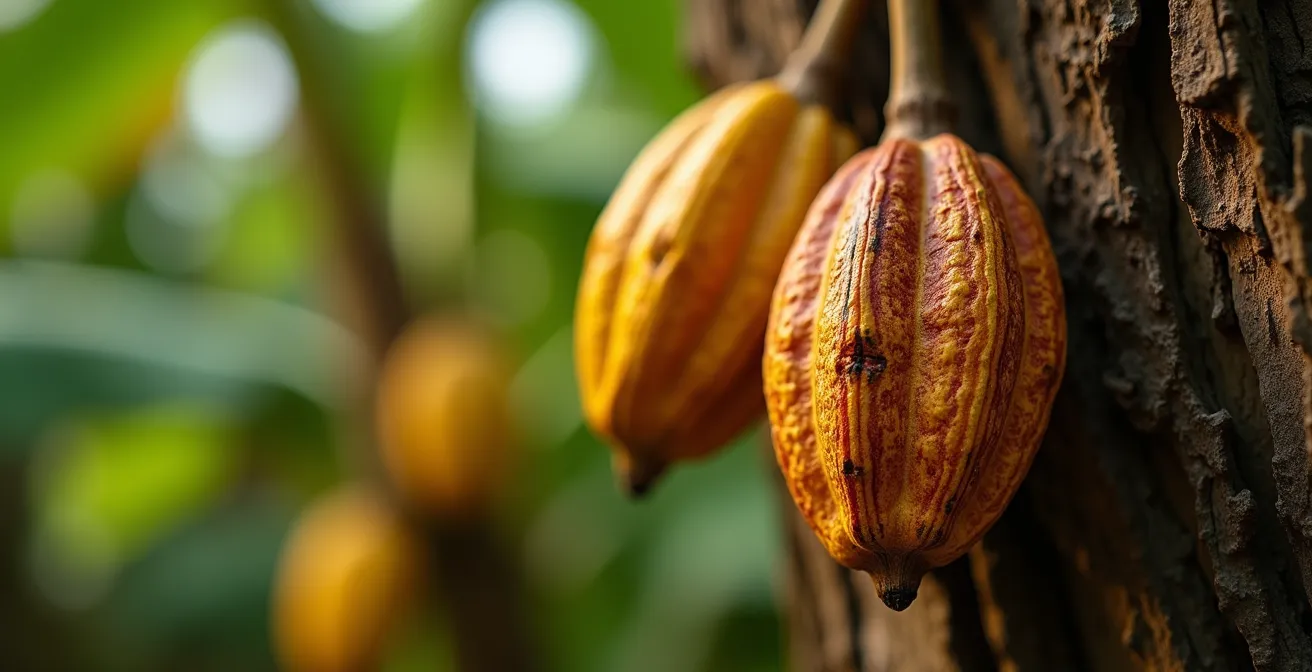
Economically, this is a game-changer for farmers. The secondary crops—such as bananas, vanilla, spices, or timber—provide a diversified, year-round income stream, making them less vulnerable to cocoa price volatility and the lean season. When you see a craft chocolate maker listing secondary crops or flavor notes derived from them, it’s a strong indicator that you are supporting a resilient, biodiverse farming model that provides stable, year-round income for the farmer.
How Does Volcanic Soil Change the Acidity of Cocoa Beans?
The conversation around ethical chocolate often focuses on social and economic factors, but the land itself plays a crucial, and often overlooked, role. The concept of “terroir”—the unique environmental context of a farm, including its soil, climate, and topography—is not just for wine. For cocoa, it can be a powerful tool for economic liberation, and nowhere is this more evident than in regions with volcanic soil.
Volcanic soils are rich in minerals and nutrients that profoundly influence the development of the cocoa bean. This specific geology often results in beans with a distinct and complex flavor profile, frequently marked by a brighter, more vibrant acidity and unique fruity or floral notes. For a farmer, this isn’t just an interesting agricultural fact; it’s a significant economic opportunity. It allows them to produce a geographically distinct, premium product that can be sold based on its unique quality, rather than as an interchangeable, low-price commodity. This is the essence of “terroir economics.”
As Eduardo Somarriba, a leading specialist in agroforestry systems, explains, this uniqueness is a pathway out of the poverty trap:
Unique flavor profiles from specific soils like volcanic allow co-ops to create a geographically distinct, premium product, helping them escape the low-price commodity trap.
– Eduardo Somarriba, Specialist in Agroforestry Systems with Cacao
Craft chocolate makers actively seek out these unique terroirs and are willing to pay significant premiums for them. Companies committed to this model, like Luker Chocolate in Colombia, demonstrate how this translates to real income. Their sustainability reports show that for these high-quality, terroir-specific beans, farmers can receive on average 90% of the New York Stock Exchange price, which includes substantial premiums for quality. By choosing a single-origin chocolate and learning about its specific terroir, you are supporting a model where farmers are rewarded for the unique character of their land.
What Really Happens During the 30-Day Journey from Tree to Bar?
The journey from a ripe cocoa pod on a tree to a finished chocolate bar takes roughly a month, and within that brief period, a series of critical post-harvest steps determine both the final flavor of the chocolate and a significant portion of the farmer’s potential income. This is where “post-harvest value addition” happens, and it’s a stage where a small investment in training and equipment can yield enormous returns for farming communities. Unfortunately, it is also where much value is often lost.
The two most crucial steps are fermentation and drying. Immediately after harvest, the wet cocoa beans are removed from the pods and placed in wooden boxes or wrapped in banana leaves to ferment for several days. This process is essential for developing the precursors to the rich, complex flavors we associate with chocolate. Following fermentation, the beans must be dried slowly and evenly to the correct moisture level. If done improperly, the beans can become moldy, overly acidic, or fail to develop any flavor at all, rendering them low-grade and fetching a minimal price. Research from the Swiss Platform for Sustainable Cocoa indicates that proper fermentation and drying can increase the value of cocoa by up to 40%. Yet, a lack of training or simple equipment causes massive income losses for countless farmers.
Furthermore, this stage often conceals a hidden workforce whose labor is critical but frequently unrecognized and uncompensated. This is particularly true for the women in farming communities, who play a vital role in ensuring quality.
Case Study: Recognizing the Value of Women’s Post-Harvest Labor
Research in Côte d’Ivoire and Ghana by the Corporate Accountability Lab has revealed that women perform critical, quality-enhancing labor during the post-harvest phase. This includes carefully sorting beans to remove defects and meticulously managing the drying process to ensure consistency—work that directly impacts the final quality and price of the cocoa. Historically, this labor has often gone unpaid. In response, truly ethical sourcing models now specifically train and directly compensate women for their post-harvest processing work. Some cooperatives implementing these programs have reported income increases of as much as 30% for their female members, empowering women and dramatically improving household finances.
When you choose a brand that invests in post-harvest training and infrastructure—and specifically highlights its programs for compensating women—you are supporting a critical leverage point in the fight for a living income.
Key Takeaways
- The low price of conventional chocolate is a direct result of an inequitable system that keeps up to 90% of farmers below a living income.
- Genuine ethical brands are defined by radical transparency (farm locations, payment data), not just a certification logo, which can be a form of greenwashing.
- Supporting agroforestry systems and brands with pre-harvest financing provides farmers with diversified, year-round income, making them more resilient.
Why Does Bean-to-Bar Couverture Require Different Tempering Curves?
The final, almost magical, transformation of cocoa into a glossy, snappy chocolate bar happens during tempering. This precise process of heating and cooling controls the crystallization of the cocoa butter. While it may seem like a purely technical step for the chef or chocolatier, the unique tempering requirements of bean-to-bar chocolate are, in fact, the final physical proof of its authentic, non-industrial origin. It is the ghost of the terroir in the machine.
Industrial chocolate is designed for uniformity. It is made from a blend of beans from countless origins, and its cocoa butter content is often standardized by adding or removing butter. This results in a highly predictable product that tempers within a consistent, narrow temperature range (typically 30-31°C). It is easy to work with because all the natural variation has been engineered out of it. Single-origin, bean-to-bar chocolate is the exact opposite. Its character is defined by its variability.
The cocoa butter content and its specific fatty acid profile are influenced by the bean’s genetics, the soil it grew in, the amount of shade from its agroforestry canopy, and the specific fermentation process it underwent. This natural variation means that the fat crystals in single-origin chocolate are more complex and unique. As a result, each origin requires its own specific tempering curve. A chocolate from Madagascar might temper perfectly at 32°C, while one from Ecuador might require 29°C. This is what the following data on fat crystal profiles illustrates.
| Characteristic | Single-Origin Bean-to-Bar | Industrial Chocolate |
|---|---|---|
| Fat Crystal Structure | Variable, complex peaks | Uniform, standardized |
| Tempering Range | 28-32°C (varies by origin) | 30-31°C (consistent) |
| Cocoa Butter Content | Natural variation (48-54%) | Standardized (often added) |
| Cooling Time | Extended (origin-specific) | Rapid (predictable) |
| Shade Tree Impact | Affects fat composition | Blended away |
This technical challenge is not a flaw; it is the mark of authenticity. As Cacao R&D expert Philippe Troplin notes, this difficulty is the very signature of real, non-industrial chocolate.
The variable fat crystal structures in single-origin beans are precisely why a standard tempering curve fails. The difficulty IS the mark of non-industrial, real chocolate.
– Philippe Troplin, Cacao R&D, Louviers, France
The “fat crystal integrity” of a bean-to-bar chocolate is a direct reflection of its supply chain integrity. Its complexity and refusal to be standardized are a physical manifestation of its unique journey from a specific plot of land, cared for by a specific farmer. When a chocolatier takes the time to master these unique curves, they are honoring that journey.
The power to change the chocolate industry lies in millions of individual choices. By shifting your mindset from a passive consumer to an active investigator, you can ensure your purchases genuinely support the farmers and ecosystems at the heart of this craft. Demand transparency, ask questions, and choose brands that provide proof of their impact, not just promises.