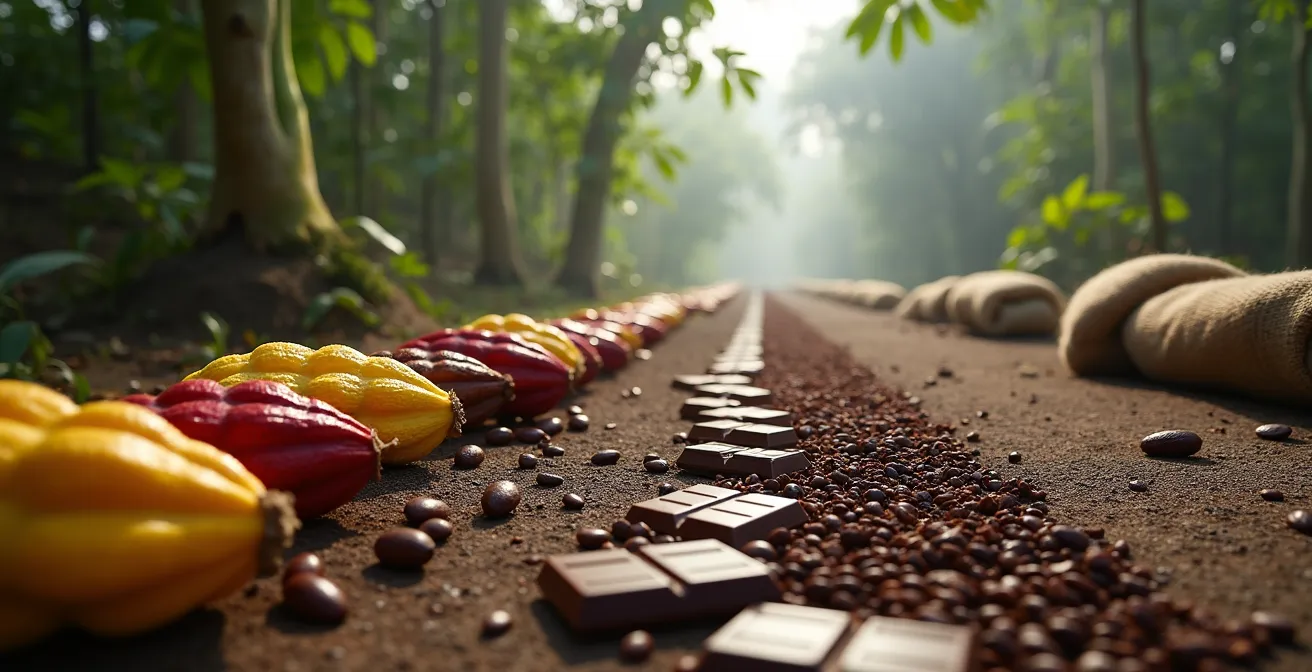
Making bean-to-bar chocolate is less a recipe and more a series of critical decisions where a single misstep in the 30-day journey can ruin everything.
- The maker’s total control over roasting and grinding is what unlocks the unique flavor profile locked inside the bean.
- Hidden logistical challenges, like controlling humidity during shipping, are as crucial as the work in the factory.
- Sustainable sourcing is not just a label; it directly translates into higher, more stable incomes for cacao farming communities.
Recommendation: Next time you taste a craft chocolate bar, look for the story of its origin and the maker’s unique touch, as these details are the true markers of quality.
When you unwrap a bar of high-quality chocolate, what do you picture? For most of us, it’s a vague image of tropical farms and Willy Wonka-esque factories. We’ve heard the terms: harvesting, fermenting, roasting. The journey seems like a straightforward, almost industrial process. We assume that good beans plus good machinery equals good chocolate. But this linear view misses the entire drama, the high-stakes navigation of a 30-day obstacle course where artistry and science collide at every turn.
The common narrative focuses on the *what*—the steps of production. But the real story, the one that separates a forgettable candy bar from an unforgettable craft chocolate, lies in the *how* and the *why*. It’s a story of critical control points, where a fraction of a percent of moisture can spell disaster, where the choice of machine defines texture, and where a relationship with a farmer on the other side of the world forms the very soul of the final product. The truth is, the journey from tree to bar is not a smooth production line. It’s a chain of custody for flavor, a relentless effort to protect a delicate ‘flavor blueprint’ imprinted in the bean at its origin.
But what if the most important steps weren’t the ones we see in documentaries, but the invisible ones—the decisions made during a trans-oceanic shipment or the precise temperature adjustments for a single, unique batch? This guide pulls back the curtain on that hidden journey. We will explore the philosophy that drives the bean-to-bar movement, dissect the critical technical challenges that makers face, understand the profound human impact of sourcing choices, and reveal why every single step is a moment where the entire batch hangs in the balance.
This article dives deep into the key moments that define the path from a raw cacao bean to a finished craft chocolate bar. The following summary outlines the crucial stages and debates within the industry that we will explore in detail.
text
Summary: The True Story Behind Your Craft Chocolate Bar
- Why the Bean-to-Bar Movement Is Changing the Industry Standard?
- How to Winnow Cocoa Beans Without Losing Valuable Nibs?
- Maker vs. Melter: Who Actually Crafts the Taste of Your Chocolate?
- The Shipping Error That Can Ruin a Batch of Cocoa Before Arrival
- How to Source High-Quality Beans Direct from Farmers for Small Batches?
- How Does Choosing Sustainable Chocolate Impact Farmers’ Lives in 2024?
- Is Making Your Own Chocolate Actually Cheaper Than Buying It?
- Why Does Bean-to-Bar Couverture Require Different Tempering Curves?
Why the Bean-to-Bar Movement Is Changing the Industry Standard?
The term “bean-to-bar” has become a powerful buzzword in the world of fine food, but its significance goes far beyond a simple marketing label. At its core, the movement represents a fundamental shift in philosophy. It’s a rebellion against the commodification of chocolate, where industrial production has often prioritized consistency and low cost over character and quality. Instead of buying pre-made chocolate to melt and reshape, bean-to-bar makers take on the entire complex process, starting with sacks of raw, fermented cacao beans. This hands-on approach allows them to control every variable that shapes the final flavor, from the roast profile to the grinding time.
This obsession with control is about revealing the “flavor blueprint” of the bean—the unique notes of fruit, nuts, or spice inherent to its specific origin, or terroir. As one industry expert highlights, while the term started as a way to educate consumers, it has evolved. According to Bar & Cocoa, an authority in craft chocolate, the movement is now often compared to craft beer or coffee, emphasizing handiwork and traceability. They explain that “while the implication of and culture surrounding bean to bar is strong, there’s no legal definition for the term,” which has led many to adopt the broader “craft chocolate” name to better capture this ethos.
This shift is not just about taste; it’s about transparency. By managing the entire chain, makers can forge direct relationships with farmers, ensuring ethical sourcing and fair payment. Companies like French Broad Chocolates in Asheville, for example, build their entire model around this principle, using direct-sourced cacao to create their small-batch bars. This approach has transformed a niche market into a global standard for quality, with craft chocolate makers now operating in most major cities and proving that consumers are hungry for chocolate with a story and a soul.
How to Winnow Cocoa Beans Without Losing Valuable Nibs?
After roasting, the cacao beans are fragile, their precious inner core (the nib) encased in a thin, papery shell (the husk). The next step, winnowing, is one of the first and most delicate “critical control points” for the artisan. This is the process of separating the light, bitter husks from the dense, flavor-rich nibs. While large manufacturers use expensive, specialized machinery, small-batch makers often rely on ingenuity and DIY solutions. A flawless separation is crucial; any remaining husk will introduce bitter, off-flavors, while any lost nibs mean wasting valuable, carefully sourced raw material.
The principle behind winnowing is simple: use airflow to blow away the lighter husks while the heavier nibs fall. However, achieving this without collateral damage is an art. One of the most common and surprisingly effective methods for home or small-scale makers involves nothing more than a bowl and a hairdryer. By pouring the crushed beans into a large bowl and applying a steady stream of air from a distance, a maker can carefully blow the husks out. According to one guide, it “takes a short time to get your technique right but once you do it’s a very effective method.” More advanced DIY setups often involve a combination of PVC piping and a shop vacuum to create a more controlled and contained vortex for separation.
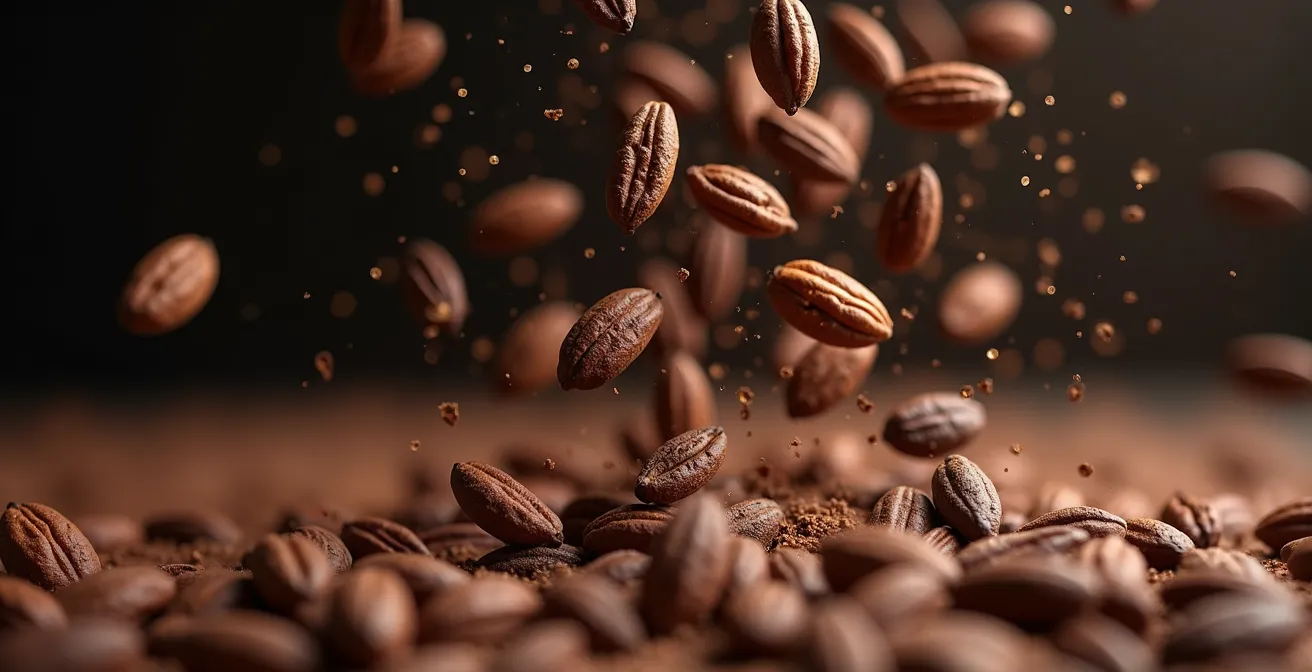
As the illustration shows, the goal is to create a current of air precise enough to lift the lightweight husk fragments without carrying away the nibs. This step is a perfect metaphor for the bean-to-bar process itself: applying a fundamental principle with precision and manual skill to preserve the inherent quality of the raw ingredient. Mastering this seemingly simple step ensures that only the purest expression of the cacao bean moves on to the next stage of grinding.
Your Action Plan: Perfecting the Home Winnowing Process
- Equipment Check: Gather your tools—cracked roasted beans, a large bowl, a hairdryer with adjustable settings, and an outdoor or easy-to-clean space.
- Initial Separation Test: Start with a small handful of beans. Hold the hairdryer about a foot away on a low, cool setting. Observe how the husks lift.
- Technique Adjustment: Vary the angle and distance of the hairdryer. Use a circular motion to agitate the beans in the bowl, ensuring all husks are exposed to the airflow. Are you losing nibs? If so, reduce airflow or increase distance.
- Purity Assessment: Inspect a sample of the winnowed nibs. Are they free of husk fragments? Taste one. It should taste purely of roasted cocoa, with no papery or bitter off-notes.
- Efficiency Plan: Once your technique is dialed in, process the rest of your batch. Note the time it takes and any adjustments needed for next time to create a repeatable, efficient system.
Maker vs. Melter: Who Actually Crafts the Taste of Your Chocolate?
In the world of chocolate, not all creators are equal. The distinction between a “bean-to-bar maker” and a “chocolatier” (often called a “melter”) is fundamental, as it defines who truly holds the reins of flavor. A chocolatier typically starts with pre-made chocolate, known as couverture, which they purchase from large industrial producers. Their artistry lies in melting, tempering, and molding this chocolate into beautiful confections, often adding fillings, nuts, or other inclusions. They are masters of form and flavor pairing, but they have little to no control over the intrinsic taste of the chocolate itself.
A bean-to-bar maker, on the other hand, is the guardian of the entire “chain of custody” for flavor. They begin with the rawest form of the ingredient: the cacao bean. As Bar & Cocoa notes, these pioneers often started because “they wanted to learn how chocolate is made, and continued after realizing how much control small batch chocolate makers have over the final product.” This control is absolute. They select the origin, dictate the roast, and fine-tune the grind, making decisions that fundamentally shape the chocolate’s final taste profile. They are not just decorating; they are composing the music from scratch.
This table clearly illustrates the profound differences in process, investment, and skill focus between the two roles. The maker’s journey is a long-term commitment to agricultural and production science, while the chocolatier’s is a faster-paced exploration of culinary artistry.
| Aspect | Bean-to-Bar Maker | Chocolatier (Melter) |
|---|---|---|
| Starting Material | Raw cacao beans | Pre-made chocolate couverture |
| Process Control | 100% control from bean selection to bar | Control over final form and inclusions |
| Time to Market | Months to years of development | Weeks to months |
| Equipment Investment | $5,000-50,000+ for roasters, melangers | $500-5,000 for tempering equipment |
| Skill Focus | Fermentation, roasting, grinding expertise | Tempering, molding, flavor pairing artistry |
Ultimately, both roles are essential to the vibrant world of chocolate. However, understanding this distinction is key for any consumer curious about what’s really in their bar. When you eat a single-origin bar from a maker, you are tasting a place and a process. When you eat a bonbon from a chocolatier, you are tasting their creative vision applied to a pre-existing canvas.
The Shipping Error That Can Ruin a Batch of Cocoa Before Arrival
Long before a cacao bean ever reaches a roaster, it undertakes a perilous journey across oceans. This transit phase is an invisible but absolutely critical control point where an entire harvest’s quality can be won or lost. The primary enemy during this voyage is moisture. Cacao beans are hygroscopic, meaning they readily absorb moisture from the air. If the humidity inside a shipping container is too high, the beans can reabsorb water, creating a perfect breeding ground for mold and off-flavors. This can completely destroy the delicate flavor blueprint developed during fermentation and drying at the origin.
To prevent this, beans must be dried to a precise level before they are packed into jute sacks for their journey. According to experts at the Institute of Culinary Education, industry standards indicate that dried beans arrive at 6-8% moisture content. Anything higher poses a significant risk. A single leak in the container, condensation from temperature fluctuations (known as “container rain”), or simply packing the beans before they are sufficiently dry can lead to disaster. By the time the beans arrive at the maker’s doorstep, as noted by Pump Street Chocolate, they have already been through a “journey of care and transformation,” but also one of immense risk.
The tragedy for a bean-to-bar maker is that this damage is often irreversible. No amount of roasting or refining can remove the musty, moldy taste from improperly handled beans. This is why direct trade relationships are so important; they build trust and communication between the farmer and the maker, ensuring that strict drying and packing protocols are followed. For the consumer, it’s a stark reminder that the journey to a great chocolate bar begins not in the factory, but in a jute sack in a container, somewhere on the high seas, where a few percentage points of humidity can make all the difference.
How to Source High-Quality Beans Direct from Farmers for Small Batches?
For a craft chocolate maker, sourcing beans is the single most important decision they make. It’s not like buying flour at a supermarket; it’s like a chef personally visiting farms to select their produce. This step defines the entire flavor palette they will work with for the next year. While online retailers like Amazon offer unroasted beans, serious makers turn to specialized importers like Meridian Cacao or Chocolate Alchemy, who provide detailed information on origin, genetics, and flavor notes. These suppliers act as crucial curators for small makers who may not have the capacity to travel to remote cacao-growing regions themselves.
The ultimate goal for many, however, is direct trade—building a personal relationship with farmers or cooperatives. This allows makers to go beyond a simple transaction and collaborate on quality. When sourcing directly, makers look for specific physical cues: beans should be mostly intact, uniform in size, and free from excessive mold. A “cut test,” where a handful of beans are sliced open, is often performed to check for consistent fermentation, indicated by deep, uniform brown or purple colors and intricate fissures, not slaty gray or solid purple interiors.
This direct relationship is about more than just quality; it’s a partnership. By paying a significant premium, makers can incentivize farmers to cultivate and preserve rare, flavor-forward cacao varieties. As Mindo Chocolate Makers explains about their work in Ecuador, this approach has a profound impact. They state, “By paying two to three times the fair-trade price for cocoa beans, we’ve ensured that we receive only the best Nacional beans and encouraged the farmers to resist the hybrid and deforestation trend.” For a small maker starting out, the advice is often to begin with a manageable quantity, like 3 kilos, which is enough to experiment with roasting and refining profiles while yielding about 30 bars of finished chocolate.
How Does Choosing Sustainable Chocolate Impact Farmers’ Lives in 2024?
In 2024, the term “sustainable” on a chocolate bar represents more than just an environmental promise; it signifies a tangible economic and social lifeline for cacao farmers. The conventional cacao market is notoriously volatile, leaving many farmers in poverty. The craft chocolate movement, with its emphasis on direct or transparent trade, directly confronts this issue by fundamentally changing the economic relationship. Instead of being price-takers in a vast commodity market, farmers become valued partners whose unique product commands a premium.
This impact is not marginal. Many craft chocolate makers pay far above the standard Fair Trade minimum. According to Mindo Chocolate Makers, a pioneer in direct trade, some sustainable chocolate makers are paying two to three times the fair-trade price for cocoa beans. This dramatic increase in income provides farmers with economic stability, allowing them to invest in their farms, their families’ education, and their communities. It empowers them to practice sustainable agroforestry, preserving biodiversity and resisting the push for high-yield, low-quality monoculture crops that degrade the soil.
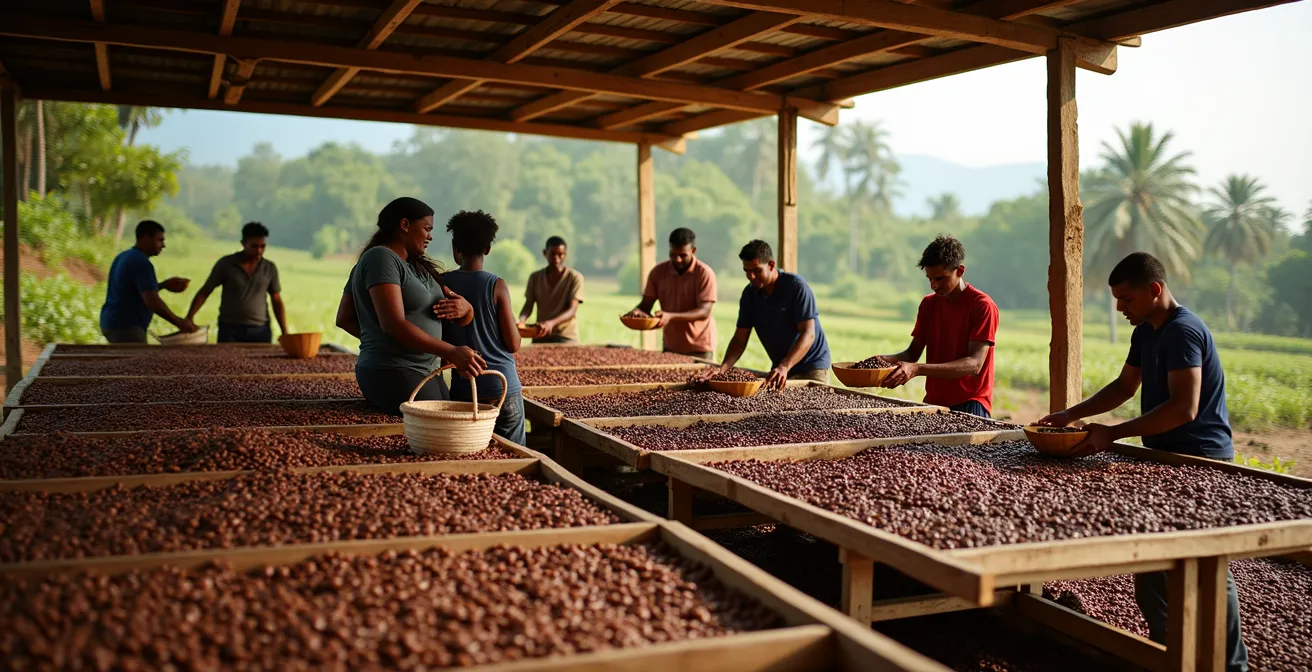
As seen in cooperatives around the world, this investment fosters a sense of dignity and professionalism. It helps fund shared infrastructure, like the centralized fermentation and drying facilities shown above, which are critical for producing the high-quality beans that fetch premium prices. This creates a powerful, virtuous cycle: the maker gets exceptional beans with a unique story, and the farmer gets a stable, profitable livelihood that honors their hard work. Retailers like Bar & Cocoa work with over 50 such makers from countries like Peru, Vietnam, and India, proving this model is not only ethical but also globally scalable. Choosing sustainable chocolate is a direct investment in this positive feedback loop.
Is Making Your Own Chocolate Actually Cheaper Than Buying It?
The allure of transforming raw beans into a polished bar of chocolate is powerful, but many aspiring makers wonder about the bottom line: is it actually cheaper than buying a craft bar? The short answer is a definitive no, at least not initially. While the raw ingredients for a single bar might cost less, the initial investment in specialized equipment and the significant time commitment make it a costly hobby or business venture upfront.
A craft chocolate bar might retail for $8 to $15, a price that reflects not just ingredients but also labor, expertise, and the very equipment needed to make it. For a home maker, there are different tiers of investment. A basic “hobbyist” setup might be cobbled together for around $100, using a home oven for roasting, a hairdryer for winnowing, and a powerful juicer for the initial grinding. However, to achieve the silky-smooth texture of professional chocolate, one piece of equipment is non-negotiable. As the experts at Chocolate Alchemy state emphatically, “You need a Melanger, full stop. … There’s not a kitchen appliance substitute for this.” A melanger is a stone grinder that refines cocoa particles for 24 to 48 hours straight, an investment that starts around $400 for a small model.
This comparative table breaks down the true cost, revealing that the financial equation is heavily weighted toward the initial setup. Even at the prosumer level, while the per-bar cost drops, the time investment remains immense.
| Setup Level | Initial Investment | Cost per 100g Bar | Time Investment |
|---|---|---|---|
| Hobbyist ($100 setup) | Oven + Hairdryer + Champion Juicer | $3-5 (beans + sugar) | 10-15 active hours |
| Prosumer ($2,500 setup) | Roaster + Spectra 11 Melanger | $2-4 (economies of scale) | 5-8 active hours + 48h grinding |
| Craft Bar Purchase | $0 | $8-15 | 0 hours |
Therefore, the decision to make your own chocolate should not be driven by a desire to save money. It should be fueled by a passion for the process and a quest for ultimate control over the final product. The real return on investment is not financial savings, but the satisfaction of crafting something truly unique from its most fundamental state.
Key Takeaways
- The essence of bean-to-bar is total control over the process to express the unique flavor profile of a specific cacao origin.
- Invisible logistical steps, especially controlling moisture during shipping, are critical failure points that can ruin a batch before it even reaches the factory.
- Direct and transparent trade models provide farmers with significantly higher, more stable incomes, fostering a sustainable cycle of quality and prosperity.
Why Does Bean-to-Bar Couverture Require Different Tempering Curves?
Tempering is the final, and perhaps most mystical, step in chocolate making. It’s the process of carefully heating and cooling chocolate to encourage the cocoa butter to crystallize into a stable form (Form V), resulting in a glossy finish, a satisfying “snap,” and a smooth melt-in-your-mouth texture. For industrial chocolate, this is a standardized process with well-defined temperature curves. However, for bean-to-bar couverture, tempering is a far more nuanced dance. Each batch, derived from a single origin or even a single farm, has a unique chemical composition, requiring its own specific tempering curve.
Two main factors contribute to this “artisanal variance.” First is the cocoa butter content and its specific fatty acid profile, which varies by bean origin and even harvest season. This directly affects the melting and crystallization temperatures. A chocolate from Peru might need to be worked at slightly different temperatures than one from Madagascar. A cheap, inaccurate thermometer can be the downfall of a whole batch, leading to streaks or a soft texture. The second factor is particle size. During the grinding and conching phase, professional chocolate makers target a 20 microns average particle size. This is below the threshold of human detection for grittiness (35 microns), but going much smaller increases the chocolate’s viscosity, making it thick and difficult to work with.
This unique particle size distribution and cocoa butter profile mean that a bean-to-bar maker cannot simply follow a generic recipe. They must rely on experience, observation, and precise tools like an infrared thermometer. They constantly test the temper by dipping a spatula or a piece of paper into the chocolate; it should set quickly and evenly within a few minutes at room temperature. This final “critical control point” is where the maker’s intimate knowledge of their specific batch of chocolate is paramount. It’s the last artistic touch, a final conversation with the material to ensure its structure is as perfect as its flavor.
Ultimately, the journey from tree to bar is a testament to dedication. Each decision, from the price paid to a farmer to the final cooling temperature, is a deliberate act of craftsmanship. The next time you enjoy a piece of single-origin chocolate, take a moment to appreciate not just the taste, but the incredible chain of events and the passionate individuals who navigated countless challenges to bring that specific flavor to you.